A 500 kW propulsion motor running on a 48V bus needs more than 10,000 amps. That’s not an engineering challenge. That’s a physical impossibility on any vessel with realistic cable runs, weight limits, and switchgear space. The maritime industry didn’t move to high voltage because it wanted to. It moved because low voltage simply ran out of headroom.
This guide breaks down why the shift happened, what it changes, and what to evaluate before you commit.
In this guide, we cover:
- Why low-voltage architectures hit a hard ceiling on commercial vessels
- The efficiency and economics behind high-voltage marine battery systems
- Safety architecture that makes high voltage viable at sea
- Why class certification decides which systems reach the water
- How modular scalability turns one platform into a fleet-wide standard
ROYPOW sits in the certified end of this market, with DNV Type Approval and a naturally cooled platform that scales to 1000V. We reference it a few times below where it helps make a point concrete.
Why Low-Voltage Systems Hit a Ceiling
Ohm’s law doesn’t negotiate. Power equals voltage multiplied by current. Keep the voltage low and push the power up, and current rises in direct proportion.
For a small workboat with a 20 kW motor, a 48V bus works fine. For a 40-metre ferry pulling 800 kW at cruise, the same architecture collapses under its own physics.
The Current Problem, in Numbers
|
Propulsion Load |
Current at 48V |
Current at 800V |
|
50 kW |
~1,040 A |
~63 A |
|
200 kW |
~4,170 A |
~250 A |
|
500 kW |
~10,400 A |
~625 A |
|
1,000 kW |
~20,800 A |
~1,250 A |
Those left-column numbers translate into real hardware problems:
- Cable mass becomes unmanageable. Carrying 10,000 amps requires copper cross-sections measured in thousands of square millimetres. On a vessel where every kilogram costs range, that’s dead weight you can’t justify.
- Resistive losses scale with the square of current. Double the current, and you quadruple the heat lost in the conductors. At low voltage, a meaningful share of your stored energy never reaches the propeller.
- Switchgear and connectors become exotic. Breakers, contactors, and busbars rated for four-figure continuous current are expensive, bulky, and hard to source in marine-approved form.
- Parallel banks multiply failure points. Reaching useful capacity at 48V means dozens of parallel strings. Every parallel connection is another balance issue, another fuse, another inspection point.
High voltage inverts all of it. Same power, a fraction of the current, dramatically smaller conductors, and far lower thermal loss across the whole distribution chain.
Pro tip: When scoping a new build, start from peak propulsion demand and work backwards to bus voltage. Selecting the battery first and discovering the current requirement later is how projects end up redesigning switchgear halfway through construction.
For a broader look at how lithium chemistry outperforms legacy options in marine service, ROYPOW’s lithium versus lead-acid breakdown covers the fundamentals.
The Economics Driving Commercial Adoption
Physics explains why high voltage works. Economics explains why owners are actually buying it.
The commercial case rests on three levers: fuel displacement, maintenance reduction, and asset utilisation. Each one compounds over a vessel’s service life.
Fuel and OPEX Reduction
Diesel-electric vessels burn fuel inefficiently at partial load. Generators sized for peak demand spend most of their operating hours running well below optimal efficiency, which wastes fuel and accelerates engine wear.
A battery system changes that dynamic entirely. It absorbs peak loads, allows generators to run at their efficiency sweet spot, and covers low-demand operation on stored energy alone.
ROYPOW’s Inland Waterway Electrification Economics 2026 research points to a 45% OPEX reduction with a 3.5-year payback period on hybrid inland vessel configurations, with battery propulsion covering 35-70% of operating time depending on route profile.
Where the Savings Actually Come From
|
Cost Category |
Diesel-Only |
Hybrid With HV Battery |
|
Fuel consumption |
Baseline |
25-45% lower |
|
Engine running hours |
Full operating time |
Reduced 35-70% |
|
Engine overhaul intervals |
Standard |
Extended significantly |
|
Emissions compliance cost |
Rising annually |
Substantially reduced |
|
Noise and vibration |
High |
Near zero on battery |
The Market Is Already Moving
This isn’t a forecast. It’s happening now. The global marine battery market sat at roughly $776 million in 2025 and is projected to reach $2.82 billion by 2033, a compound annual growth rate approaching 18%.
Lithium-ion holds around 78% of marine battery market share, and hybrid-powered vessels account for roughly 65% of application share, driven by harbour craft, offshore support vessels, and short-sea shipping fleets.
The competitive picture has shifted, too. Cell pricing is no longer the differentiator. Integrated system capability and classification approval are.
The Retrofit Opportunity
New builds get the attention. The larger near-term volume sits in retrofits.
Aging fleets with sound hulls and functional drivetrains represent an enormous installed base where a hybrid battery retrofit delivers immediate fuel savings without the capital cost of a new vessel. ROYPOW’s electric retrofit solutions are built around exactly this pathway.

Safety Architecture That Makes It Viable
Here’s the obvious objection: seawater conducts electricity, and putting 800 volts on a vessel sounds like an unnecessary risk.
It’s a fair concern, and the answer isn’t reassurance. It’s engineering.
Why LiFePO4 Is the Marine Standard
Chemistry choice sets the safety ceiling before any protection system is added. Lithium iron phosphate (LFP) has become the default for commercial marine applications for concrete reasons:
- Higher thermal runaway threshold. LFP cells require substantially more heat to enter thermal runaway than nickel-based chemistries.
- Stable cathode structure. The phosphate bond doesn’t release oxygen under thermal stress the way layered oxide cathodes can, which removes the primary fuel source in a cell fire.
- Long cycle life. Commercial vessels cycle daily. LFP handles that duty profile across thousands of cycles without meaningful capacity collapse.
- Predictable behaviour under abuse. Crush, penetration, and overcharge testing produce far less energetic outcomes than alternative chemistries.
The comparison between lithium iron phosphate and ternary lithium on ROYPOW’s blog goes deeper on the chemistry trade-offs.
Multi-Level Protection in Practice
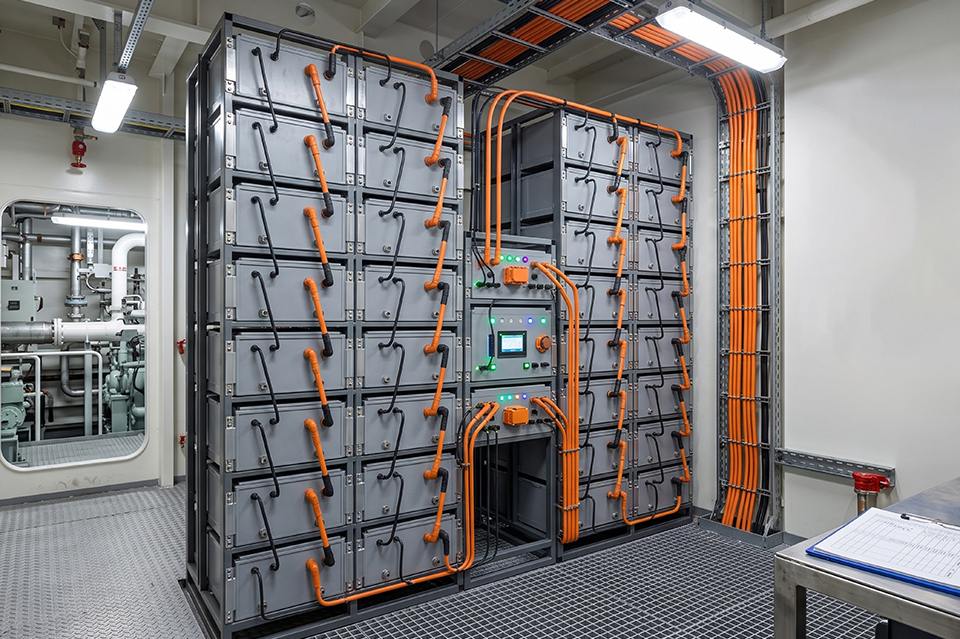
Certified marine systems layer protection so that no single failure produces a system-level event. ROYPOW’s high-voltage marine platform illustrates the standard approach:
- Passive cell-level thermal runaway isolation. If one cell fails, physical barriers prevent propagation to neighbouring cells. Tested to confirm no cell-to-cell propagation occurs.
- Integrated fire suppression system. The device is equipped in the battery to prevent fire risks.
- Redundant overcharge protection. A secondary protection layer functions independently of the BMS, so a control system fault doesn’t remove overcharge defence.
- Hard-wired emergency stop. Local emergency stop on the distribution control box plus remote emergency stop capability, both hard-wired rather than software-dependent.
- Fusing at pack and PDU level. Short circuit protection at two independent levels of the architecture.
- Explosion-proof metal valves. Fitted to the rear of each pack and designed for direct connection to an exhaust duct, routing any vented gas safely outside the battery space.
- IP67 ingress protection. Full sealing against salt spray, humidity, and washdown, which is non-negotiable in a marine environment.
- Independent over-temperature failsafe. Single-cell over-temperature triggers protective action independent of the main control loop.
The BMS Does the Continuous Work
Every layer above is passive or event-triggered. The battery management system is the piece running every second the vessel operates, monitoring cell voltage, temperature, current, and state of charge across potentially hundreds of cells.
On a well-designed system, the BMS also integrates with vessel power management systems and inverters, sharing data with the bridge rather than operating as an isolated black box. ROYPOW’s BMS is field-proven with major inverter and PMS platforms including Victron Energy.
Pro tip: During procurement, ask specifically whether thermal runaway anti-propagation has been tested and documented, not just designed for. The distinction between a design intent and a witnessed test result is the distinction between a claim and a certification.
For a deeper explanation of battery management fundamentals, ROYPOW’s guide to BMS systems is a solid starting point.
Why Class Certification Decides Everything
You can build a technically excellent battery system and still never put it on a commercial vessel. Without classification society approval, it doesn’t reach the water.
This is the filter that separates marine battery suppliers from industrial battery suppliers selling into marine.
What DNV Type Approval Actually Means
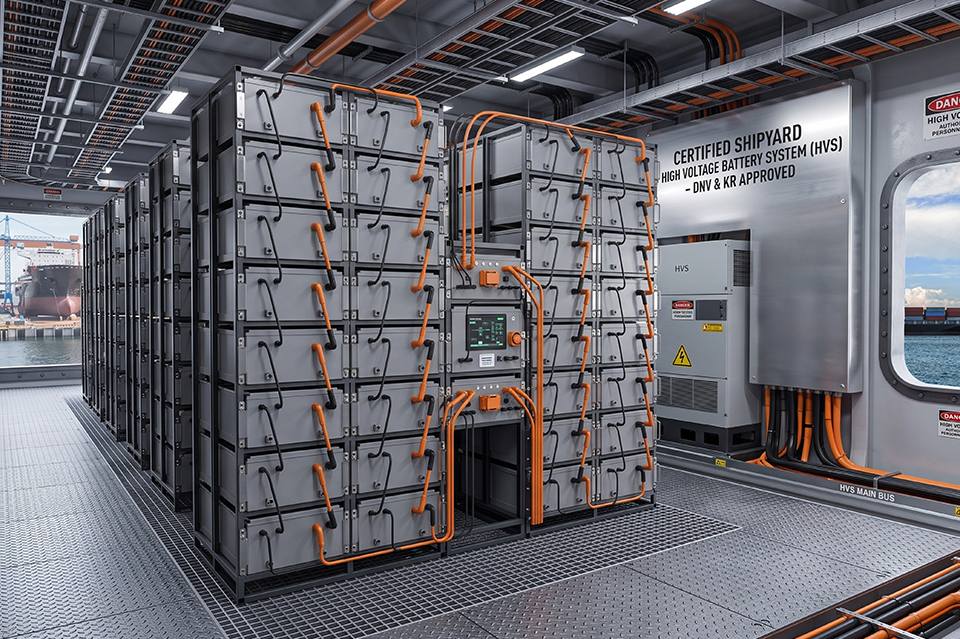
DNV (Det Norske Veritas) is a Norwegian classification and certification body recognised globally across the maritime sector. A DNV Type Approval confirms that a battery system has been assessed against internationally recognised maritime safety and performance requirements.
For a shipowner, that certification does several things at once:
- Simplifies vessel approval. Class societies review the vessel, not the battery, when the battery already carries type approval.
- Reduces project risk. Certification failure mid-build is one of the most expensive outcomes in a newbuild programme.
- Unlocks funding. Government-backed electrification and decarbonisation programmes frequently list class approval as a procurement prerequisite.
- Establishes insurability. Underwriters assess battery installations far more favourably when class approval is documented.
Certifications Worth Requiring
|
Certification |
What It Covers |
|
DNV Type Approval |
Maritime safety and performance compliance |
|
UN 38.3 |
Transport safety for lithium batteries |
|
IEC 62619 |
Industrial lithium battery safety |
|
IP67 |
Ingress protection against dust and immersion |
ROYPOW’s marine lithium battery systems received DNV Type Approval, and the platform also carries UN 38.3 compliance. For projects targeting ABS classification, existing DNV test records can typically be reused to accelerate the process rather than starting testing from zero.
The Cooling Question
One practical certification advantage worth flagging: natural cooling.
Liquid-cooled marine battery systems introduce pumps, coolant lines, heat exchangers, and leak detection, all of which add failure modes, maintenance burden, and certification complexity. A naturally cooled architecture removes that entire subsystem.
Fewer moving parts. Less to inspect. Less to fail at sea.
Modular Scalability Across an Entire Fleet
This is the point most discussions of marine electrification skip, and it’s arguably the strongest argument for high voltage as a standard rather than a case-by-case choice.
A commercial operator rarely runs one vessel type. A harbour operator might have tugs, a passenger ferry, and a couple of workboats. Historically, each would need a separately engineered power system.
Modular high voltage architecture changes that equation completely.
One Platform, Many Configurations
The building block is a standard module. On ROYPOW’s system, that’s a 51.2V, 320Ah unit weighing 117 kg. Modules combine in series to reach the required bus voltage and in parallel to reach the required energy capacity.
From that single module, the system scales across an enormous range:
|
Parameter |
Range |
|
System voltage |
102.4V to 870.4V |
|
Single system energy |
32.7 kWh to 2,785 kWh |
|
Total fleet-level energy |
Up to 100 MW via parallel systems |
|
Peak discharge rate (30s) |
1C, 320A per module |
|
Continuous rate |
0.5C, 160A per module |
|
Cooling |
Natural |
|
Ingress protection |
IP67 |
What Standardisation Delivers Operationally
The engineering flexibility is useful. The operational consequences are what actually save money:
- One spare parts inventory. A single module type covers every vessel in the fleet. No vessel-specific stock holding.
- One training programme. Crews and shore technicians learn one system, not five.
- One integration profile. Inverter compatibility, PMS communication, and BMS behaviour stay consistent across the fleet.
- Predictable expansion. Adding capacity to an existing vessel means adding modules, not redesigning the power system.
- Simplified certification on subsequent vessels. The first approved installation establishes a template for the next.
Matching Configuration to Vessel Duty
Different vessel types stress a battery system in different ways, and the modular approach handles each without a bespoke design:
- Tugboats need short, violent power bursts during bollard pull operations. High peak discharge capability matters more than total energy.
- Ferries run predictable routes with fixed charging windows. Energy capacity and charge acceptance rate dominate the specification.
- Offshore support vessels need sustained hotel loads plus dynamic positioning support, favouring larger energy configurations with strong continuous discharge.
- Fish farming vessels and workboats often operate hybrid profiles where the battery handles low-speed transit, and the generator handles heavy work cycles.
ROYPOW’s marine platform is available in both the MBmax16.3H and MBmax14.3H configurations, covering fully electric and hybrid vessels alongside offshore platforms.
Pro tip: When evaluating suppliers, ask how many distinct module types their platform requires to cover your full vessel range. A supplier needing four module variants to serve four vessel types is handing you four inventories, four training tracks, and four sets of integration risk.
For more on how marine battery technology has developed across commercial applications, ROYPOW’s post on advancements in marine energy storage offers useful context.
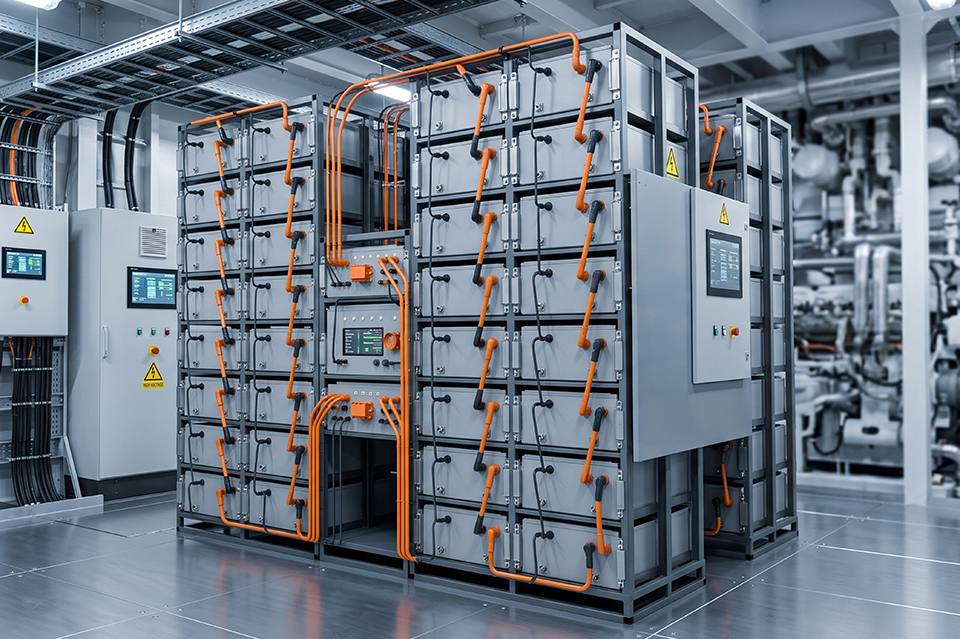
Chart the Course Ahead With ROYPOW
High voltage stopped being the ambitious option and became the practical one. The current mathematics rules out low voltage above a certain power threshold, the economics favour hybrid operation, and class certification has become the gate every serious project must pass through.
Key takeaways from this guide:
- Low-voltage architecture becomes physically impractical above roughly 100-200 kW of propulsion load
- Higher bus voltage cuts current proportionally, reducing cable mass, heat loss, and switchgear cost
- Hybrid configurations deliver around 45% OPEX reduction with payback near 3.5 years on inland routes
- LiFePO4 is the marine chemistry standard for thermal stability and cycle life
- Multi-level safety means passive cell isolation, redundant overcharge protection, hard-wired e-stops, and IP67 sealing
- DNV Type Approval is a procurement gate, not a marketing badge
- Natural cooling removes pumps, coolant lines, and an entire category of failure modes
- Modular architecture lets one module type serve tugs, cargo vessels, ferries, OSVs, and workboats across a whole fleet
ROYPOW’s high voltage lithium marine battery system carries DNV Type Approval, scales from 32.7 kWh to 2,785 kWh across a 102.4V to 870.4V range, and runs on natural cooling with IP67 protection throughout. Whether you’re specifying a newbuild or planning a retrofit, their team can size a configuration against your actual duty profile. Start at the contact page.
Frequently Asked Questions
What is a high voltage marine battery system?
A marine battery system operating between roughly 100V and 1000V, designed to power electric or hybrid vessel propulsion while reducing current, cable size, and energy loss.
Why do commercial vessels need high voltage instead of 48V?
Low voltage requires impractically high current at commercial propulsion loads. An 800V system delivers the same power at roughly one-sixteenth the current of a 48V bus.
Is a high voltage battery system safe on a vessel?
Yes. Certified systems combine LiFePO4 chemistry, passive cell-level thermal isolation, redundant overcharge protection, hard-wired emergency stops, and IP67 sealing throughout.
Why does DNV certification matter for marine batteries?
DNV Type Approval confirms compliance with international maritime safety standards. It simplifies vessel approval, supports insurability, and is often required for funded electrification projects.
Which vessels benefit most from high voltage battery systems?
Ferries, tugboats, offshore support vessels, workboats, fish farming vessels, and yachts, particularly those running predictable routes or frequent low-speed operations.
Can a marine battery system work alongside diesel generators?
Yes. Hybrid configurations let generators run at peak efficiency while the battery covers load peaks and low-demand operation, reducing fuel consumption and engine hours.