Every industrial battery over 2 kWh sold into the EU will need a digital passport by 18 February 2027. Not a datasheet. Not a certificate in a drawer.
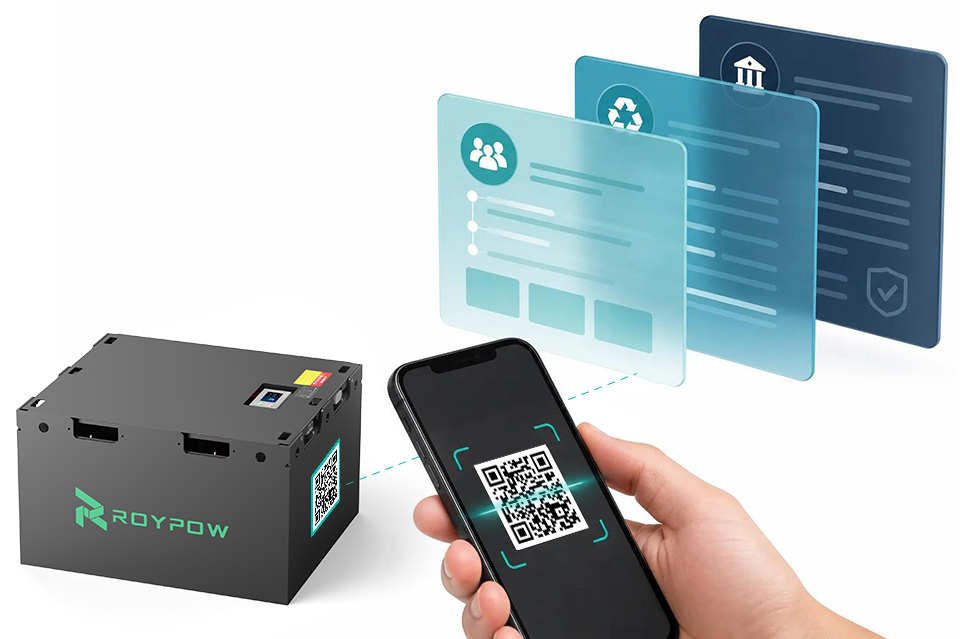
A live electronic record, reachable by QR code, carrying carbon footprint data, material composition, and performance history. If your supplier is not already building toward that, you will find out at the border rather than in a meeting.
This guide breaks down what the regulation requires and when.
What we’ll cover:
- What the regulation covers and which battery category you fall into
- The deadline table that matters for industrial batteries
- Carbon footprint, recycled content, and due diligence duties
- What the July 2025 amendment actually changed
- NEW: Inside the digital battery passport and how registration works
ROYPOW already holds a world-first TÜV SÜD attestation against this regulation for industrial batteries. Their full model range is scheduled to complete DPP registration and go fully operational by 18 February 2027.
What the EU Battery Regulation Covers
Regulation (EU) 2023/1542 replaced the old Batteries Directive with something far broader. The Directive governed heavy metals and collection. The Regulation governs the entire life cycle.
It has applied since 18 February 2024, and it repealed Directive 2006/66/EC from 18 August 2025.
Who It Applies To
The scope is deliberately wide. It covers all categories of batteries, regardless of shape, volume, weight, design, material composition, chemistry, use, or purpose. It applies whether the battery is produced in the Union or imported, and whether it is sold standalone or built into a product.
Two narrow exclusions exist: equipment tied to Member States’ essential security interests and military material, and equipment designed to be sent into space.
The Five Categories
Category determines which requirements apply to you, so this is the first thing to establish.
|
Category |
What It Covers |
|
Portable |
Sealed, under 5 kg, not designed for industrial or vehicle use |
|
SLI |
Starting, lighting, ignition batteries for vehicles |
|
LMT |
Light means of transport, such as e-bikes and e-scooters |
|
Electric vehicle |
Traction batteries for road vehicles |
|
Industrial |
Industrial activity, communication infrastructure, agriculture, electricity generation or distribution |
Two details inside that industrial definition matter more than people expect.
First, any battery over 5 kg that does not fall into another category is treated as an industrial battery. Second, batteries used for energy storage in private or domestic environments are also classified as industrial batteries.
Where ROYPOW’s Range Sits
That classification sweeps in almost the entire motive power and storage market:
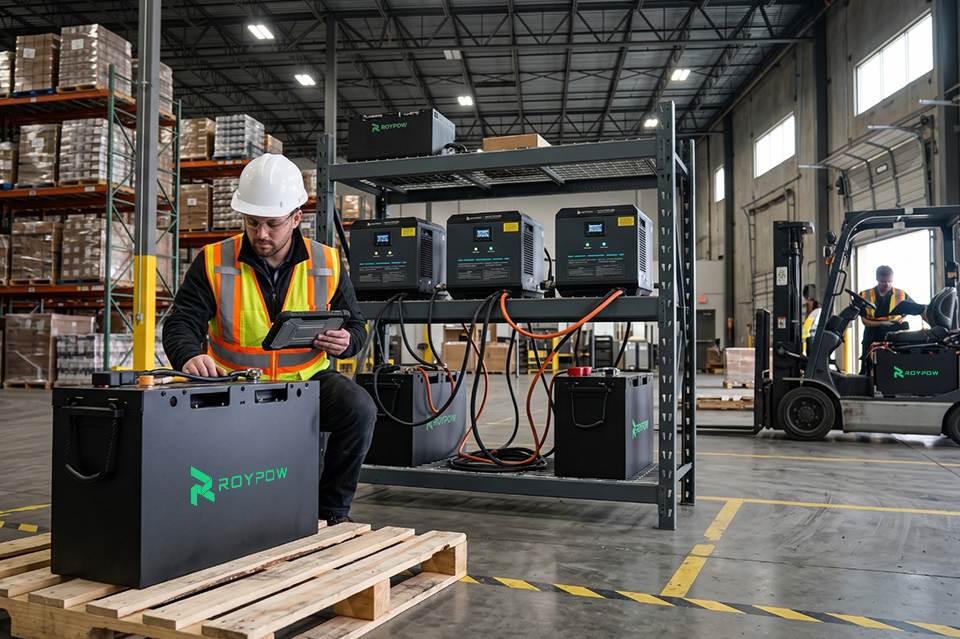
- and other material handling packs
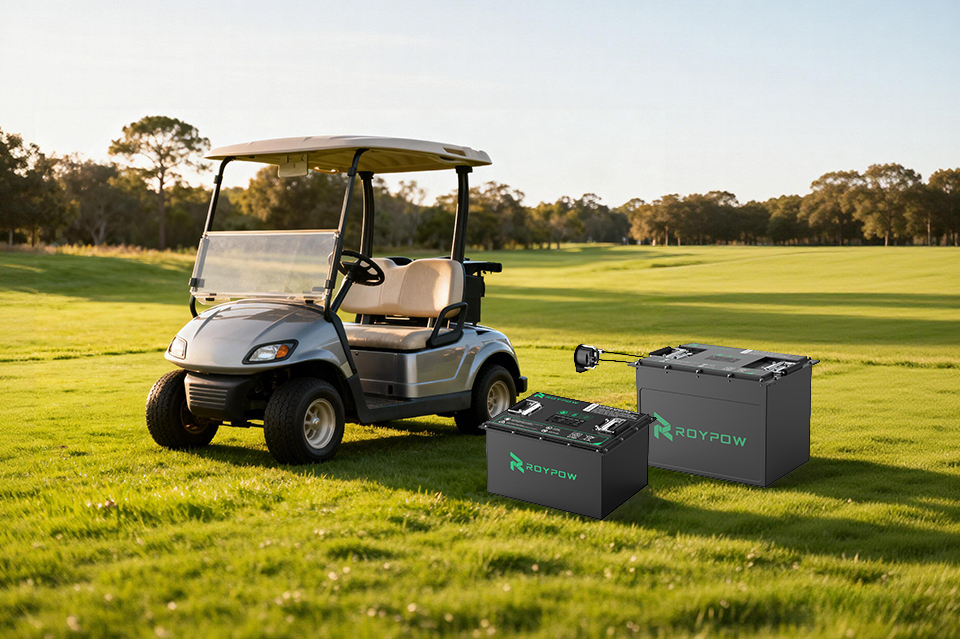
- Golf cart batteries, since golf carts are not road vehicles
- Scissor lift batteries and floor cleaning machine batteries
- Marine and waterborne transport batteries
- Jobsite Hybrid Energy Storage Systems
If a battery could arguably sit in two categories, the Regulation says it falls under the category with the strictest requirements. Do not assume the lighter classification applies.
The Deadlines That Actually Matter
The regulation staggers its obligations across more than a decade. Here is the timeline that matters for industrial batteries over 2 kWh.
|
Date |
Requirement |
|
18 Feb 2024 |
Regulation applies |
|
18 Aug 2024 |
Technical documentation for stationary storage safety (Art. 12) |
|
18 Aug 2025 |
Directive 2006/66/EC repealed |
|
18 Feb 2026 |
Carbon footprint declaration for rechargeable industrial batteries |
|
26 Jul 2026 |
Commission due diligence guidelines published |
|
18 Aug 2026 |
General labelling obligations begin |
|
18 Feb 2027 |
QR code and digital battery passport mandatory |
|
18 Aug 2027 |
Battery due diligence obligations apply |
|
18 Aug 2028 |
Recycled content documentation required |
|
18 Aug 2031 |
First minimum recycled content targets bite |
|
18 Aug 2036 |
Second, higher recycled content targets bite |
Several of those dates carry a conditional clause tied to when the Commission adopts the supporting delegated or implementing act, so the effective date can shift later. 18 February 2027 does not. It is a hard date written directly into Articles 13 and 77.
Why 2027 Is the Pressure Point
From that date, two things happen simultaneously.
All batteries must carry a QR code built to the specification in Part C of Annex VI. And every LMT battery, every industrial battery over 2 kWh, and every electric vehicle battery placed on the market must have an electronic record: the battery passport.
No passport, no sale. That is the practical effect.
Carbon Footprint and Recycled Content Rules
These two articles represent the heaviest data burden in the regulation, because both require information that most manufacturers have never systematically collected.
Article 7: Carbon Footprint Declaration
A carbon footprint declaration must be drawn up for each battery model, per manufacturing plant. Not per company. Not per product family. Per model, per plant.
The declaration must contain:
- Administrative information about the manufacturer
- Information about the battery model
- Geographic location of the manufacturing plant
- Carbon footprint expressed as kg CO2 equivalent per kWh of total energy provided over the battery’s expected service life
- The footprint broken down by life cycle stage
- The identification number of the EU declaration of conformity
- A web link to a public version of the supporting study
That final requirement deserves emphasis. The supporting study becomes publicly accessible. Carbon footprint stops being an internal metric and becomes a competitive one.
For rechargeable industrial batteries other than those with exclusively external storage, the declaration applies from 18 February 2026, or 18 months after the relevant acts enter into force, whichever falls later.
Article 8: Recycled Content
Recycled content arrives in two waves, and the first wave is documentation rather than performance.
From 18 August 2028, industrial batteries over 2 kWh containing cobalt, lead, lithium, or nickel in active materials must be accompanied by documentation stating the recovered percentage of each, again per model, per plant, per year.
Then the minimums apply:
|
Material |
From 18 Aug 2031 |
From 18 Aug 2036 |
|
Cobalt |
16% |
26% |
|
Lead |
85% |
85% |
|
Lithium |
6% |
12% |
|
Nickel |
6% |
15% |
These targets flow backwards into cell sourcing decisions being made today. A manufacturer locking in a cell supply agreement in 2026 is implicitly making a 2031 compliance decision.
For context on how the recovery side of this equation works in practice, ROYPOW’s lithium battery recycling guide covers the current state of the recovery chain.
Article 12: Stationary Storage Safety
Separate from the two above, stationary battery energy storage systems carry their own safety file obligation. Since 18 August 2024, technical documentation must demonstrate successful testing against the safety parameters in Annex V, assess hazards not covered there, evidence their mitigation, and include instructions if a hazard such as fire or explosion occurs.
That documentation must be reviewed again if the battery is later repurposed, remanufactured, or prepared for re-use.
Due Diligence: What Changed in 2025
This is the part of the picture that moved recently, and a lot of published guidance has not caught up.
The Original Obligation
Article 48 requires economic operators placing batteries on the EU market to establish and implement battery due diligence policies covering the sourcing, processing, and trading of cobalt, natural graphite, lithium, and nickel.
Crucially, those policies must be verified by a notified body and periodically audited by that body. Documentation must be retained for 10 years after the last battery produced under the relevant policy is placed on the market.
The July 2025 Amendment
Regulation (EU) 2025/1561, adopted on 18 July 2025, amended Article 48 on two points.
|
Provision |
Was |
Now |
|
Due diligence obligations apply |
18 August 2025 |
18 August 2027 |
|
Commission guidelines published |
18 February 2025 |
26 July 2026 |
Why the Postponement Happened
The amendment is refreshingly direct about its reasoning. Three factors drove it.
The geopolitical landscape continues to shift, and manufacturers need time to analyse and adjust supply chains. The designation of notified bodies is taking longer than expected, which creates a bottleneck in third-party verification capacity. And due diligence schemes addressing battery raw materials still need further development before the Commission can recognise their equivalence.
A fourth consideration sits behind it: alignment with Directive (EU) 2024/1760 on corporate sustainability due diligence, so companies in the battery supply chain face one coherent set of guidance rather than two.
Pro tip: Treat the two-year postponement as preparation time, not relief. The verification bottleneck that caused the delay still exists. Notified body capacity will be tighter in 2027 than it is now, not looser.
Inside the Digital Battery Passport
The battery passport is the mechanism that ties everything above together, and it is where compliance becomes visible to buyers rather than just to regulators.
What It Is
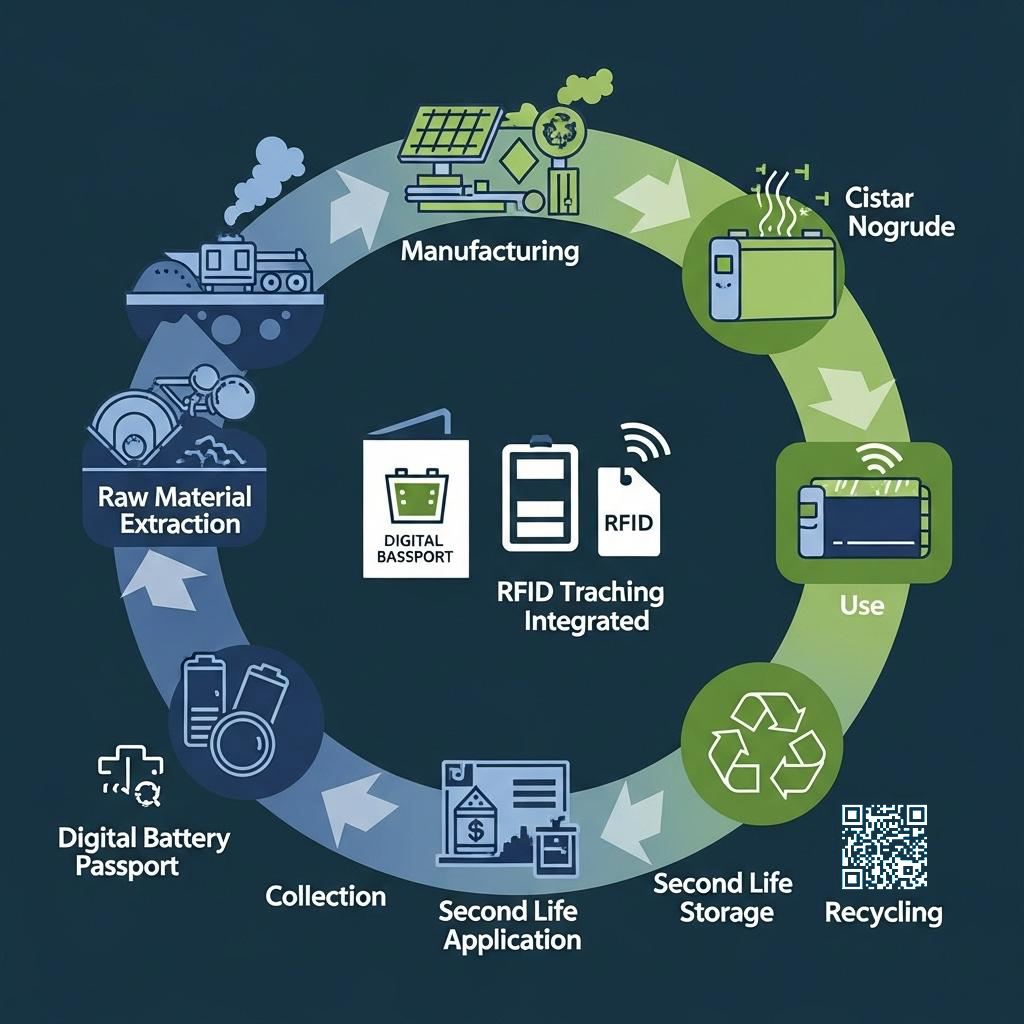
From 18 February 2027, each LMT battery, each industrial battery over 2 kWh, and each EV battery placed on the market must carry an electronic record containing both model-level information and information specific to that individual unit, including data resulting from its use.
Access is tiered:
|
Tier |
Who Sees It |
|
Public |
Anyone scanning the QR code |
|
Restricted |
Notified bodies, market surveillance authorities, the Commission |
|
Legitimate interest |
Repairers, remanufacturers, second-life operators, recyclers |
That third tier exists for a specific purpose: giving the people who will eventually dismantle or repurpose the battery the composition and safety information they need to do it properly.
How Access Works
The passport is reached through the QR code required under Article 13(6), which links to a unique identifier assigned by the economic operator placing the battery on the market.
Both the QR code and the identifier must comply with the ISO/IEC 15459 series of standards, covering unique identification across parts 1 through 6.
The data itself must be based on open standards, in an interoperable format, transferable through an open data exchange network without vendor lock-in, and machine-readable, structured, and searchable.
The Obligations That Follow
Three duties sit on the economic operator, and they do not end at the point of sale.
- Information must be kept accurate, complete, and up to date
- If a battery is repurposed or remanufactured, it needs a new passport linked to the original, and responsibility transfers to whoever places it back on the market
- When a battery becomes waste, responsibility transfers again, to the producer, the producer responsibility organisation, or the selected waste management operator
The passport ceases to exist only once the battery has been recycled.
This is the same architectural thinking behind the EU’s wider Digital Product Passport framework under the Ecodesign for Sustainable Products Regulation. Batteries are simply the first product group to reach the deadline.
Conformity Assessment and Notified Body Routes
Compliance is not self-declared across the board. Which route applies depends on which requirement you are satisfying.
The Three Modules
|
Module |
Description |
Notified Body Involved |
|
Module A |
Internal production control |
No |
|
Module D1 |
Quality assurance of the production process |
Yes |
|
Module G |
Conformity based on unit verification |
Yes |
For requirements under Articles 6, 9, 10, 12, 13, and 14, which cover substance restrictions, performance, durability, stationary storage safety, labelling, and information, manufacturers may use Module A for series production.
Where Third-Party Assessment Becomes Mandatory
For Articles 7 and 8, carbon footprint and recycled content, Module A is not available. Series-produced batteries must use Module D1, and non-series batteries must use Module G.
Both involve a notified body.
Add the Article 48 requirement for third-party verification of due diligence policies, and the picture becomes clear. The highest-value, highest-scrutiny requirements all route through notified bodies, which is precisely the capacity constraint that prompted the 2025 postponement.
Manufacturers who begin that engagement early will be assessed. Those who begin in late 2026 will be queuing.
How ROYPOW Is Preparing for 2027
Most suppliers are still describing the regulation. ROYPOW has been working against it.
A World-First Attestation
In 2025, ROYPOW received the world’s first TÜV SÜD Compliance Assessment Attestation for EU Battery Regulation (EU) 2023/1542 in industrial batteries.
That matters for a practical reason. An attestation of this kind means the assessment groundwork, documentation structure, and data collection systems already exist. The company is not starting from a blank page in 2026.
The Roadmap to 18 February 2027
ROYPOW’s full range of battery models is scheduled to complete the following before the regulation’s hard deadline:
|
Stage |
What It Delivers |
|
DPP registration |
Each model registered within the Digital Product Passport framework |
|
EO certification |
Economic Operator credentials established for market placement |
|
Pilot issuance |
Live passports issued and validated on a controlled model subset |
|
Full-scale operational launch |
Every model in the range passport-enabled and shipping compliant |
That sequencing is deliberate. Pilot issuance before full-scale launch means the data pipeline, QR linkage, and unique identifier assignment are proven on real units before the obligation becomes binding across the catalogue.
Why Buyers Should Care Now
If you specify, distribute, or integrate industrial batteries into equipment sold in the EU, the passport obligation lands on whoever places the battery on the market. A supplier arriving at the deadline unprepared transfers that problem directly to you.
ROYPOW’s broader certification record supports the same point. The company holds UL 2580 certification across all lithium forklift battery voltage platforms, DNV Type Approval on its marine lithium battery systems, and TÜV SÜD product certifications on its EU-standard three-phase residential storage system.
Pro tip: When evaluating any battery supplier for EU-bound equipment, ask a specific question: which models will have issued passports before 18 February 2027, and what stage is the DPP registration at today. A supplier who cannot answer with dates is answering with hope.
Marine Batteries: Onboard Installation Only
One clarification deserves its own section, because the marine category attracts the most scope confusion.
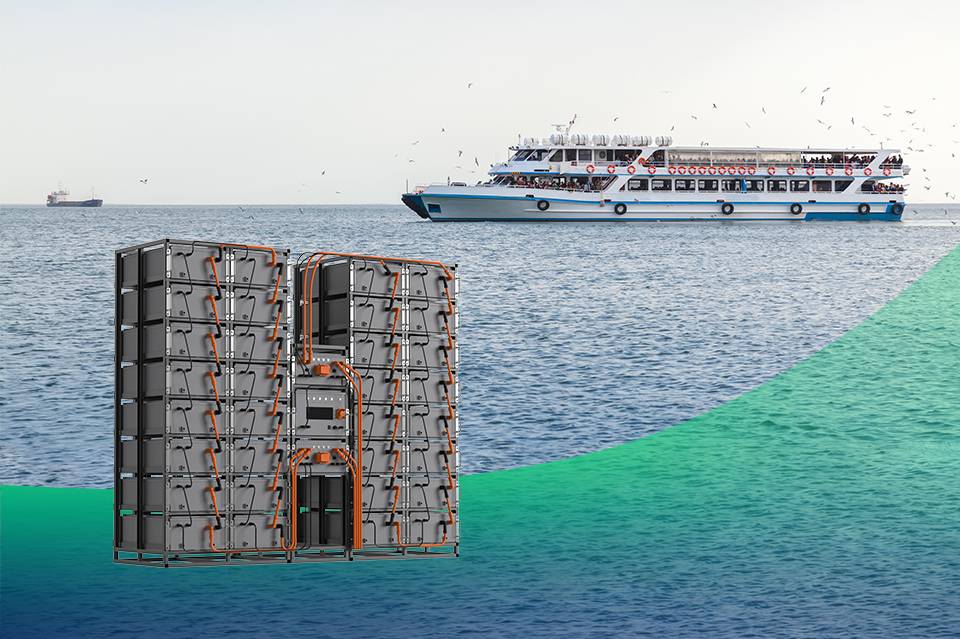
ROYPOW’s high-voltage marine energy storage batteries are designed exclusively for installation inside the vessel. They are not intended for, and cannot be used in, shore power applications.
Why the Distinction Matters
Shore power and onboard storage are different applications with different engineering and regulatory profiles.
Shore power infrastructure sits on land, connects to the grid, and falls under grid-connection and port electrical standards. Onboard marine storage sits inside the hull, operates as part of the vessel’s own power and propulsion architecture, and falls under classification society rules.
ROYPOW’s high-voltage marine battery system is engineered for the second of those. It carries DNV Type Approval, IP67 ingress protection, natural cooling, and multi-level safety architecture including passive cell-level thermal runaway isolation, all specified against the conditions a battery faces inside a vessel.
What That Means in Practice
- The system is specified for fully electric and hybrid vessels, and offshore platforms
- It suits work boats, tugboats, ferries, passenger vessels, yachts, OSVs, and fish farming vessels
- It scales from 32.7 kWh to 2,785 kWh across a 102.4V to 870.4V range
- It is not a shore power or quayside charging product, and should not be specified as one
If your project needs shore-side infrastructure, that is a separate conversation with a separate product class. Specifying an onboard marine system for a landside application is a compliance and safety mismatch, not just a commercial one.
Stay Ahead of the 2027 Deadline With ROYPOW
The EU Battery Regulation is not a future problem. The carbon footprint clock has already started, due diligence verification capacity is already constrained, and the passport deadline is fixed. Suppliers who built their compliance infrastructure early will ship without interruption. Those who did not will discover the gap at the worst possible moment.
Key takeaways from this guide:
- The regulation covers all battery categories, imported or EU-made, standalone or built into products
- Any battery over 5 kg not in another category counts as industrial, as does domestic energy storage
- Where a battery fits two categories, the stricter requirements apply
- Carbon footprint declarations run per model, per plant, with the supporting study published publicly
- Recycled content documentation starts 18 August 2028, with binding minimums from 2031 and 2036
- Regulation (EU) 2025/1561 moved due diligence from August 2025 to 18 August 2027
- Carbon footprint and recycled content cannot be self-declared. Module D1 or G applies, both requiring a notified body
- 18 February 2027 is the fixed date for QR codes and digital battery passports, with no conditional extension
ROYPOW holds the world’s first TÜV SÜD Compliance Assessment Attestation against this regulation for industrial batteries, and its full model range is scheduled to complete DPP registration, EO certification, pilot issuance, and full-scale operational launch by 18 February 2027.
If you are specifying batteries for EU-bound equipment, their team can confirm model-level readiness directly. Start at the contact page, or explore dealer partnership options.
Frequently Asked Questions
What is the EU Battery Regulation?
Regulation (EU) 2023/1542 governs sustainability, safety, labelling, and end-of-life requirements for all batteries placed on the EU market. It replaced Directive 2006/66/EC.
When is the battery passport required?
From 18 February 2027. Every LMT battery, industrial battery over 2 kWh, and electric vehicle battery placed on the EU market needs an electronic passport.
Which batteries count as industrial batteries?
Batteries for industrial activity, infrastructure, agriculture, or electricity generation. Also any battery over 5 kg not in another category, plus domestic energy storage batteries.
When do battery due diligence obligations start?
18 August 2027. Regulation (EU) 2025/1561 postponed the original 18 August 2025 date by two years due to notified body capacity constraints.
What are the recycled content requirements?
Documentation from 18 August 2028. Minimums from 18 August 2031: 16% cobalt, 85% lead, 6% lithium, 6% nickel. Higher targets follow in 2036.
Does the regulation apply to imported batteries?
Yes. It applies to all batteries placed on the EU market regardless of where they were produced, including batteries built into imported products.
Can ROYPOW marine batteries be used for shore power?
No. ROYPOW’s high-voltage marine energy storage batteries are designed exclusively for installation inside the vessel and are not suitable for shore power applications.