


Benefits
-

10 Years of Design Life - 3500+ cycle life
-

Fast, Opportunity Charging - Reduced unplanned downtime and more uptime
-

Steady Output - High consistent performance
-

Zero Maintenance - Save maintenance costs and labor costs
-

Smart Management - Built-in BMS and 4G module
-

Safe Operations - UL certification & IP65 protections
-

5 Years of Warranty - Hassle-free experience and peace of mind
-

Environmental-friendly & Sustainable - No fumes or acid spills, carbon footprint reduced
- Product Overview
- Product Specifications
- PDF Download

DNV Type Approval Certification


Compatible with Fully Electric and Hybrid Power Vessels
-
-
System Specification
Model MBmax16.3H Battery Module 51.2 V/320 Ah Single System Energy 32.7-2785.2 kWh Discharge/Charge Peak Rate,30s 1C/320 A, 16.3 kW Continuous Rate, One
Complete Charge/Discharge0.5C/160 A, 8.2 kW Discharge/Charge RMS Rate 0.35C/110 A, 5.6 kW System Solution 1 C-rate Dimension (L x W x H) 800 x 465 x 247 mm Weight 112 kg System Voltage 102.4- 870.4 V Total System Energy 2-100 Mw by parallel single energy system Cooling Natural Cooled Class Compliance DNV, UN 38.3 Ingress Protection IP67 -
-
-
Safety
Thermal Runaway Anti-propagation Passive Cell-Level Thermal Runaway Isolation Emergency Stop Circuit Hard-wired: Local Emergency Stop on DCB; Remote Emergency Stop Independent Safety Function Fail Safe for Over Temperature on Single Cell Short Circuit Protection Fuse on Pack & PDU Level Explosion-proof Valves Metal Valves on Each Pack Backside, Easy Connect to Exhaust Duct -
- File Name
- File Type
- Language
-

ROYPOW High-Volt Marine Battery System Brochure - Ver. May 20, 2025
- En
-

-
ROYPOW High-Volt Marine Battery System Brochure - Korean
- ROYPOW High-Volt Marine Battery System Brochure - Korean - Ver. August 07, 2025
- Korean
-
-
ROYPOW-High-Volt-Marine-Battery-System-Brochure-Japanese-Ver.-August-13-2025
- Japanese
-
-
DNV-CERTIFICATE
- En
-
-
Inland Waterway Electrification Economics White Paper 2026
- En
-


【Webinar Replay】Empowering the Maritime Industry with HV DNV-Certified Lithium Battery Solution

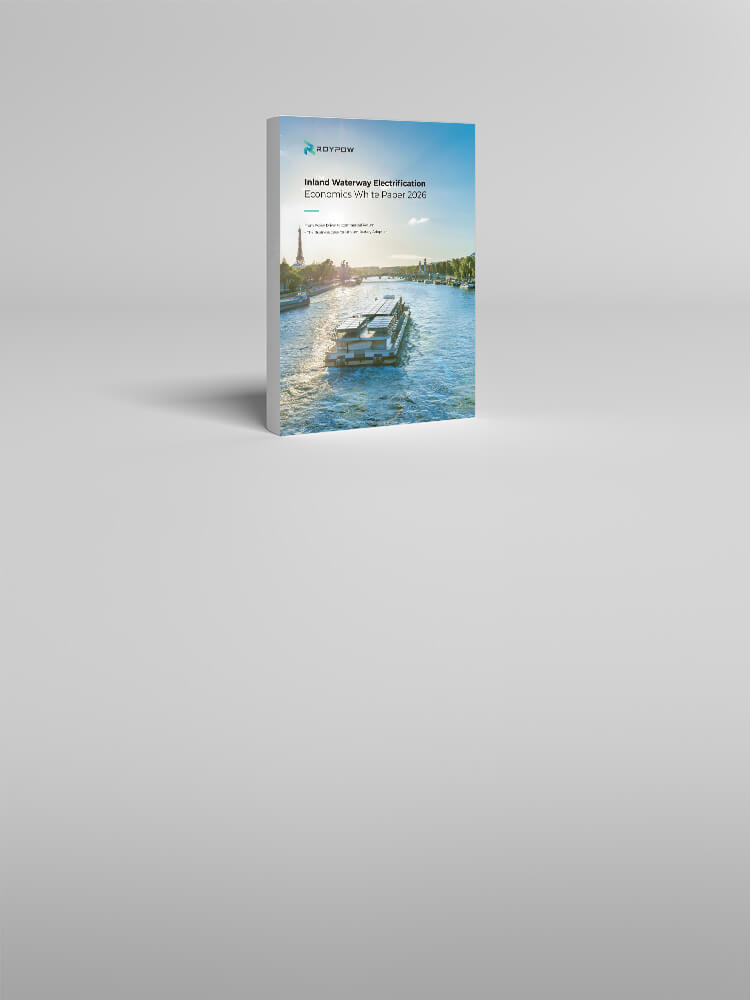
Inland Waterway Electrification Economics 2026
✅ 35-70% battery propulsion from hybrid systems
✅ DNV-certified | Based on EEA, ReNEW & DINA research
-
1. What is a high voltage marine battery system and why is it preferred for commercial vessels?
+A high voltage marine battery system operates at significantly higher voltages than traditional marine battery banks, typically ranging from 100V to 1000V. Higher system voltage reduces current flow for the same power output, helping minimize cable size, lower heat generation, improve energy efficiency, and simplify system integration. For commercial vessels such as ferries, tugboats, and offshore support vessels, a high voltage architecture can support larger propulsion loads and longer operating hours while reducing overall system losses. ROYPOW’s high voltage marine battery system supports scalable configurations up to 1000V and 2785kWh.
-
2. How does a marine lithium battery system improve vessel operating costs?
+A marine lithium battery system can significantly reduce operating expenses by lowering fuel consumption, minimizing maintenance requirements, and improving energy efficiency. Unlike lead-acid batteries, lithium batteries require no watering, have longer service life, and support higher usable capacity. When integrated into electric or hybrid propulsion systems, operators may achieve substantial reductions in fuel and maintenance costs while supporting decarbonization initiatives.
-
3. What is the difference between a marine energy storage system (Marine ESS) and a marine propulsion battery system?
+A marine energy storage system (Marine ESS) is designed to store and manage electrical energy for various onboard applications, including peak shaving, hotel loads, renewable energy integration, and propulsion support. A marine propulsion battery system specifically provides power to electric propulsion motors. In many modern electric and hybrid vessels, a single integrated battery platform can serve both energy storage and propulsion functions while being managed through advanced battery control systems.
-
4. Is a marine LiFePO4 battery system safer than other lithium battery chemistries?
+Yes. LiFePO4 (Lithium Iron Phosphate) technology is widely recognized as one of the safest lithium battery chemistries available for marine applications. It offers superior thermal stability, longer cycle life, and lower thermal runaway risk compared with many alternative lithium chemistries. For marine environments where safety and reliability are critical, LiFePO4 battery systems have become a preferred choice for vessel electrification projects. Community discussions among marine professionals also frequently highlight the importance of robust BMS protection and marine-grade safety design in lithium installations.
-
5. Why is a DNV certified marine battery system important for commercial shipping projects?
+A DNV certified marine battery system demonstrates compliance with internationally recognized maritime safety and performance requirements. Certification can simplify vessel approval processes, support class society compliance, and provide shipowners with greater confidence in system reliability. For commercial ferries, workboats, offshore vessels, and government-funded electrification projects, DNV certification is often a key consideration during procurement.
-
6. Can a battery system for hybrid vessels operate alongside diesel generators?
+Yes. A hybrid marine battery system is specifically designed to work together with diesel generators, shore power, renewable energy sources, and onboard electrical loads. Hybrid configurations allow operators to optimize generator usage, reduce fuel consumption, lower emissions, and improve vessel efficiency without relying solely on battery power.
-
7. What types of vessels can benefit from a vessel electrification battery solution?
+Vessel electrification battery systems are suitable for:
- Electric ferries
- Tugboats
- Passenger vessels
- Offshore support vessels (OSVs)
- Workboats
- Fish farming vessels
- Luxury yachts
These vessels often operate predictable routes or require frequent low-speed operations, making them ideal candidates for marine electrification solutions.
-
8. How scalable is a maritime energy storage system for large vessel applications?
+Modern maritime energy storage systems are designed with modular architecture. Additional battery modules can be added to increase energy capacity and system voltage based on vessel requirements. This modular approach enables shipbuilders and operators to configure systems for both small electric boats and large commercial vessels while maintaining a common battery platform. ROYPOW’s platform supports scalable energy configurations up to 2785kWh.
-
9. What are the advantages of an electric ferry battery system?
+An electric ferry battery system offers:
- Lower fuel costs
- Reduced engine noise
- Zero local emissions during battery-powered operation
- Lower maintenance requirements
- Improved passenger comfort
- Compliance with increasingly strict environmental regulations
These benefits make electric ferries one of the fastest-growing segments within maritime decarbonization programs worldwide.
-
10. What battery characteristics are important for a tugboat battery system?
+Tugboat operations require battery systems capable of delivering high power during short-duration peak loads while maintaining long-term reliability. Important considerations include:
- High discharge capability
- Fast charging performance
- Marine-grade safety protection
- DNV compliance
- Vibration resistance
- Flexible integration with hybrid propulsion systems
A high voltage battery architecture can be particularly beneficial for tugboats because of their demanding power profiles.
-
11. Why are yacht lithium battery systems becoming increasingly popular?
+Yacht owners are adopting lithium battery systems because they provide higher energy density, lighter weight, faster charging, and quieter operation compared with traditional battery technologies. Lithium systems can also support extended off-grid cruising by powering hotel loads, air conditioning, entertainment systems, and electric propulsion components more efficiently.
-
12. Can an offshore vessel battery system withstand harsh marine environments?
+Marine battery systems designed for offshore applications are engineered to operate in challenging conditions, including vibration, humidity, salt spray, and temperature fluctuations. Features such as IP67 protection, advanced battery management systems, and multi-level safety architecture help ensure reliable performance in offshore environments.
-
13. How does a commercial marine battery system support marine decarbonization goals?
+Commercial marine battery systems help reduce greenhouse gas emissions by decreasing dependence on diesel engines. When integrated into hybrid or fully electric vessel architectures, battery systems can support lower fuel consumption, reduced carbon emissions, and improved energy efficiency, making them a key component of modern marine decarbonization solutions.
-
14. What should shipowners consider when selecting a marine electrification solution?
+Key evaluation criteria include:
- Battery chemistry (LiFePO4 preferred for safety)
- System voltage range
- Energy capacity scalability
- Classification society approvals
- Safety architecture
- Integration capability with propulsion systems
- Lifecycle cost
- Manufacturer support and global service capabilities
Choosing a marine electrification solution that balances safety, performance, compliance, and total cost of ownership is essential for long-term project success.
-
15. What is DNV Certification?
+DNV certification refers to official approval granted by DNV (Det Norske Veritas), a globally recognized classification and certification body based in Norway. It verifies that a company’s products, services, or management systems meet international standards for quality, safety, and sustainability. Common certifications include ISO 9001 (Quality), ISO 14001 (Environment), and ISO 45001 (Health & Safety). Trusted worldwide, DNV certification helps businesses enhance credibility, meet regulatory requirements, and access global markets with confidence.
-
16. Are your batteries compatible with 12V/24V systems used in local vehicles?
+Yes, we offer customized voltage solutions. Contact us to discuss retrofitting options.
-
17. Do you support inverters (e.g., ABB, Danfoss) and PMS (e.g., COMAP, DEIF)?
+Yes, our BMS is fully compatible with these systems and has been deployed in existing projects.
-
18. Which certifications do your batteries hold beyond DNV?
+Yes, we can fast-track ABS certification by reusing DNV test records. Request a customized quotation.
-
19. How is cooling handled in your battery systems?
+Our solution uses natural cooling (no active cooling required).
-
20. How do you prevent fire risks and thermal runaway?
+Triple-layer protection:
Real-time BMS monitoring with automatic shutdown for anomalies.
Redundant overcharge protection (works even if BMS fails).
Local/remote emergency stop systems.
Thermal runaway tested: No cell-to-cell propagation occurs. -
21. Is a fire extinguisher system required?
+No additional system needed—our design meets DNV’s stringent safety standards.
-
22. Do you offer product support in Northern Ireland?
+Yes! We provide:
Free installation/commissioning for first-time clients.
Training and annual maintenance services.
Local spare parts storage (e.g., battery packs, fuses) for quick replacements.
Tips: For after-sales inquiry please submit your information here.






Subscribe to our newsletter
Get the latest ROYPOW's progress, insights and activities on renewable energy solutions.
Tips: For after-sales inquiry please submit your information here.





- English
- Chinese
- French
- German
- Portuguese
- Spanish
- Russian
- Japanese
- Korean
- Arabic
- Irish
- Greek
- Turkish
- Italian
- Danish
- Romanian
- Indonesian
- Czech
- Afrikaans
- Swedish
- Polish
- Basque
- Catalan
- Esperanto
- Hindi
- Lao
- Albanian
- Amharic
- Armenian
- Azerbaijani
- Belarusian
- Bengali
- Bosnian
- Bulgarian
- Cebuano
- Chichewa
- Corsican
- Croatian
- Dutch
- Estonian
- Filipino
- Finnish
- Frisian
- Galician
- Georgian
- Gujarati
- Haitian
- Hausa
- Hawaiian
- Hebrew
- Hmong
- Hungarian
- Icelandic
- Igbo
- Javanese
- Kannada
- Kazakh
- Khmer
- Kurdish
- Kyrgyz
- Latin
- Latvian
- Lithuanian
- Luxembou..
- Macedonian
- Malagasy
- Malay
- Malayalam
- Maltese
- Maori
- Marathi
- Mongolian
- Burmese
- Nepali
- Norwegian
- Pashto
- Persian
- Punjabi
- Serbian
- Sesotho
- Sinhala
- Slovak
- Slovenian
- Somali
- Samoan
- Scots Gaelic
- Shona
- Sindhi
- Sundanese
- Swahili
- Tajik
- Tamil
- Telugu
- Thai
- Ukrainian
- Urdu
- Uzbek
- Vietnamese
- Welsh
- Xhosa
- Yiddish
- Yoruba
- Zulu
- Kinyarwanda
- Tatar
- Oriya
- Turkmen
- Uyghur