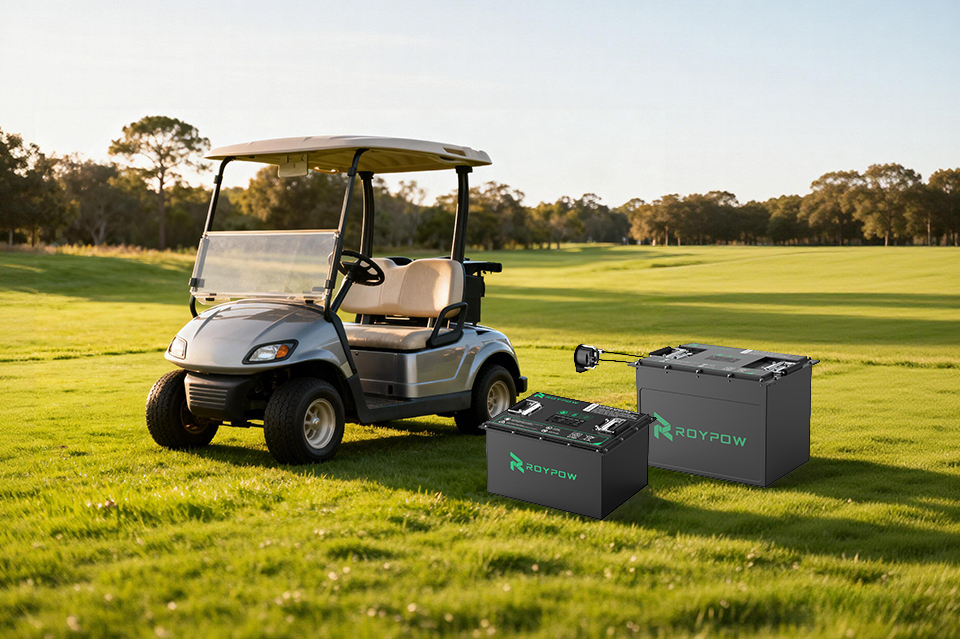
Most Yamaha owners don’t realize their cart’s biggest performance problem isn’t the motor, the tires, or the controller. It’s the battery sitting underneath the seat, quietly losing capacity with every charge cycle. Lead-acid batteries lose up to 50% of their range over time, and most owners don’t notice until it’s too late. The good news: a lithium conversion fixes that permanently.
This guide gives you everything you need before spending a single dollar.
Here’s what we’ll cover:
- Why Yamaha golf cart batteries are overdue for a lithium upgrade
- Model-by-model compatibility across G-Series, Drive, Drive2, and UMAX
- Step-by-step overview of the conversion process
- Real cost breakdown and what you save over 10 years
- NEW: Why Yamaha’s regenerative braking makes BMS selection critical, and what happens when you get it wrong
ROYPOW makes LiFePO4 drop-in batteries purpose-built for Yamaha golf cart systems, with an intelligent BMS designed to handle regen braking currents safely. Worth keeping on your shortlist as you read through.
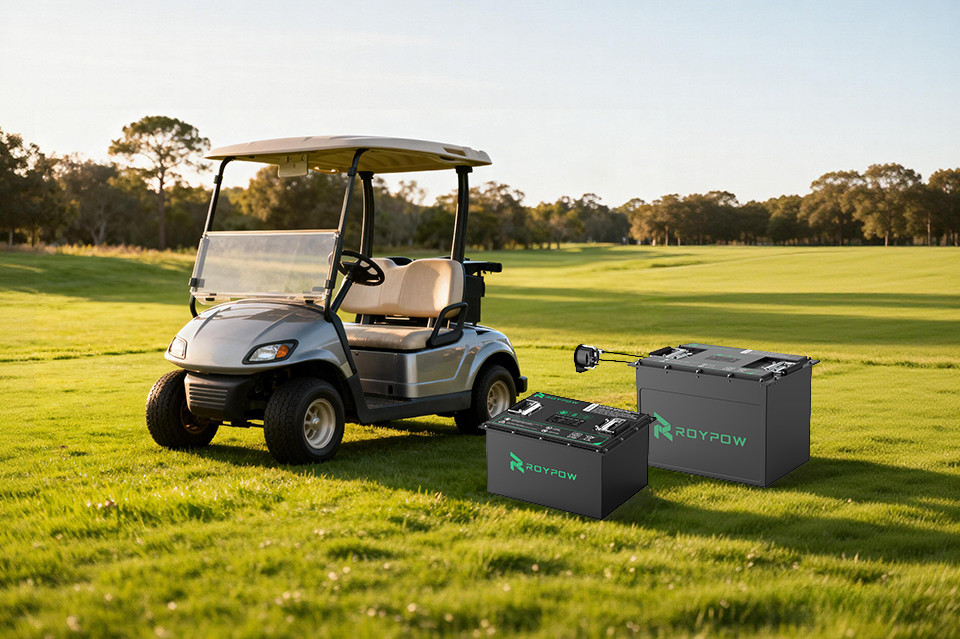
Yamaha Batteries Are Long Overdue for an Upgrade
Most Yamaha owners replace their dead lead-acid pack with another lead-acid pack. Same chemistry. Same maintenance. Same cycle of gradual degradation. And three years later, the same replacement bill.
It’s the most expensive habit in golf cart ownership, and it’s entirely avoidable.
Here’s what lead-acid is quietly doing to your Yamaha golf cart on every single charge cycle:
- Capacity fades immediately. A brand-new lead-acid pack starts losing usable capacity from the very first cycle. By year two, most packs are delivering noticeably less range than they did at purchase.
- Voltage sags under load. Every time you climb a hill, accelerate with passengers, or run accessories, voltage drops. That “sluggish on the back nine” feeling isn’t the cart. It’s the battery.
- Maintenance never stops. Flooded lead-acid cells need distilled water added regularly. Skip it and you permanently damage the plates through sulfation, a chemical process that eats usable capacity and can’t be reversed.
- Cold weather hits hard. Lead-acid can lose 30-50% of its effective capacity in cooler temperatures. Yamaha owners in seasonal climates feel this most.
Lithium iron phosphate (LiFePO4) changes every one of these dynamics. Weight drops by up to 70%. Charge time cuts from 8-10 hours to 2-4 hours. Maintenance disappears entirely. And the voltage curve stays flat from a full charge to nearly empty, meaning the cart you drive on hole 1 is the same cart you drive on hole 18.
The lithium vs lead-acid comparison on ROYPOW’s site breaks down the full performance gap across every metric. Worth reading before you decide whether to replace or upgrade.
Yamaha Model Compatibility, by Model
Every Yamaha model from the G-Series through the current Drive2 can run on lithium. The critical variable, just like with any golf cart conversion, is matching the correct voltage to your specific model’s electrical system.
Here’s the full breakdown:
Yamaha G-Series (G14 through G22)
The G-Series spans several decades and two voltage systems. Knowing which one your cart runs on is step one.
|
Model |
Years |
Voltage |
Battery Config |
|
G14 |
1995-1996 |
36V |
Six 6V batteries |
|
G16 |
1996-2002 |
36V |
Six 6V batteries |
|
G19 |
1999-2002 |
48V |
Six 8V batteries |
|
G22 |
2003-2007 |
48V |
Six 8V batteries |
G14 and G16 owners use a 36V LiFePO4 pack to replace all six 6V batteries in a single unit. Straightforward swap, significant weight reduction, and dramatically better range.
G19 and G22 owners move to a 48V system. Important note for G19 owners specifically: the G19 uses regenerative braking. This is covered in full detail in the final section below, but the short version is this: your BMS selection matters more than it does on any other G-Series model.
Yamaha Drive (G29) 2007-2016
The Drive, also known as the G29, was Yamaha’s best-selling cart and runs on a 48V system using four 12V batteries. The battery tray layout is slightly different from Club Car and EZGO, but a quality 51.2V LiFePO4 monoblock drops in cleanly with correct cable lengths and a compatible charger.
Range on a 105Ah lithium pack typically jumps from 22-28 miles on lead-acid to 40-55 miles. The weight reduction alone, around 180-200 lbs in most configurations, improves acceleration and reduces frame stress noticeably.
Yamaha Drive2 (G29-2) 2017-Present
The Drive2 is the most lithium-friendly Yamaha ever built. It runs 48V from the factory and in its PowerTech Li configuration, comes with a factory-installed ROYPOW lithium battery as standard. If you have a lead-acid Drive2, the conversion is one of the cleanest drop-in swaps in the golf cart market. If you have a factory lithium Drive2 and want to upgrade capacity, verify BMS compatibility with Yamaha’s controller signals before buying.
Yamaha UMAX Utility Series
The UMAX series runs on 48V and handles heavier loads than standard golf carts. Fleet use, campus transport, and commercial property applications are common. Because of the workload, a 160Ah+ pack is the practical choice here, not 105Ah. The extra capacity supports sustained high-draw operation without stressing the BMS or shortening cycle life.
For Yamaha-specific model matching, the ROYPOW Yamaha compatibility page lists verified fitment by model and year.
Pro tip: Always find your Yamaha’s serial number before buying anything. It’s on a metal plate on the frame, just below the seat or on the driver-side front panel. The serial number decodes both the model year and original voltage configuration, removing all guesswork.
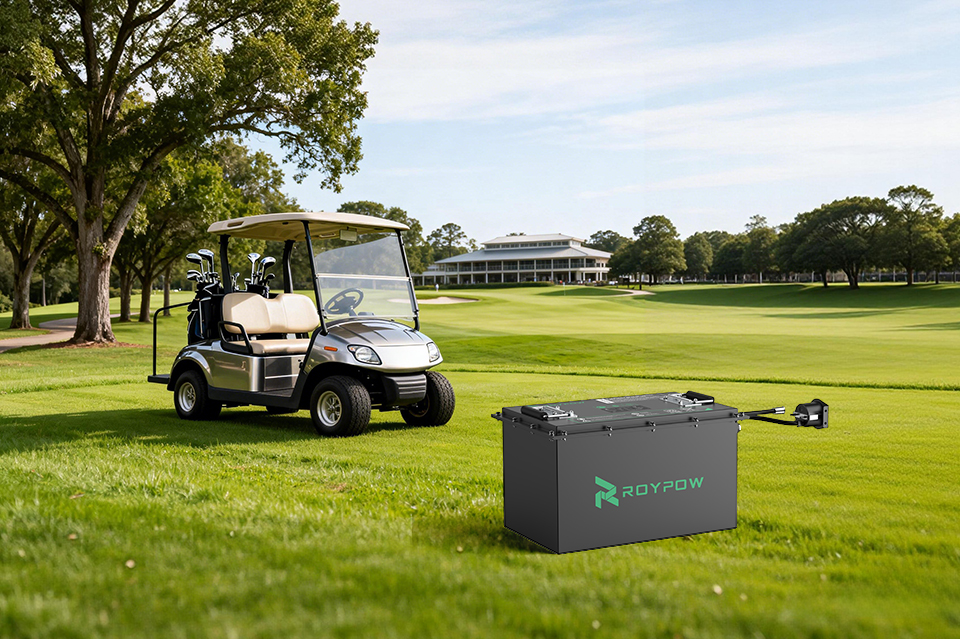
How the Conversion Process Works
Yamaha conversions are straightforward for Drive, Drive2, and most G-Series models. The compartment fits a single lithium monoblock cleanly, the wiring is accessible, and no controller modifications are needed in standard setups.
Here’s what the process looks like from start to finish.
Step 1: Confirm Voltage and Battery Configuration
Count your existing batteries and multiply: six 6V = 36V, six 8V, or four 12V = 48V. This is your lithium voltage target, non-negotiable.
Step 2: Source a Complete Conversion Kit
A proper Yamaha lithium conversion kit should include:
- LiFePO4 battery pack (matched to your voltage and Ah requirement)
- Lithium-specific charger with the correct Yamaha plug configuration
- State-of-charge display or gauge
- Mounting hardware and cable harness
- 12V voltage reducer (if you run accessories like lights or speakers)
Note: Yamaha uses a unique charger plug configuration that differs from Club Car and EZGO. Confirm the charger plug type before ordering.
Step 3: Disconnect and Remove the Lead-Acid Pack
Disconnect the negative terminal first, always. Remove each lead-acid battery carefully. They’re heavy, typically 50-60 lbs each, and they contain sulfuric acid. Wear gloves and eye protection. Recycle them through a certified battery recycler.
Step 4: Prepare the Battery Compartment
Clean the tray. Inspect for corrosion, cracked plastic, or any wiring damage. The Drive and Drive2 trays are sized around four 12V batteries, and a single lithium monoblock typically fits cleanly with minimal adapter hardware.
Step 5: Install and Connect the Lithium Pack
Seat the battery securely using the provided mounting hardware. Connect positive to positive, negative to negative. Double-check polarity before making the final connection. A pre-charge resistor connection before the final hookup reduces the spark on first connection, a small step that protects both the battery and the controller.
Step 6: Install the Lithium Charger
Your existing Yamaha lead-acid charger uses a charge profile incompatible with lithium chemistry. Install the included lithium-specific charger. ROYPOW’s golf cart battery charger matches LiFePO4 chemistry precisely and supports the correct constant-current, constant-voltage charge profile.
Step 7: Test Before Regular Use
Charge fully, then run a performance check:
- Verify the state-of-charge gauge reads correctly
- Test acceleration on flat ground and uphill
- Test braking behaviour, especially on a slope (covered in full in the next section)
- Confirm the voltage at the controller terminals matches the expected output
Most Yamaha conversions in good mechanical condition complete without issues. If the BMS cuts power during the uphill test, wait 30 seconds, reset, and check that your charger profile is correctly set.
Real Cost Breakdown Over 10 Years
The sticker shock on a lithium conversion is real. A complete kit for a 48V Yamaha Drive or Drive2 runs $1,500 to $3,000, depending on capacity and brand. A fresh set of quality lead-acid batteries for the same cart costs $800 to $1,500.
But the 10-year math tells a very different story.
Side-by-Side Cost Over 10 Years (48V Yamaha, Single Cart)
|
Cost Factor |
Lead-Acid (10 Years) |
Lithium (10 Years) |
|
Initial battery purchase |
$800-$1,500 |
$1,500-$3,000 |
|
Replacement cycles needed |
2-3 sets |
0-1 set |
|
Total battery expense |
$2,400-$4,500 |
$1,500-$3,000 |
|
Charger cost |
Existing charger |
$200-$400 one-time |
|
Maintenance (watering, terminal cleaning) |
Ongoing cost and time |
Zero |
|
Estimated 10-year total |
$3,000-$6,000+ |
$1,700-$3,400 |
The crossover point where lithium becomes cheaper on a cumulative basis typically lands between years three and five for regular users. After that, every additional year on lithium is money you’re not spending on batteries or maintenance.
Capacity and Range Gains
The financial case is strong. The performance case is stronger.
|
Metric |
Lead-Acid (48V Yamaha) |
Lithium 105Ah |
|
Range per charge |
22-30 miles |
40-55 miles |
|
Charge time |
8-10 hours |
2-4 hours |
|
Weight saving |
Baseline |
180-200 lbs lighter |
|
Usable capacity at 5 years |
60-70% of the original |
90-95% of the original |
Those range numbers are meaningful for real use. A cart that could barely finish 18 holes on aging lead-acid now completes a full round and a return trip to the garage with a charge to spare.
Resale Value
A Yamaha with a quality lithium conversion is a noticeably more attractive used cart than the same model with aging lead-acid. Buyers recognize the value of a maintenance-free battery with years of service life remaining. The conversion investment partially follows the cart when you sell.
For more on how golf cart battery lifespan connects to total ownership cost, ROYPOW’s guide breaks down the key variables across usage patterns and climates.
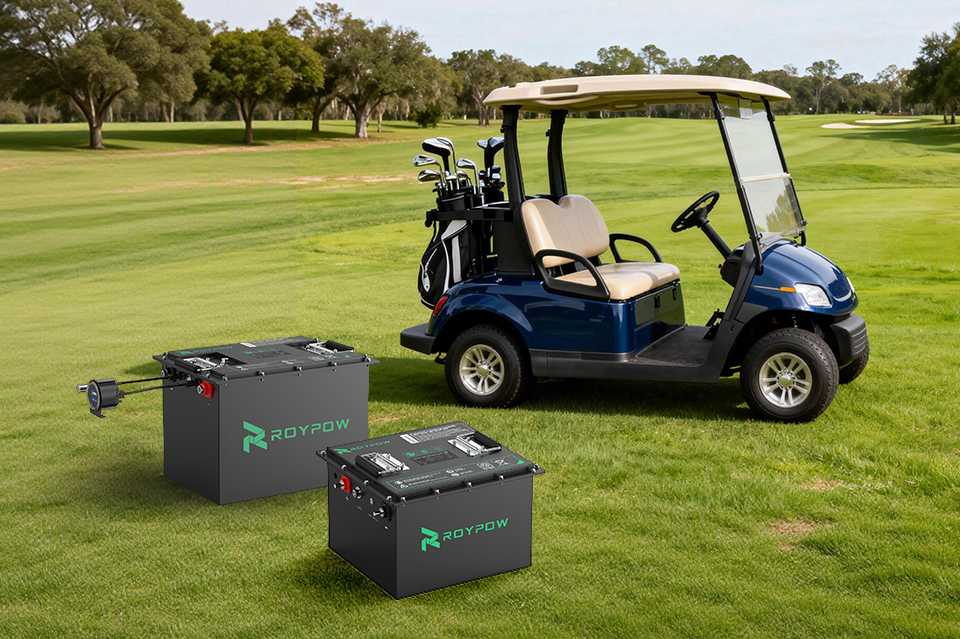
Yamaha’s Regenerative Braking: What Most Guides Miss
This is the section most conversion guides either skip entirely or gloss over with a single sentence. For Yamaha owners, it’s the most important technical detail in the entire process.
Here’s what regenerative braking actually does, and why it matters for your lithium battery selection.
How Regenerative Braking Works
When you release the accelerator on certain Yamaha models, or when you brake going downhill, the AC motor switches modes. Instead of consuming power, it generates power, acting as a generator that sends current back into the battery pack. This recovers energy that would otherwise be lost as heat through friction braking.
For lead-acid batteries, this is a non-issue. Lead-acid cells absorb regen current easily without reaching damaging voltage levels because their internal chemistry naturally buffers the incoming charge.
Lithium cells are different. Each LiFePO4 cell has a precise maximum voltage threshold. When regen current pushes a cell above that threshold, the BMS does exactly what it’s designed to do: it disconnects the battery to prevent overcharge damage.
When the BMS disconnects mid-downhill run, the cart loses all regenerative braking instantly, and full friction braking engages abruptly. Owners describe it as the cart suddenly lurching to a near-stop while descending a slope. It’s jarring, potentially dangerous, and it trips up a significant number of Yamaha conversions done with budget lithium packs.
Which Yamaha Models Use Regenerative Braking
|
Model |
Regen Braking Present |
|
Yamaha G14, G16 (36V) |
No |
|
Yamaha G19 (48V) |
Yes |
|
Yamaha G22 (48V) |
No |
|
Yamaha Drive/G29 (DC motor versions) |
No |
|
Yamaha Drive/G29 (AC motor versions) |
Yes |
|
Yamaha Drive2 (all PowerTech AC versions) |
Yes |
|
Yamaha UMAX (48V) |
Varies by year |
The Drive2 in particular deserves attention. All Drive2 electric models use AC motors with regenerative braking as standard. If you own a Drive2 and are converting to lithium, BMS regen compatibility is not optional.
What to Look for in a Regen-Compatible BMS
A BMS rated for regenerative braking applications needs:
- High charge-acceptance current rating. The BMS should be able to absorb regen current spikes (which can reach 25-40 amps or more going downhill) without triggering overvoltage cutoff
- Regen-specific cell voltage tolerance. Some BMS designs allow a slightly wider upper voltage band during regen events, absorbing the spike before the protection circuit fires
- Fast recovery reset. If the BMS does trip, it should reset within seconds rather than requiring a key cycle
Never charge a regen-compatible battery to 100% before a ride involving significant downhill sections. Keeping the starting charge at 80-90% leaves headroom for regen energy input, reducing the risk of the BMS hitting its upper voltage ceiling mid-descent.
The Practical Solution
Specify regen compatibility explicitly when purchasing your Yamaha lithium conversion kit. Ask the supplier directly: “Does this BMS handle regenerative braking from an AC motor without tripping on descent?” If the supplier can’t answer that question with a spec reference, it’s the wrong battery for your Drive2 or regen-equipped Drive.
ROYPOW’s 48V lithium golf cart batteries are engineered with an intelligent BMS built to manage the charge-acceptance demands that come with regenerative braking systems. It’s one of the reasons Yamaha chose ROYPOW as the factory battery supplier for the Drive2 PowerTech Li.
For a full guide on choosing the right lithium battery for your specific Yamaha model, the how to choose the right lithium battery for your golf cart post on ROYPOW’s blog is the best place to start.
Power Your Yamaha the Smart Way With ROYPOW
A Yamaha lithium conversion isn’t complicated when you go in prepared. Match your voltage, respect the regen braking requirements on AC motor models, choose a BMS that handles charge spikes, and use a lithium-specific charger. Do that, and you won’t be revisiting this decision for a decade.
Key takeaways from this guide:
- Lead-acid fades from cycle one. Lithium holds consistent voltage and capacity across its entire lifespan
- G14 and G16 models use 36V. G19, G22, Drive, Drive2, and UMAX all run 48V
- The Drive2 PowerTech AC uses regenerative braking. BMS regen compatibility is non-negotiable for this model
- A regen-incompatible BMS disconnects mid-descent, causing sudden hard braking. A real safety concern, not just a performance issue
- Keep charge at 80-90% before rides with significant downhill sections to protect BMS headroom
- 10-year lithium cost runs $1,700-$3,400 versus $3,000-$6,000+ for lead-acid replacements over the same period
- One lithium pack replaces an entire lead-acid bank and drops 180-200 lbs from your cart
ROYPOW is Yamaha’s factory-chosen lithium battery supplier for the Drive2 PowerTech Li, with an intelligent BMS specifically engineered to manage regenerative braking currents safely. Whether you’re upgrading a G-Series, a Drive, or a Drive2, their 36V and 48V Yamaha-compatible packs are worth making your first call.
Frequently Asked Questions
Can you put lithium batteries in a Yamaha golf cart?
Yes. All major Yamaha models, including G-Series, Drive, Drive2, and UMAX, accept lithium batteries. Confirm your voltage system and BMS regen compatibility before purchasing.
What voltage does a Yamaha golf cart battery use?
G14 and G16 models use 36V. G19, G22, Drive, Drive2, and UMAX all run 48V systems. Always verify before buying.
How much does a Yamaha lithium battery conversion cost?
Expect $1,500 to $3,000 for a complete kit. Over 10 years, lithium consistently costs 30-50% less than repeated lead-acid replacements.
Does the Yamaha Drive2 need a special lithium battery?
Yes. Drive2 models use AC motors with regenerative braking. The lithium battery’s BMS must support regen current input, or it will disconnect mid-descent.
How long do lithium batteries last in a Yamaha golf cart?
A quality LiFePO4 Yamaha battery lasts 8-10 years or 3,000-5,000+ charge cycles, significantly outperforming lead-acid under the same conditions.