Your stacker came with a battery. Nobody explained how to size it, charge it, or replace it. So when the runtime halves after eighteen months, most operations assume that’s just how stackers work. It isn’t. Electric stacker batteries fail early for reasons that are specific, predictable, and largely avoidable. The problem is that stackers get treated like light equipment when their duty cycle often says otherwise.
This guide covers what you need before your next replacement decision.
What we’ll cover:
- Stacker types and how their power demands differ
- Why 24V dominates the category and when it doesn’t
- Sizing capacity against real duty cycles, not rated hours
- Built-in chargers and the limits they quietly impose
- NEW: Why stacker batteries fail faster than forklift batteries
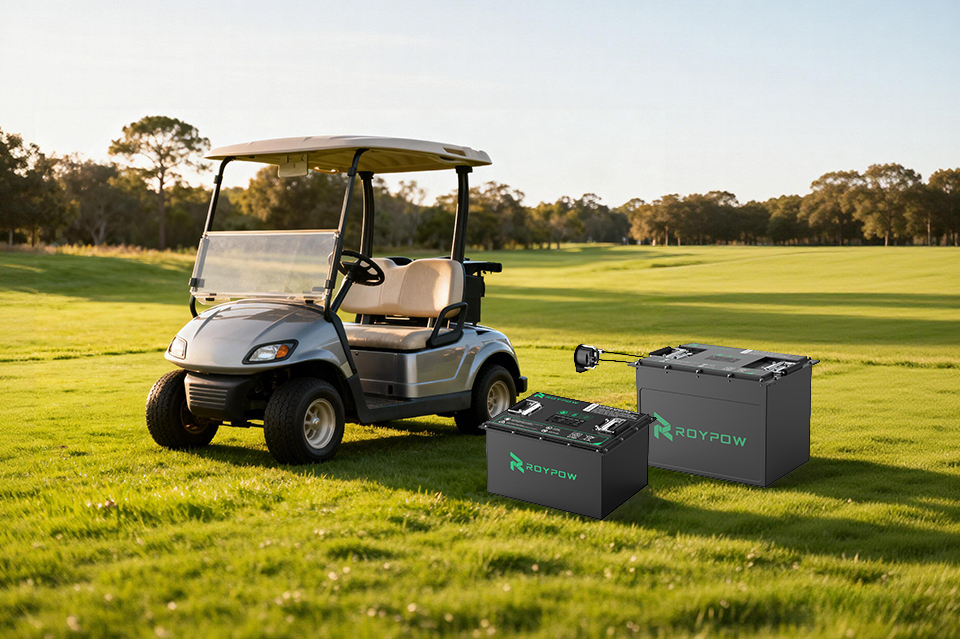
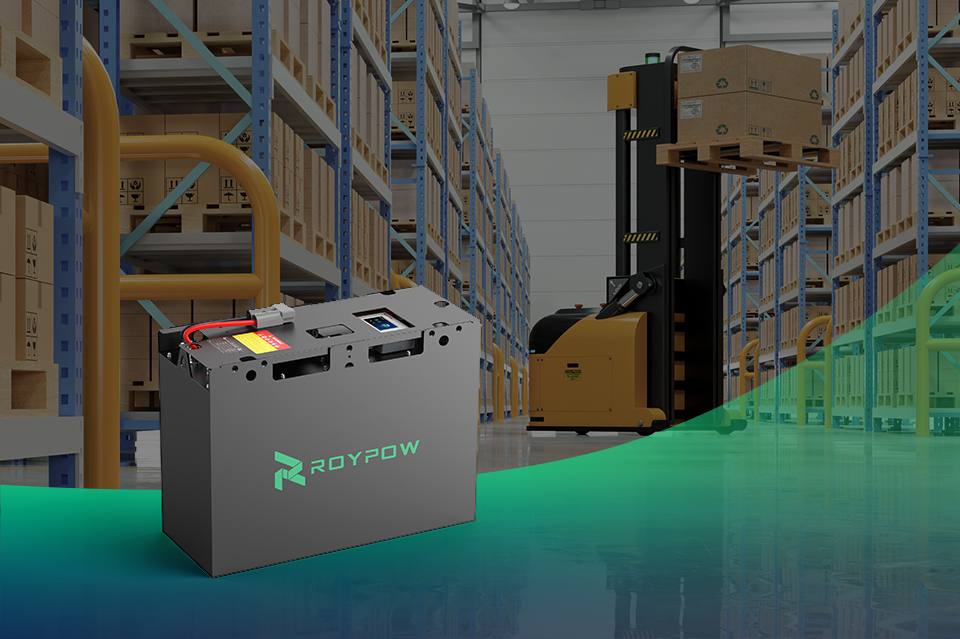
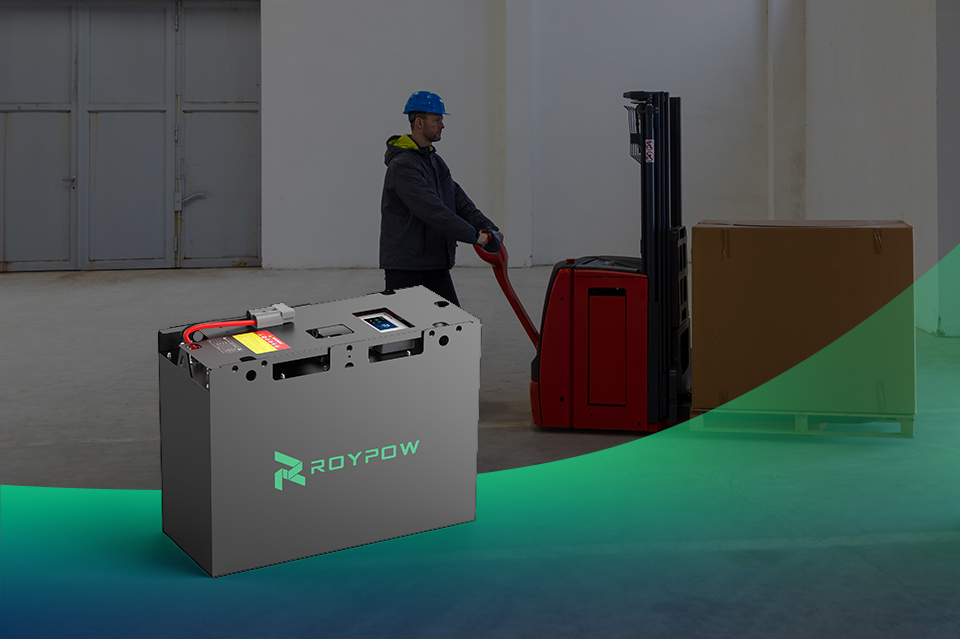
ROYPOW’s electric stacker batteries are LiFePO4 packs with integrated BMS, built for the partial-charge duty cycles stackers actually run. Worth having a real spec in mind as the sizing sections get specific.
Stacker Types and Their Power Demands
“Electric stacker” covers a wide range of machines, and their battery requirements differ more than the shared name suggests.
The Five Categories
- Manual pallet stackers. Hydraulic lift by hand pump, manual push. No battery at all. Included here because they’re the starting point most operations upgrade from, and because manual pallet stacker batteries is a common search from people who don’t yet realise their unit has no electrical system.
- Semi-electric stackers. Powered lift, manual push. The battery drives only the hydraulic pump. Duty cycle is light: short bursts of hydraulic work with long idle gaps. Small packs work fine here.
- Electric walkie stackers. Powered lift and powered drive, operator walks behind. Now the battery handles both traction and hydraulics. This is where capacity requirements jump significantly, and where most undersizing happens.
- Electric straddle stackers. Straddle legs support the load rather than a counterweight. Lighter overall and more compact, which means a tighter battery compartment. Adjustable straddle legs suit diverse pallet sizes, but the leg geometry constrains where the battery can physically sit.
- Electric counterbalanced stackers. A counterweight replaces the straddle legs, allowing the unit to handle enclosed pallets and turn in aisles a straddle can’t. Heavier machine, heavier duty, larger battery.
How Demand Scales
|
Stacker Type |
Powered Functions |
Typical Battery |
Duty Intensity |
|
Manual |
None |
None |
N/A |
|
Semi-electric |
Lift only |
24V, 20-60Ah |
Light |
|
Walkie straddle |
Lift and drive |
24V, 60-150Ah |
Moderate |
|
Walkie counterbalanced |
Lift and drive |
24V, 150-210Ah |
Moderate to heavy |
|
Reach stacker |
Lift, drive, fork extension |
24V, 150-210Ah |
Heavy |
Reach stackers deserve a note. Some models use a scissor fork extension system that lets the unit act as a counterbalanced stacker with forks extended and a straddle stacker with forks retracted. That versatility adds a third hydraulic function, which adds draw.
Pro tip: If you’re replacing a battery on a unit you inherited, check the data plate for powered functions, not just the voltage. A semi-electric pack dropped into a full-electric unit will run flat by mid-morning.
For a wider view of how lithium performs across material handling equipment, ROYPOW’s guide on choosing a lithium forklift battery covers the selection fundamentals.
Why 24V Dominates the Category
Almost every electric stacker on the market runs 24V. That’s not an accident, and understanding why helps you spot when a quote is wrong.
The Engineering Logic
Voltage selection comes down to balancing current against complexity.
Higher voltage reduces current for equivalent power, which cuts cable thickness, heat, and copper losses. That’s exactly why forklifts move to 48V and 80V as capacity climbs.
But stackers don’t need it. A walkie stacker draws modest peak power compared to a counterbalance forklift, so 24V keeps current within a range where standard cabling and connectors work comfortably. Going higher would add cost without solving a problem.
24V also keeps the system within touch-safe limits, which simplifies maintenance access and reduces training requirements for the operators typically running this equipment.
When You’d See Something Else
|
Voltage |
Where It Appears |
|
12V |
Very light semi-electric units, lift-only |
|
24V |
The overwhelming majority of electric stackers |
|
36V |
Heavy-duty or high-lift stackers, some European models |
|
48V |
Rare, typically stackers bordering on reach truck territory |
If a supplier quotes 36V or 48V for a standard walkie stacker, confirm the OEM spec before proceeding. Voltage mismatch either damages the controller or triggers a fault lockout.
Capacity Is the Real Variable
Since voltage is effectively fixed, capacity does all the work. And this is where the quotes diverge wildly.
Common configurations range from 60Ah on light straddle stackers up to 210Ah on counterbalanced walkie units built for full-shift work. That’s a 3.5x spread within the same voltage platform.
Picking the wrong end of that range is the single most common stacker battery mistake.
ROYPOW’s 24V forklift battery range spans the capacities used across Class III stacker and pallet truck equipment.
Sizing Against Real Duty Cycles
Rated runtime figures assume light, intermittent use. Most operations don’t run that way.
Build the Actual Cycle
For each stacker, capture across a representative shift:
- Lifts per shift and average lift height
- Average load weight
- Travel distance between pick and place
- Powered hours versus idle hours
- Shift count per day
Worked Example: Retail Distribution Walkie Straddle Stacker
A grocery distribution backroom running one 8-hour shift:
|
Activity |
Energy per Cycle |
Cycles/Shift |
Shift Total |
|
Lift to 2.8m with 900kg load |
0.011 kWh |
140 |
1.54 kWh |
|
Travel, average 22m loaded |
0.008 kWh |
140 |
1.12 kWh |
|
Travel, return unloaded |
0.005 kWh |
140 |
0.70 kWh |
|
Controls and indicators |
Continuous |
8 hrs |
0.16 kWh |
|
Shift total |
|
|
3.52 kWh |
Now apply usable capacity:
- Lead-acid at 65% usable: needs roughly 5.4 kWh installed (approximately 225Ah at 24V)
- LiFePO4 at 92% usable: needs roughly 3.8 kWh installed (approximately 160Ah at 24V)
The lithium pack does the same shift at 70% of the installed capacity, in a smaller physical package.
Capacity Guidance by Use Pattern
|
Use Pattern |
Recommended 24V Capacity |
|
Occasional, a few lifts daily |
40-60Ah |
|
Light single shift, under 50 cycles |
60-100Ah |
|
Standard single shift, 100-150 cycles |
100-150Ah |
|
Heavy single shift or light two-shift |
150-210Ah |
|
Full two-shift operation |
210Ah with opportunity charging |
The Mistake Almost Everyone Makes
Buying to the purchase price rather than the duty cycle.
A 60Ah pack costs meaningfully less than a 150Ah pack. On a unit running 120 cycles per shift, that 60Ah pack will be cycled to near-empty every single day. Deep cycling is the fastest way to destroy any battery chemistry, and the pack that saved you money at purchase gets replaced two or three times before the correctly sized one needs replacing once.
Pro tip: Size so your heaviest normal shift consumes no more than 70% of usable capacity. That margin costs a little upfront and buys you years of cycle life.
Built-In Chargers and Their Hidden Limits
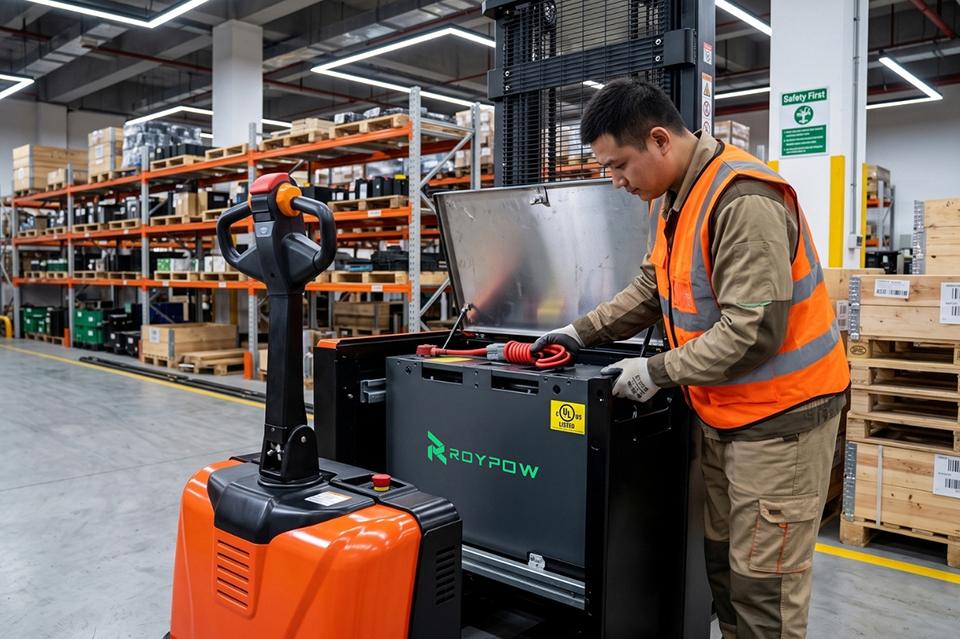
Most electric stackers ship with an onboard charger built into the unit. Convenient, and genuinely useful. But it carries consequences worth understanding.
What Built-In Charging Gives You
- Plug into any standard outlet, no charging bay required
- Opportunity charging during natural breaks
- No separate charger to buy, site, or maintain
- No cable handling or connector wear
Typical onboard chargers on 24V stackers sit around 24V/25A, which suits overnight or extended break charging.
The Constraint Nobody Mentions at Purchase
The onboard charger is matched to the original battery chemistry.
If your stacker shipped with lead-acid, the built-in charger runs a lead-acid charge profile: constant current, then absorption, then a float or equalisation stage. That profile is actively harmful to lithium cells. Equalisation voltage in particular will push a LiFePO4 pack past safe cell voltage, triggering BMS protection or causing damage.
So when you upgrade to lithium, you have three options:
|
Option |
What It Involves |
|
Replace the onboard charger |
Swap for a lithium-profile unit matched to the pack |
|
Use an external lithium charger |
Bypass the onboard unit entirely |
|
Buy a pack with matched charger |
Supplier provides both, profile-verified |
The third option is the clean path. It removes the compatibility question entirely.
Charging Habits That Extend Life
- Top up during breaks. Partial charges suit lithium and prevent deep discharge
- Avoid running to empty. Repeated deep cycles are the primary degradation driver
- Don’t leave it on charge indefinitely. Prolonged time at 100% adds calendar aging
- Charge in moderate temperatures. Below 0°C, charging lithium without pre-heating causes permanent damage
- Store at 50-70% if the unit sits unused for weeks
For a full breakdown of charging behaviour and its effect on lifespan, ROYPOW’s guide on charging with lithium battery chargers covers the profiles in detail.
Why Stacker Batteries Fail Faster Than Forklift Batteries
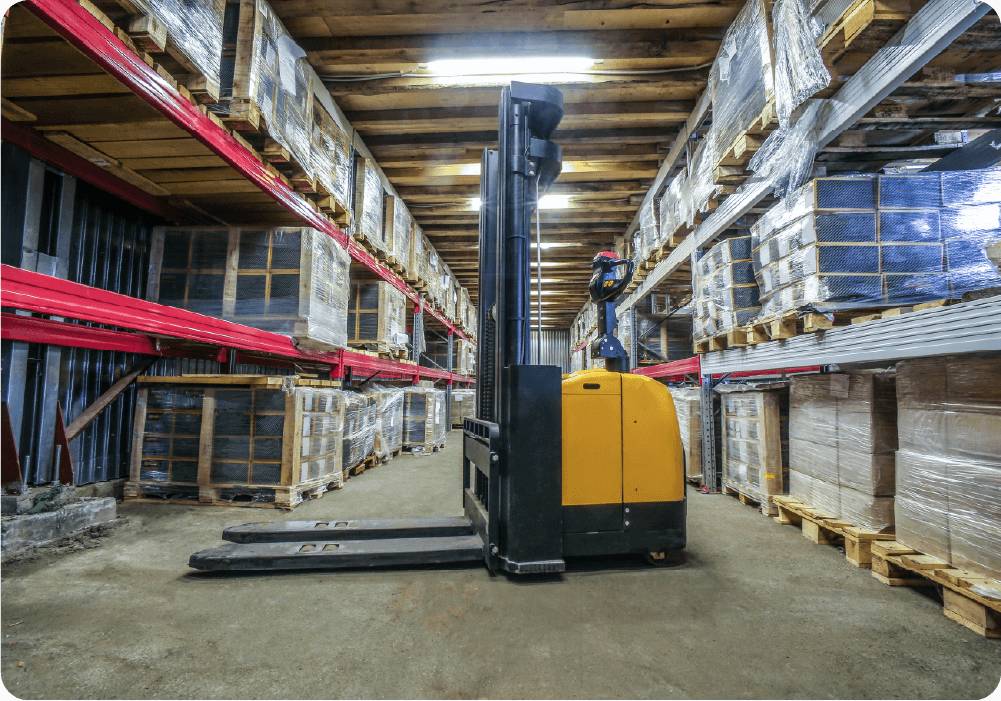
Here’s the pattern almost nobody explains at the point of sale, and it’s the reason so many operations replace stacker batteries far more often than they expected.
A forklift battery and a stacker battery might carry similar cycle ratings. In practice, the stacker pack often dies first. Four reasons compound.
1. Depth of Discharge Is Consistently Worse
Stackers ship with small packs because the machine is marketed as light equipment. But the work assigned to them frequently isn’t light.
A 60Ah pack running 120 cycles per shift gets taken to 15-20% state of charge daily. A forklift battery sized for the same workload would be at 60-70% at shift end.
Cycle life ratings are quoted at a specific depth of discharge. A pack rated 3,000 cycles at 50% DoD might deliver only 800-1,200 at 90% DoD. Same battery, a quarter of the life, purely because of how deeply it’s cycled.
2. Nobody Owns the Maintenance
Forklift fleets have battery rooms, scheduled watering, and someone accountable for battery health. Stackers sit in a retail backroom or a small warehouse corner.
For a lead-acid stacker pack, that means:
- Electrolyte never topped up, exposing plates and causing permanent sulfation
- Terminals corroding unchecked
- No equalisation charges
- No capacity testing to catch degradation early
The battery isn’t failing prematurely. It’s failing from neglect that the operating model makes almost inevitable.
3. Charging Is Improvised
Forklift charging happens on a schedule in a designated place. Stacker charging happens whenever someone remembers.
For lead-acid, that’s genuinely damaging. Interrupting a lead-acid charge before completion accelerates sulfation. So the “plug it in during lunch” habit that everyone adopts with a built-in charger is quietly destroying a lead-acid pack while doing no harm at all to a lithium one.
The convenience of onboard charging actively works against lead-acid chemistry.
4. Duty Cycle Drifts Upward
Stackers get bought for a modest job and then absorb more work as the operation grows. Nobody revisits the battery spec.
The pack sized for 40 cycles a day is now doing 130. The failure gets blamed on battery quality rather than on a requirement that changed underneath it.
What Actually Fixes It
|
Failure Cause |
Lead-Acid |
LiFePO4 |
|
Deep discharge damage |
Severe, permanent |
Minimal at equivalent depth |
|
Missed maintenance |
Causes sulfation |
No maintenance required |
|
Partial charging |
Accelerates sulfation |
Preferred, extends life |
|
Increased duty cycle |
Fails rapidly |
Absorbs with capacity headroom |
Lithium doesn’t just tolerate the way stackers are actually used. It suits it. No watering means no maintenance to skip. No sulfation means partial charges cause no harm. Higher usable capacity means the same physical pack handles a heavier duty cycle without deep-cycling.
Pro tip: Before replacing a stacker battery, count actual daily cycles rather than assuming the original spec still fits. Operations that do this typically find they need 40-60% more capacity than the unit shipped with.
For the broader economics of this calculation, ROYPOW’s analysis of why battery price is not the true cost applies directly.
Keep Your Stackers Moving With ROYPOW
Electric stacker batteries fail early for reasons that trace back to sizing and chemistry, not bad luck. Match capacity to your real cycle count, use a charger built for the chemistry, and pick a battery that suits how the equipment is actually used rather than how it was described at purchase.
Key takeaways from this guide:
- Semi-electric, walkie, straddle, counterbalanced, and reach stackers all carry different power demands
- 24V covers almost every electric stacker. Capacity, not voltage, is the variable that matters
- Size so a heavy shift uses no more than 70% of usable capacity
- Lead-acid gives you 60-65% of rated capacity. LiFePO4 gives you 90-95%
- A built-in charger is matched to the original chemistry. Upgrading to lithium means matching the charger too
- Deep cycling is the main killer. A pack rated 3,000 cycles at 50% DoD may deliver under 1,200 at 90%
- Partial charging harms lead-acid and benefits lithium, which is why onboard chargers suit lithium far better
- Duty cycles drift upward over time. Recount cycles before every replacement rather than repeating the original spec
ROYPOW’s electric stacker batteries are LiFePO4 packs with integrated smart BMS, fire suppression system and matched charging, sized across the full 24V range for walkie, straddle, counterbalanced, and reach stacker applications. Send their team your cycle count and unit model, and they’ll size against it directly. Start at the contact page.
Frequently Asked Questions
What voltage do electric stacker batteries use?
Almost all electric stackers run 24V. Very light semi-electric units may use 12V, while heavy-duty or high-lift stackers occasionally use 36V.
How many amp-hours does an electric stacker battery need?
Light single-shift use needs 60-100Ah. Standard shifts need 100-150Ah. Heavy or two-shift operation needs 150-210Ah with opportunity charging.
Can you put a lithium battery in an electric pallet stacker?
Yes, provided the voltage matches and the charger is replaced or bypassed. Built-in lead-acid chargers use a profile that damages lithium cells.
Why do electric stacker batteries fail so quickly?
Usually deep discharge from undersized packs, skipped maintenance on lead-acid, and partial charging that accelerates sulfation. Duty cycles also drift upward without a battery upgrade.
Do manual pallet stackers need a battery?
No. Manual stackers use a hand-operated hydraulic pump with no electrical system. Semi-electric models add a battery to power the lift only.
Is lithium worth it for a small stacker fleet?
Usually yes. Small operations lack dedicated battery maintenance, which is exactly where lead-acid degrades fastest and lithium’s zero-maintenance design pays off.