Your turret truck lifts to 40 feet at 8 a.m., and the same lift takes noticeably longer at 3 p.m. Nobody logs it. Nobody reports it. But across a fleet of six trucks running two shifts, that quiet slowdown is costing you picks per hour every single day. The truck isn’t wearing out. The battery is sagging under load, and lift speed is the first thing to go.
This guide covers what VNA batteries face that standard forklift batteries never do.
What we’ll cover:
- What VNA trucks demand that counterbalance trucks don’t
- Why voltage sag hits lift speed before it hits anything else
- Duty cycle math for high-bay picking operations
- Compartment fit and why VNA gives you no room to improvise
- NEW: In-aisle opportunity charging without a battery room
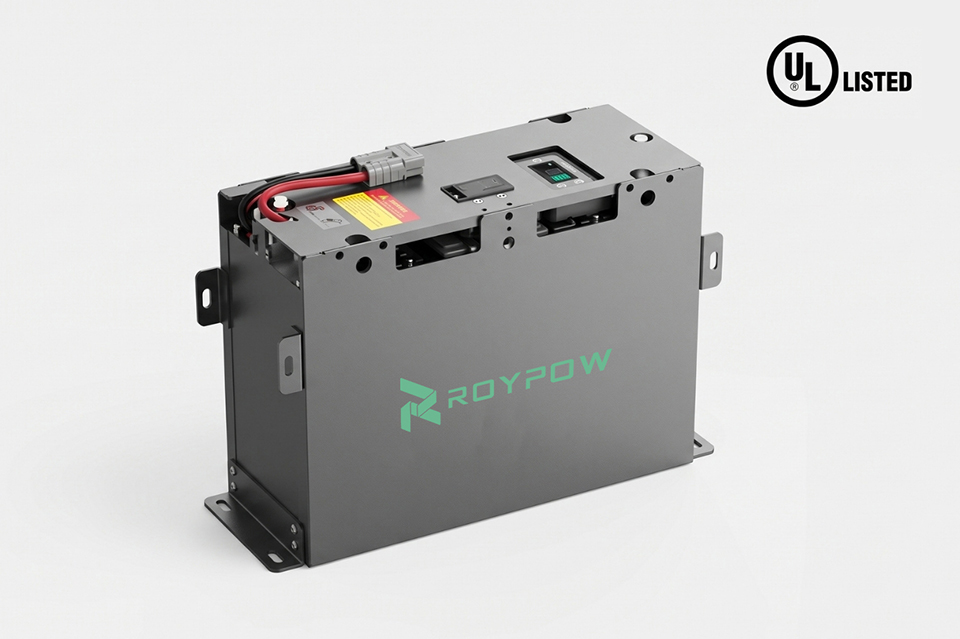
For reference throughout, ROYPOW’s narrow aisle forklift batteries are built as compartment-matched LiFePO4 packs holding flat voltage to full lift height. Useful to have a real spec in mind as the numbers below get specific.
What VNA Trucks Demand That Others Don’t
A counterbalance forklift moves loads horizontally and lifts them a few metres. A VNA turret truck does something fundamentally different, and the power profile reflects that.
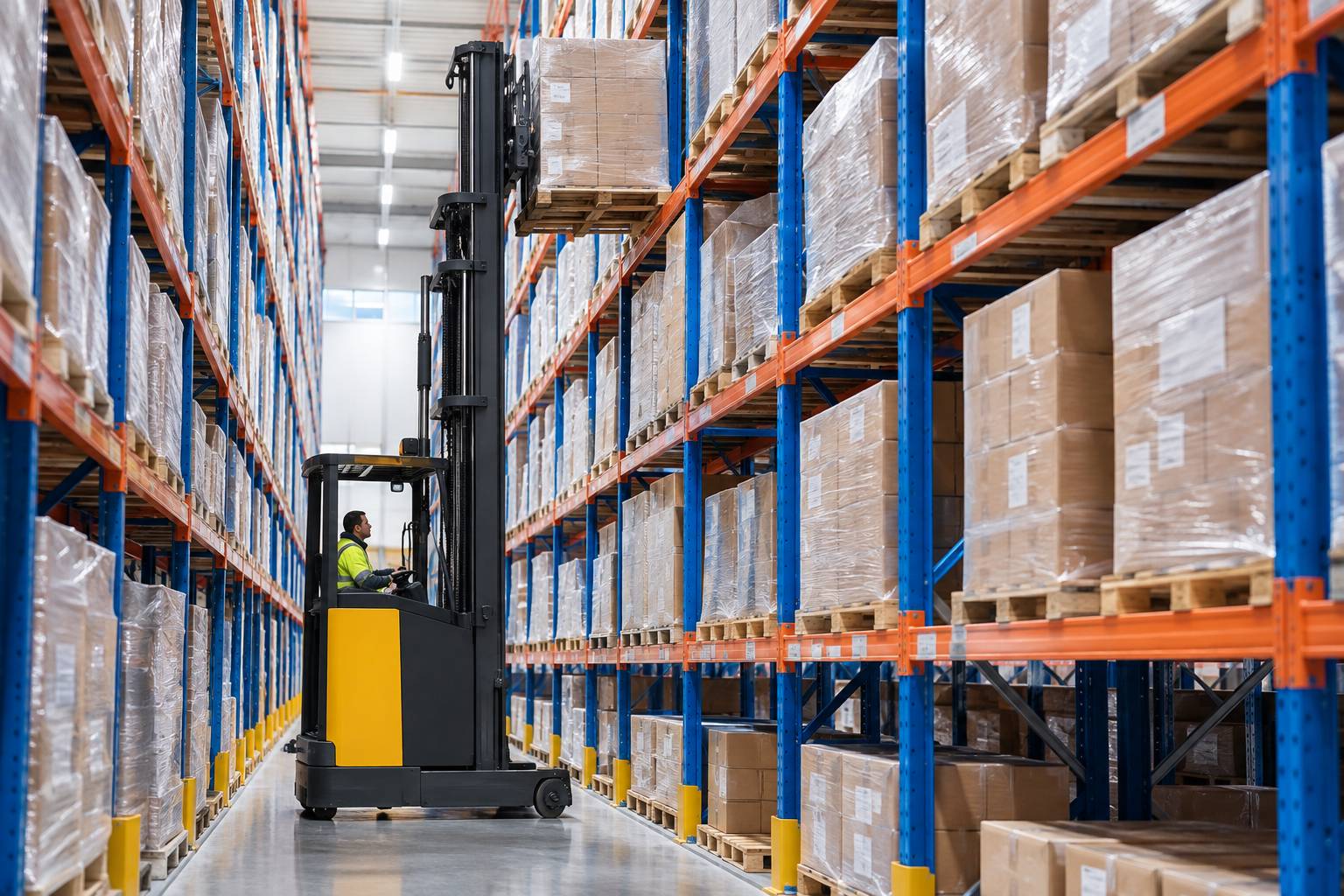
VNA turret trucks use articulating forks so operators can access pallets on either side of the aisle without turning the truck around, working in aisles as narrow as 56 inches with racking up to 622 inches. They’re classified as Class II electric motor narrow aisle trucks under OSHA, with most models lifting between 2,500 and 3,500 pounds up to 50 feet.
That vertical reach changes the whole energy equation.
Lifting Is the Dominant Load
On a counterbalance truck, traction and hydraulics split the energy budget reasonably evenly. On a VNA truck, hydraulic work dominates.
Lifting a load is pure hydraulic work drawn from the traction battery. Higher masts and heavier loads demand larger pumps, valves, and motors, and they drain the battery considerably faster. A truck raising 1,500 kg to 12 metres is doing roughly four times the lifting work of the same load raised to 3 metres.
Do that 80 times a shift and the difference compounds into a completely different battery requirement.
The Load Types That Stress Batteries Most
|
Truck Type |
Primary Demand |
Battery Stress |
|
Turret truck (man-up) |
Sustained high lifts, operator platform |
Continuous hydraulic draw, long cycles |
|
Turret truck (man-down) |
Rapid full-pallet handling |
High peak draw, frequent cycles |
|
Order picker |
Frequent mid-height stops |
Constant start-stop hydraulic load |
|
Reach truck |
Mast extension plus lift |
Combined hydraulic loads |
|
Narrow aisle side loader |
Long-load handling, mixed terrain |
Variable draw, indoor-outdoor duty |
Speed-Limiting Logic Adds a Constraint
Modern VNA trucks automatically reduce travel speed at higher fork heights and increased steering angles. That’s a safety feature, and it’s correct.
But it means your throughput is already capped by the truck’s own logic. Adding a battery-driven slowdown on top of that compounds a limit you can’t remove.
Pro tip: When benchmarking VNA throughput, measure picks per hour at the start and end of a shift separately. If the gap exceeds 10%, your battery is the constraint, not your operators.
For broader context on how lithium performs across material handling classes, ROYPOW’s guide to choosing a lithium forklift battery covers the fundamentals.
Why Voltage Sag Hits Lift Speed First
This is the mechanism most operations never diagnose correctly, because the symptom looks like a truck problem rather than a battery problem.
The Chemistry Behind It
Lead-acid batteries discharge through a chemical reaction that progressively coats the lead plates with lead sulfate. That coating acts as an insulator, which reduces the battery’s ability to deliver current. Simultaneously, the electrolyte becomes more dilute, further slowing ion transfer.
The result is a steadily falling voltage under load.
By the time a lead-acid battery reaches 50% capacity, power delivery to the motors has already decreased, producing sluggish performance and slower lift speeds. And since discharging below 20% causes permanent damage, you’re realistically working with only 60-70% of rated capacity.
Why Lifting Feels It Before Driving Does
Hydraulic lifting is the highest-current draw the truck makes. When voltage sags, the effect shows up first wherever current demand is highest.
The sequence goes like this:
- Battery state of charge drops through the shift
- Terminal voltage under load falls
- Hydraulic pump motor RPM drops
- Lift speed decreases
- Cycle time per pick increases
- Picks per hour fall
Driving speed is affected too, but less noticeably, because traction draws less peak current than a loaded high lift.
Battery state of charge strongly affects lifting capacity and speed. As voltage sags under high current, lift speed and travel acceleration drop, which cuts throughput.
The Number That Actually Matters
Field engineers assessing VNA sites often run two figures: the maximum safe lift height from the data plate, and the maximum height the truck can cycle to all shift without hitting low-voltage cutout. The second number is usually lower, and it’s the one that protects your throughput plan.
That second number is a battery specification, not a truck specification. Most operations never calculate it.
How Lithium Changes the Curve
LiFePO4 chemistry delivers a fundamentally different discharge profile. Voltage stays essentially flat from full charge until the pack is nearly depleted.
|
Metric |
Lead-Acid |
LiFePO4 |
|
Voltage across discharge |
Falls steadily |
Flat until near-empty |
|
Usable capacity |
60-70% of rated |
90-95% of rated |
|
Lift speed at 30% SoC |
Noticeably reduced |
Unchanged |
|
Performance at end of shift |
Degraded |
Same as shift start |
The practical consequence: lithium’s flat discharge curve maintains voltage stability under load, unlike lead-acid’s roughly 20% sag. A turret truck on lithium lifts at the same speed on the last pick of the shift as the first.
ROYPOW’s narrow aisle battery range is built on automotive-grade LiFePO4 cells specifically to hold that curve under sustained hydraulic load.
Duty Cycle Math for High-Bay Picking
Sizing a VNA battery from rated hours is how operations end up with packs that measure correctly and underperform in practice. The duty cycle has to come from observed behaviour.
Build the Cycle Profile First
For a single truck, capture:
- Lifts per shift, split by average height
- Average load weight per lift
- Travel distance per pick cycle
- Idle time at the pick face
- Shift length and shift count per day
Worked Example: Man-Up Turret Truck
A 3PL running case picking across a 14-metre high-bay:
|
Activity |
Per Cycle |
Cycles/Shift |
Shift Total |
|
Lift to average 9m with load |
0.09 kWh |
92 |
8.3 kWh |
|
Lower under load |
Negligible (regen on some trucks) |
92 |
0 kWh |
|
Travel, aisle and cross-aisle |
0.04 kWh |
92 |
3.7 kWh |
|
Turret rotation and positioning |
0.02 kWh |
92 |
1.8 kWh |
|
Auxiliary (lights, controls, platform) |
Continuous |
8 hrs |
1.4 kWh |
|
Shift total |
|
|
15.2 kWh |
Running two shifts daily puts consumption near 30 kWh per truck per day.
Now apply the reality checks:
- Lead-acid usable capacity: 65%. Meeting 30 kWh needs roughly 46 kWh installed
- LiFePO4 usable capacity: 92%. Meeting 30 kWh needs roughly 33 kWh installed
That’s before considering whether the lead-acid pack can deliver its rated capacity at the current levels high lifts demand. Usually it can’t.
The Battery-Per-Truck Problem
This is where lead-acid gets expensive in VNA specifically.
A lead-acid pack can’t run two shifts and recharge in time for the next day. Operations typically run two batteries per truck, sometimes three. That means:
- Double or triple the battery purchase cost
- A change-out bay and handling equipment
- 15-20 minutes of truck downtime per swap
- Dedicated battery room floor space
- Labour hours assigned to battery handling
A single lithium pack with opportunity charging runs both shifts on one battery. One truck, one battery.
Pro tip: Calculate your cost per available truck hour, not cost per battery. A lead-acid pack looks cheap until you add the second pack, the change-out labour, and the downtime it generates across a year.
For the full economics of this calculation, ROYPOW’s analysis of why forklift battery price isn’t the true cost covers the framework in detail.
Compartment Fit Leaves No Room to Improvise
On a counterbalance truck, you can usually find a battery that fits. On a VNA truck, you cannot.
The Space Constraint Is Absolute
VNA trucks are engineered around aisle width first. Every dimension follows from that. One order picker family shows battery compartment widths around 790-979 mm and height about 800 mm, which constrains the physical size of the energy pack. Within that envelope, engineers balance battery capacity against truck weight and aisle performance.
You cannot make the compartment bigger. You cannot hang a pack externally. Whatever capacity you need has to fit inside a box the OEM defined years ago.
This is why energy density matters more in VNA than in any other forklift class. LiFePO4 delivers substantially more usable energy per litre of compartment volume than lead-acid, which means more runtime inside the same physical envelope.
Battery Weight Is Structural, Not Incidental
On many VNA and reach trucks, the battery forms part of the truck’s counterweight. Remove 800 kg of lead-acid and drop in 300 kg of lithium, and you’ve changed the truck’s stability characteristics.
The fix is straightforward, but it must be engineered, not improvised:
- Ballast added to the pack or tray to match OEM-specified weight
- Weight distribution matched, not just total mass
- Centre of gravity verified against the OEM data plate
- Documentation retained for compliance and inspection
A supplier who doesn’t raise this conversation before quoting is a supplier to be cautious about.
Certifications to Require
VNA trucks operate with an elevated operator platform in several configurations. Battery safety standards are not optional here.
|
Certification |
Coverage |
|
UL 2580 |
Vehicle battery safety, US market |
|
IEC 62619 |
Industrial battery safety, international |
|
IP54 minimum |
Dust and splash protection |
ROYPOW holds UL 2580 certification across all lithium forklift battery voltage platforms, including the 24V, 36V, 48V, and 80V systems used across Class II equipment.
Voltage Platforms in Narrow Aisle Service
|
Voltage |
Typical Application |
|
Light order pickers, low-level pickers |
|
|
Mid-duty reach and narrow aisle trucks |
|
|
Most VNA turret trucks and reach trucks |
|
|
Heavy-duty VNA, high-lift turret trucks |
In-Aisle Charging Without a Battery Room
This is the operational change that matters most in VNA, and it’s the one least discussed.
The Battery Room Is Costing You Racking
Think about what a VNA warehouse is actually for. You built narrow aisles to maximise storage density. Every square metre of floor is calculated against pallet positions.
Then you gave 40 square metres of it to a battery room.
A lead-acid battery room requires:
- Acid-resistant flooring and containment
- Forced ventilation for hydrogen gassing
- Eyewash stations and spill kits
- Change-out space and lifting equipment
- Charger banks with dedicated electrical supply
- Clearance aisles around all of it
None of that stores a single pallet.
What Opportunity Charging Replaces
Lithium doesn’t gas, doesn’t need watering, and doesn’t require ventilation. That removes the entire justification for a dedicated room.
Instead, chargers mount at the aisle end, at the pick face, or in the cross-aisle. Operators plug in during natural breaks:
- Break and lunch periods
- Shift handover
- Waiting for inbound stock
- Any idle gap over ten minutes
Those short top-ups accumulate. A lithium pack accepting partial charges throughout the day never reaches the low state of charge where performance degrades, which means the voltage sag problem from section two never arises in the first place.
Why Lead-Acid Can’t Do This
Partial charging is actively harmful to lead-acid chemistry. Interrupting a charge cycle before completion accelerates sulfation, permanently reducing capacity. Lead-acid needs complete, uninterrupted charge cycles followed by a cooling period.
That constraint is exactly why the two-battery-per-truck model exists. It isn’t a preference. It’s a chemistry limitation.
LiFePO4 has no memory effect and no sulfation mechanism. Partial cycles are not merely tolerated; they’re preferable, because shallow cycling extends total cycle life.
Reclaiming the Floor Space
Run the arithmetic on your own site:
|
Item |
Typical Value |
|
Battery room footprint |
30-50 m² |
|
VNA pallet positions per m² (14m racking) |
3-5 |
|
Pallet positions recoverable |
90-250 |
|
Annual revenue per pallet position (3PL) |
$180-$400 |
|
Potential annual value |
$16,000-$100,000 |
That’s a revenue line, not a cost saving, and it doesn’t appear in any battery quote.
Pro tip: Before committing to a lithium fleet conversion, map where aisle-end chargers would physically go. Electrical supply routing to those positions is the practical constraint, and it’s far cheaper to resolve during planning than after the batteries arrive.
For a broader view of how lithium is reshaping warehouse operations, ROYPOW’s piece on lithium-ion batteries powering intelligent warehousing covers the operational shift.
Lift Faster, All Shift, With ROYPOW
VNA operations live or die on picks per hour, and lift speed is where battery performance shows up first. Flat voltage delivery, a pack that fits the compartment exactly, and charging that happens in-aisle rather than in a dedicated room. Get those three right and the throughput gap between your first pick and your last pick closes.
Key takeaways from this guide:
- Hydraulic lifting dominates the VNA energy budget. A 12-metre lift does four times the work of a 3-metre lift
- Voltage sag reduces lift speed before it affects anything else, because lifting draws the highest current
- Lead-acid gives you 60-70% of rated capacity. LiFePO4 gives you 90-95%
- The height a truck can cycle to all shift is a battery spec, not a truck spec, and most operations never calculate it
- VNA compartments are fixed by aisle-width engineering, which makes energy density the binding constraint
- Battery weight often serves as counterweight. Ballast matching is engineering work, not an afterthought
- One lithium pack with opportunity charging replaces two or three lead-acid packs per truck
- Eliminating the battery room recovers 30-50 m² of floor in a warehouse built specifically to maximise density
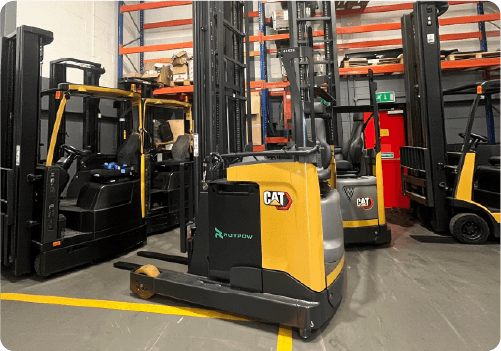
ROYPOW’s narrow aisle forklift batteries are compartment-matched LiFePO4 packs with UL 2580 certification across every voltage platform, built to hold lift speed from the first pick to the last. Their team can size against your actual lift profile and compartment dimensions. Start at the contact page.
Frequently Asked Questions
What voltage do VNA forklift batteries use?
Most VNA turret and reach trucks run 48V systems. Light order pickers often use 24V or 36V, while heavy high-lift turret trucks may require 80V.
Why do VNA forklifts slow down late in a shift?
Voltage sag. As lead-acid batteries discharge, terminal voltage falls under load, reducing hydraulic pump motor speed and slowing lifts before anything else is affected.
Can lithium batteries fit VNA forklift compartments?
Yes. LiFePO4 delivers more usable energy per litre than lead-acid, so more runtime fits the same fixed compartment. Ballast is added where the battery serves as counterweight.
How many batteries does a VNA truck need per shift?
One lithium pack covers multiple shifts with opportunity charging. Lead-acid operations typically need two or three packs per truck plus change-out infrastructure.
Do VNA forklift batteries need a dedicated battery room?
Lead-acid does, for ventilation and acid containment. Lithium does not, allowing aisle-end charging and recovering that floor space for racking.
What certifications should VNA forklift batteries have?
UL 2580 for US operations and IEC 62619 internationally. Both matter more in VNA, where operators frequently work from an elevated platform.