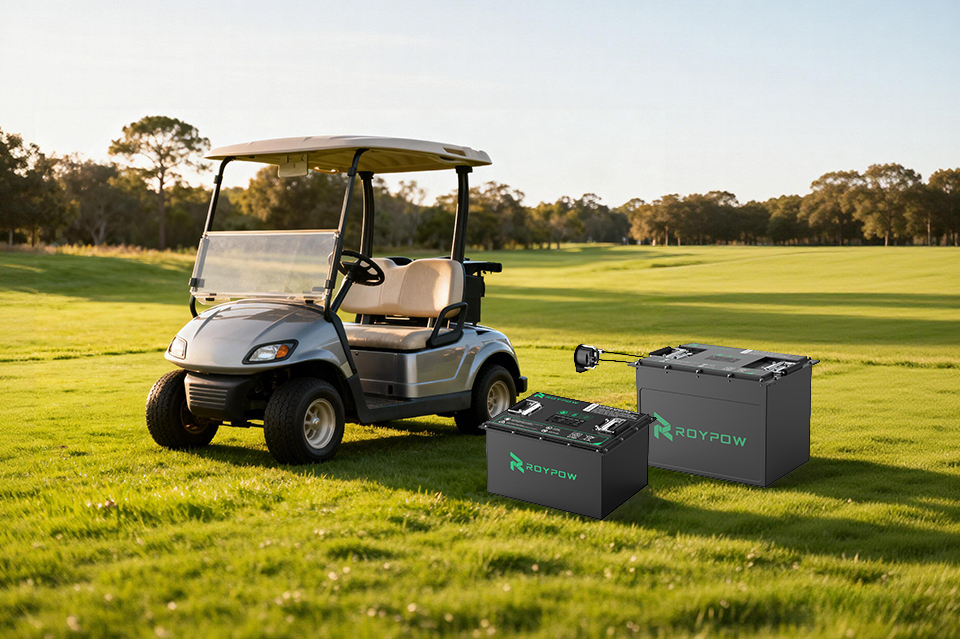
Most Club Car owners don’t realize their cart is already halfway to a better battery. The compartment fits. The voltage matches. The only thing standing between you and a lithium upgrade is knowing which model you have and what to watch out for before you buy. Get that wrong and you’re either overspending or buying a pack your cart can’t actually use.
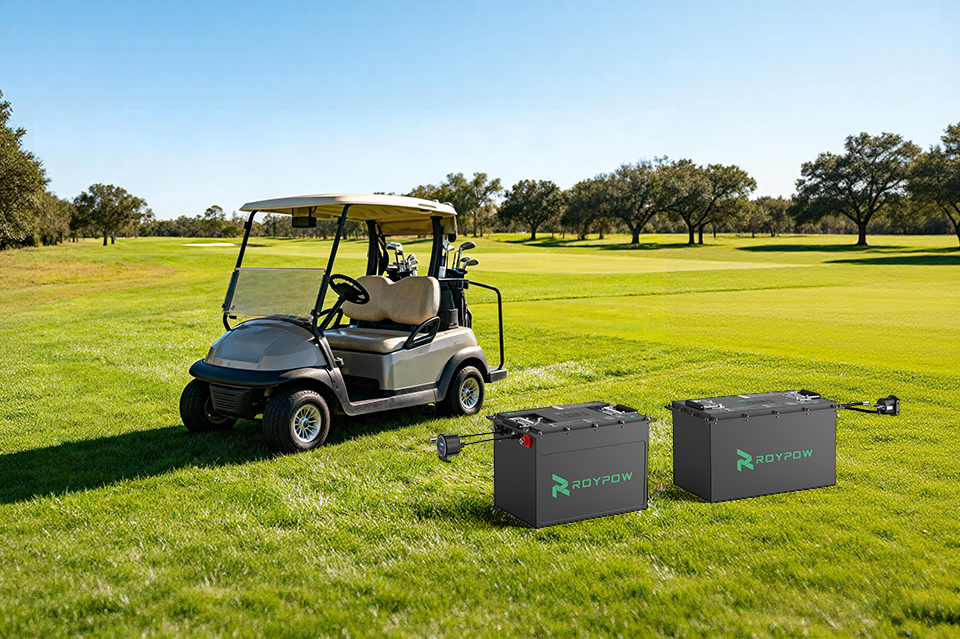
This guide gives you exactly what you need to convert with confidence.
Here’s what we’ll cover:
- Why Club Car golf cart batteries are overdue for a lithium upgrade
- Model-by-model compatibility across Precedent, Tempo, Onward, DS, and more
- Step-by-step overview of the conversion process
- Real cost breakdown and what you actually save long-term
- The CAN-bus communication issue on newer Club Car models that most guides skip entirely
ROYPOW builds LiFePO4 club car batteries designed for drop-in compatibility across all major Club Car models, with an intelligent BMS that handles the electrical communication newer carts demand. If you’re narrowing down your options, keep them in the mix.
Club Car Batteries Are Ready for an Upgrade
Lead-acid batteries have powered Club Car golf carts for decades. They’ve also been the source of most of the frustration Club Car owners know too well: weekly watering, corroded terminals, mid-round power fade, and a fresh replacement bill every two to three years.
The numbers tell the story clearly.
|
Metric |
Lead-Acid |
Lithium (LiFePO4) |
|
Lifespan |
2-4 years |
8-10+ years |
|
Cycle life |
300-800 cycles |
3,000-5,000+ cycles |
|
Weight (48V setup) |
250-300 lbs |
55-70 lbs |
|
Charge time |
8-10 hours |
2-4 hours |
|
Maintenance |
Weekly |
Zero |
|
Power consistency |
Fades with charge |
Flat until nearly empty |
That weight difference is worth sitting with. A typical lead-acid pack in a 48V Club Car weighs somewhere between 250 and 300 lbs. A lithium replacement brings that down to under 70 lbs. That’s nearly 200 lbs of dead weight gone, which means better acceleration, less strain on the motor and frame, and noticeably more range per charge.
The maintenance angle matters just as much. Lead-acid cells need distilled water added regularly to keep the plates submerged. Skip it, and you accelerate sulfation, a permanent chemical degradation that quietly kills capacity before the battery even shows visible signs of failure. Lithium has no electrolyte to manage. No water. No acid. No terminals to clean.
And the power delivery itself is different in a way you feel on every ride. Lead-acid voltage drops steadily as the battery discharges. By the back nine, your Club Car is noticeably slower. Lithium holds a flat, consistent voltage right up until the pack is nearly empty. The cart you drive on hole 1 is the same cart you drive on hole 18.
For a full breakdown of what this upgrade looks like in practice, ROYPOW’s guide on why upgrading to a lithium golf cart battery makes the case in detail.
Club Car Model Compatibility, by Model
The good news: virtually every Club Car model from the last two decades can run on lithium. The detail that matters is which voltage system your specific model uses, because that determines which pack you buy.
Here’s a model-by-model breakdown:
Club Car DS
The DS is Club Car’s longest-running model, produced from 1981 to the present day. Older DS models (pre-2000) ran on 36V systems using six 6V batteries. Models from 2000 onward moved to 48V, using either six 8V or four 12V batteries in series.
- 36V DS: A single 36V LiFePO4 pack replaces all six 6V batteries in one unit
- 48V DS: A single 48V lithium pack replaces the full bank, simplifying wiring and dropping significant weight
The DS battery tray is relatively generous in space, making it one of the more straightforward conversion platforms.
Club Car Precedent (2004-Present)
The Precedent runs on a 48V system and uses a molded plastic battery tub with internal dividers designed for six 8V lead-acid blocks. When installing a single lithium monoblock, those internal dividers typically need to be removed to create a flat seating surface. Most installers handle this in under an hour with basic tools.
The Precedent also features an On-Board Computer (OBC) that manages lead-acid charging. When you switch to lithium, the OBC must be bypassed using a jumper harness, because the OBC’s charging profile is incompatible with lithium chemistry. Most quality lithium conversion kits include the bypass harness.
Club Car Tempo (2018-Present)
The Tempo is the fleet-focused successor to the Precedent, running on 48V. It shares the same basic electrical architecture as the Precedent and accepts the same lithium conversion approach, with one important caveat: some Tempo variants ship with a CAN-bus-enabled controller (covered in detail in the final section below).
Club Car Onward (2018-Present)
The Onward is Club Car’s consumer flagship and runs on 48V. It’s available in both lead-acid and factory lithium configurations. If you have a lead-acid Onward, conversion is straightforward. If you have a factory lithium Onward, replacing the OEM pack with an aftermarket unit requires CAN-bus-compatible BMS technology.
Pro tip: Check your Club Car’s serial number before buying anything. The serial number tells you the model year and original voltage configuration. You’ll find it on the driver-side frame just below the glove box.
ROYPOW’s full range of lithium golf cart batteries covers 36V, 48V, and 72V configurations with drop-in compatibility across all major Club Car models.
How the Conversion Process Works
The conversion is more accessible than most people expect. For older 36V and 48V DS and Precedent models, a competent DIYer can complete the full swap in two to four hours. Here’s a practical overview of what the process actually involves.
Step 1: Confirm Your System Voltage
Lift the seat, count your batteries, and multiply: six 6V batteries = 36V. Six 8V or four 12V = 48V. This is your target lithium voltage. Do not skip this step.
Step 2: Source the Right Kit
A complete lithium conversion kit for a Club Car should include:
- The LiFePO4 battery pack (matched to your voltage)
- A lithium-specific charger (your lead-acid charger cannot safely charge lithium)
- An OBC bypass harness (for Precedent and later DS models)
- Mounting hardware and cable harness
- A state-of-charge gauge or display
Step 3: Remove the Lead-Acid Pack
Disconnect the negative terminal first, always. Lead-acid batteries are heavy, often in the 40-60 lbs range each, so have a second person or a proper lifting setup ready. Dispose of them responsibly through a battery recycler.
Step 4: Prepare the Battery Tray
For Precedent models, cut or remove the internal plastic dividers to create a flat seating surface for the lithium monoblock. Clean the tray and inspect for any corrosion or damage.
Step 5: Install the Lithium Pack
Seat the battery securely using the provided mounting brackets. Connect positive to positive, negative to negative. Double-check polarity before making the final connection. Arcing at this stage almost always indicates reversed polarity or a short.
Step 6: Bypass the OBC (if applicable)
Install the bypass jumper harness at the OBC location. This redirects charging management to the lithium battery’s own BMS, which handles all charge control natively.
Step 7: Connect and Test
Install the new lithium-compatible charger. Charge fully before first use. Test the state-of-charge readout, verify the voltage at the controller, and run the cart through a basic range and performance check.
Pro tip: Never use your existing lead-acid charger with a lithium battery, even temporarily. Lead-acid chargers use a charge profile (constant current followed by an equalization phase) that can overcharge lithium cells and trigger BMS lockout or permanent cell damage.
For charger compatibility guidance, ROYPOW’s golf cart battery charger is matched specifically to LiFePO4 chemistry and works cleanly with all Club Car voltage configurations.
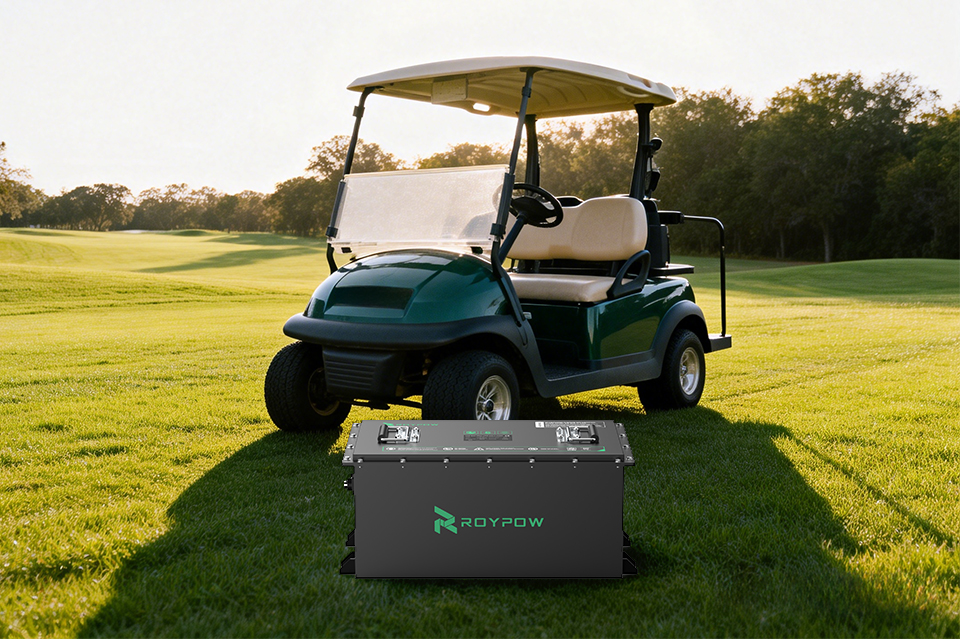
The Real Cost of Switching to Lithium
The upfront cost of a Club Car lithium battery conversion runs between $1,500 and $3,000, depending on voltage, capacity, and whether you’re doing it yourself or paying for installation. A fresh set of quality lead-acid batteries for the same cart runs $800 to $1,500.
On paper, lithium costs more. In practice, the math runs the other way.
10-Year Cost Comparison (48V Club Car, Single Cart)
|
Cost Factor |
Lead-Acid (10 years) |
Lithium (10 years) |
|
Battery purchase |
$800-$1,500 |
$1,500-$3,000 |
|
Replacements needed |
2-3 sets |
0-1 sets |
|
Total battery spend |
$2,400-$4,500 |
$1,500-$3,000 |
|
Maintenance (water, terminal care) |
Ongoing |
Zero |
|
Charger compatibility |
Existing charger |
Lithium charger ($200-$400 once) |
|
Estimated 10-year total |
$3,000-$6,000+ |
$1,700-$3,400 |
The crossover point, where lithium becomes cheaper than lead-acid on a cumulative basis, typically hits somewhere between years three and five for regular users. After that, every year you run lithium is money you’re not spending on replacements or maintenance.
The Resale Angle
This one surprises people. A Club Car with a quality lithium battery installed commands a noticeably higher resale value than the same cart with an aging lead-acid. Buyers in the used golf cart market actively search for lithium-converted carts because they know what they’re avoiding.
Capacity Matters Too
Choosing the right Ah rating affects both range and long-term cost efficiency:
- 80-100Ah: Casual weekend golfers, flat terrain, 18-25 miles per charge
- 105Ah: The sweet spot for most Club Car owners. 30-40 miles on moderate terrain
- 160Ah+: Community transport, commercial use, hilly courses, or accessory-heavy builds
For a deeper look at how golf cart battery lifespan interacts with usage habits and value, ROYPOW’s guide on understanding golf cart battery lifetime determinants breaks down the key variables.
The CAN-Bus Issue Most Guides Skip
This is the section that separates a confident conversion from an expensive mistake.
Older Club Car models (DS pre-2018, early Precedents) use simple analog electrical systems. Swap the batteries, bypass the OBC, connect your charger, and done. But newer Club Car models, specifically factory lithium Tempo, Onward, and post-2018 models with the IQ Plus controller system, operate on a CAN bus (Controller Area Network) communication network.
What CAN-Bus Actually Means
In a CAN-bus-equipped cart, the battery doesn’t just supply power. It communicates. The battery pack sends and receives data signals to the Vehicle Control Module (VCM), the motor controller, and the dashboard. That data covers:
- State of charge
- Cell voltage and temperature
- Charge authorization signals
- Fault reporting
When you install an aftermarket lithium battery that doesn’t speak CAN-bus, the VCM loses the signals it expects. The result varies by cart: dashboard gauge reads zero or incorrect, the cart throws fault codes, charging becomes unreliable, or, in some cases, the cart simply refuses to operate normally.
How to Know If Your Cart Uses CAN-Bus
|
Model |
CAN-Bus? |
|
Club Car DS (lead-acid original) |
No |
|
Club Car Precedent (pre-2014) |
No |
|
Club Car Precedent (2014+ IQ Plus) |
Possibly |
|
Club Car Tempo (factory lithium) |
Yes |
|
Club Car Onward (factory lithium) |
Yes |
|
Club Car Carryall (utility, factory lithium) |
Yes |
If your cart came from the factory with lithium already installed, assume CAN-bus is active.
What to Do About It
You have two paths:
- Path 1: Buy a CAN bus-compatible lithium battery. These batteries include a BMS engineered to communicate with Club Car’s VCM via the J1939 CAN protocol, sending the signals the controller expects. Dashboard functions correctly, no fault codes, clean integration.
- Path 2: Upgrade the drivetrain. Some owners replace the Club Car controller with an aftermarket unit (such as a Navitas AC system) that accepts standard lithium inputs without CAN dependency. This unlocks any lithium battery but adds cost and complexity.
For most owners, Path 1 is the right call. ROYPOW’s 48V LiFePO4 golf cart batteries include an intelligent BMS built to handle the communication demands of modern Club Car systems. It’s the detail that most budget lithium packs skip entirely, and the reason some conversions work flawlessly while others cause persistent fault codes and frustration.
Pro tip: Before buying any lithium battery for a 2018+ Club Car with factory lithium, confirm in writing that the BMS supports CAN-bus communication with Club Car’s VCM. This single question filters out most compatibility problems before they start.
For a fuller picture of lithium compatibility across Club Car models, ROYPOW’s blog post on putting lithium batteries in a Club Car walks through the key considerations by model.
Make Your Club Car Lithium Conversion Count With ROYPOW
Converting your Club Car to lithium is one of those upgrades that pays dividends every single ride. Less weight, more range, zero maintenance, and a battery that outlasts the cart itself. Get the right battery the first time, and you won’t be revisiting this decision for a decade.
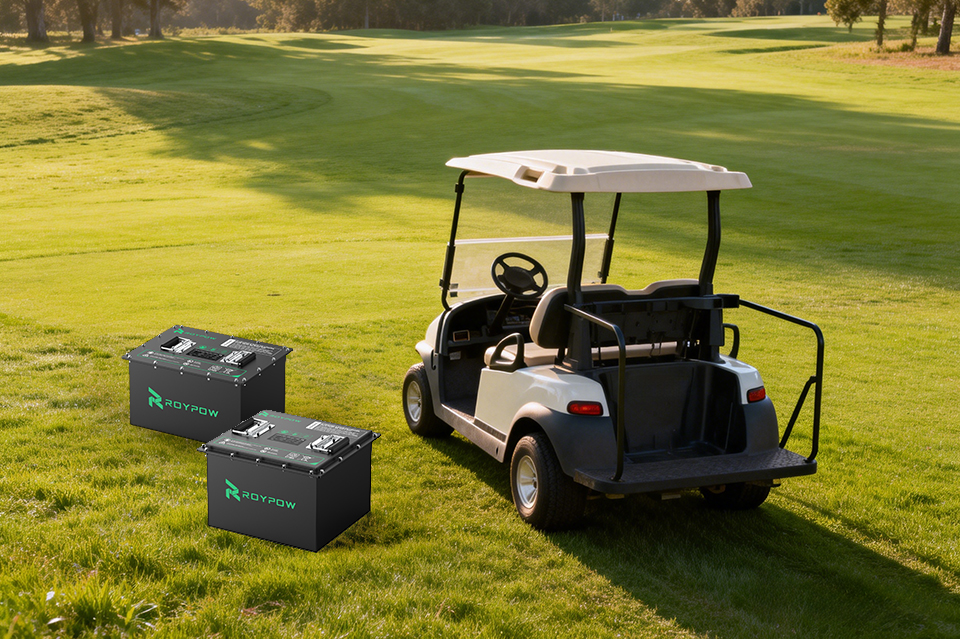
Key takeaways from this guide:
- Lead-acid loses power as it drains. Lithium holds flat voltage from hole 1 to hole 18
- Match your voltage first: 36V for older DS models, 48V for Precedent, Tempo, and Onward
- The OBC bypass is mandatory on most 48V Club Car models when switching to lithium
- CAN-bus compatibility is non-negotiable on factory lithium Tempo, Onward, and 2018+ models
- A 105Ah pack covers most owners. Go 160Ah+ for hills, accessories, or heavy daily use
- Lithium costs more upfront but runs 30-50% cheaper over a 10-year window
- Always use a lithium-specific charger. Your existing lead-acid charger will cause damage
ROYPOW offers drop-in LiFePO4 Club Car batteries across 36V, 48V, and 72V configurations, with an intelligent BMS built for the communication demands of modern Club Car systems. If you want a conversion that works cleanly from day one, that’s where to start.
Frequently Asked Questions
Can you put lithium batteries in a Club Car?
Yes. Most Club Car models accept lithium as a drop-in replacement. Older models need an OBC bypass. Newer factory-lithium models require CAN-bus-compatible batteries.
What voltage battery does a Club Car use?
Most modern Club Cars use a 48V system. Older DS models may run 36V. Always confirm by counting batteries and multiplying the individual voltages before buying.
How long do Club Car lithium batteries last?
A quality LiFePO4 Club Car battery lasts 8-10 years or 3,000-5,000+ charge cycles, significantly outlasting lead-acid packs under the same conditions.
Do I need a new charger for a lithium Club Car conversion?
Yes. A lithium-specific charger is mandatory. Your existing lead-acid charger uses an incompatible charge profile that can damage lithium cells or trigger BMS lockout.
Is lithium worth it for a Club Car golf cart?
For regular users, yes. Higher upfront cost is offset within 3-5 years through eliminated maintenance, fewer replacements, and better performance across every metric.