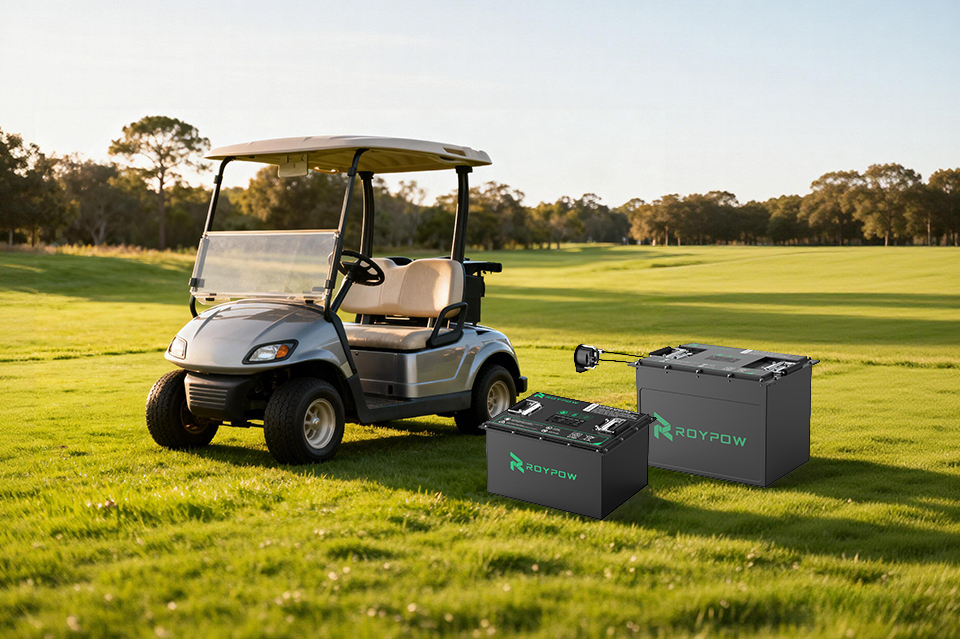
At -30°C, your forklift battery isn’t just slowing down. It’s quietly bleeding capacity, skipping charges, and pushing your operation toward unplanned downtime at the worst possible moment. Most operations find this out the hard way, mid-shift, with a loaded pallet and nowhere to go. The fix isn’t working around your battery. It’s choosing one actually built for the freeze.
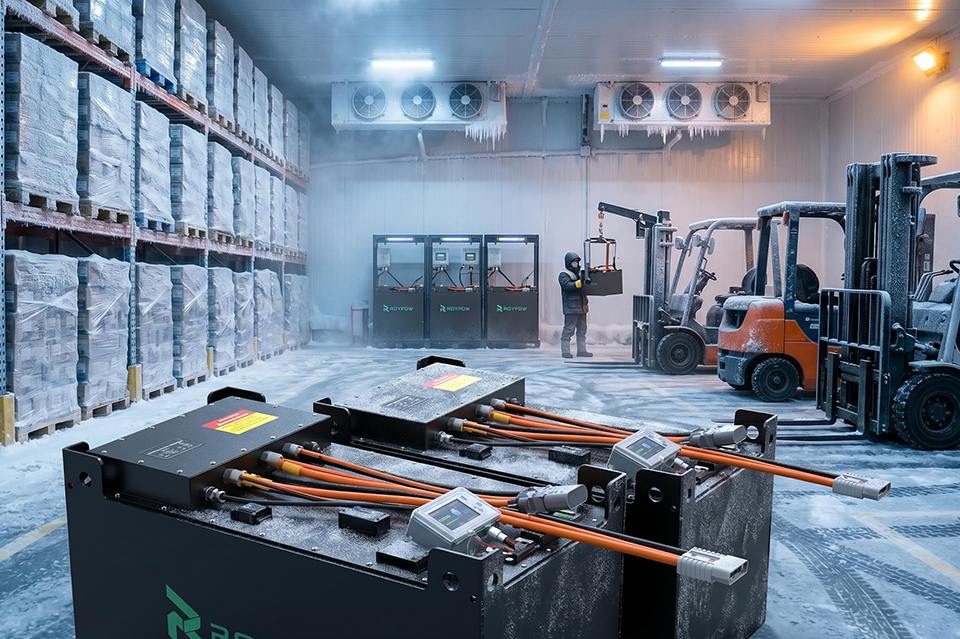
This guide breaks down everything you need to run a cold storage operation without letting battery failure call the shots.
Here’s what we’ll cover:
- Why standard forklift batteries fail in freezer environments
- How antifreeze and self-heating battery technology actually works
- Key specs to look for in a cold storage forklift battery
- TCO breakdown: what switching to lithium actually saves you
- How IP67 protection and condensation control protect your fleet beyond just temperature
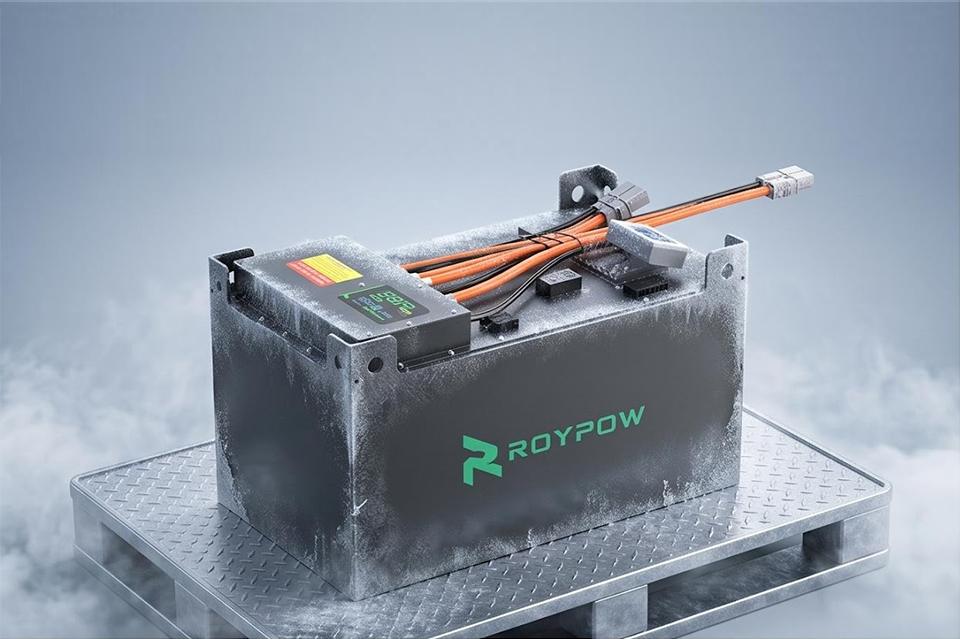
ROYPOW’s anti-freeze LiFePO4 forklift batteries are purpose-built for sub-zero warehouse operations, rated to -40°C with active self-heating and IP67 sealing. Worth knowing before you spec your next fleet upgrade.
Why Standard Batteries Fail in Freezers
Cold storage doesn’t just challenge your forklift battery. At the right temperature, it breaks it.
The core problem with lead-acid is chemistry. The sulfuric acid electrolyte that powers the cell becomes increasingly viscous as temperatures drop, slowing the ion movement that generates power. The result isn’t gradual. It’s a cliff.
|
Temperature |
Lead-Acid Capacity Remaining |
|
25°C (77°F) |
100% |
|
0°C (32°F) |
75% |
|
-10°C (14°F) |
~56% |
|
-20°C (-4°F) |
~45-50% |
|
-30°C (-22°F) |
Near unusable |
A battery rated for 8 hours at room temperature might deliver just 3-4 hours inside a freezer warehouse. That’s not a performance issue. That’s a shift planning crisis.
The cascading problems don’t stop there:
- Charging becomes dangerous. Cold lead-acid batteries can’t accept charge efficiently. Forcing a charge in sub-zero conditions accelerates sulfation, permanently hardening lead sulfate crystals onto the plates and destroying capacity that never returns.
- Batteries must leave the freezer to charge. That means pulling forklifts out of the work zone, dealing with condensation as they warm up, and managing a separate heated battery room. In a multi-shift operation, you’re often running two to three batteries per truck just to keep one truck moving.
- Lifespan collapses. Cold cycles hit lead-acid batteries harder than any other operating condition. What might last 3-5 years in a temperate warehouse can degrade in under 2 years in a -20°C environment.
Lithium iron phosphate (LiFePO4), by contrast, retains over 80% of its capacity even at deep-freeze temperatures, before any active heating technology is applied. The chemistry is fundamentally more stable. Add active thermal management on top, and cold storage stops being a battery problem at all.
For a broader look at how lithium reshapes forklift economics, the lithium vs lead-acid forklift battery breakdown on ROYPOW’s site is worth reading before you spec your next replacement.
How Antifreeze and Self-Heating Technology Works
“Antifreeze battery” isn’t just a marketing term. There’s real engineering behind it, and understanding it helps you evaluate which products are actually worth the investment.
Purpose-built cold storage lithium batteries tackle the temperature problem from two directions simultaneously: passive insulation and active heating.
Passive Insulation: The First Line of Defence
Every module in a properly engineered cold storage battery is wrapped in high-grade thermal insulation material, typically PE (polyethylene) insulation cotton. This acts as a thermal barrier, slowing heat loss during operation and preventing the cells from cooling too rapidly during stationary periods.
The heat generated naturally during normal discharge helps maintain cell temperature from within. In moderate cold (-5°C to -15°C), this alone is often enough to sustain safe operating temperatures between charges.
Active Self-Heating: The Critical Mechanism
For deep-freeze environments (-20°C and below), passive insulation isn’t sufficient. This is where PTC (Positive Temperature Coefficient) heating plates come in.
Here’s how it works in ROYPOW’s anti-freeze LiFePO4 forklift batteries:
- The BMS continuously monitors module temperature in real time
- When any module drops below 5°C, the PTC heating element activates automatically
- The element draws energy from the charger (not the battery cells) to warm the module
- Heating continues until the module reaches 25°C, the optimal charging temperature
- Only then does the BMS permit charging to begin
This sequence matters. Charging a lithium cell below 0°C without pre-heating causes lithium plating, where lithium metal deposits on the anode instead of intercalating into it. That damage is irreversible. The self-heating function prevents it entirely, automatically, without any operator intervention.
Pro tip: When evaluating cold storage batteries, ask specifically whether the heating system runs off the charger or the battery cells. Charger-powered heating preserves usable capacity. Cell-powered heating quietly eats into your runtime.
The whole system runs silently in the background. Operators don’t need to manage it, wait for it, or remember to activate it. The battery handles its own thermal state and signals readiness when it’s safe to charge.
Key Specs for Cold Storage Batteries
Not all lithium batteries marketed for cold environments are built to the same standard. Here’s what to actually look for before committing.
Temperature Rating
This is the most obvious spec, but the wording matters. Look for:
- Operating temperature (discharging): Should be rated to at least -20°C, with premium options covering -40°C
- Charging temperature: With active self-heating, the battery should be able to charge in situ inside the freezer, typically achievable down to -30°C with PTC heating
Avoid batteries that only list operating temperature without specifying the charging range. A battery that operates at -20°C but must be moved to a warm room to charge defeats the entire purpose.
IP Rating
This is non-negotiable for freezer environments. IP67 is the minimum standard you should accept.
|
IP Rating |
Protection Level |
|
IP54 |
Dust protected, splash resistant |
|
IP65 |
Dust tight, water jet resistant |
|
IP67 |
Dust tight, submersion to 1m for 30 minutes |
IP67 is the rating that matters in cold storage because of condensation. Every time a forklift moves between a freezer zone and an ambient corridor, moisture forms on every cold surface, including battery connectors, seals, and cable entries. An IP67 rating confirms the enclosure is fully sealed against this.
BMS Intelligence
The BMS in a cold storage application carries more responsibility than in a standard warehouse. It needs to:
- Monitor individual cell temperatures, not just pack temperature
- Activate heating selectively per module, not as a blunt whole-pack action
- Prevent charging below safe thresholds automatically
- Manage cell balancing across the full operating temperature range
ROYPOW’s intelligent BMS handles all of the above. It also enables real-time monitoring data, so fleet managers can track battery health, state of charge, and temperature status across the fleet without physically inspecting each unit.
For more on the industrial lithium batteries, the 5 essential features of ROYPOW LiFePO4 forklift batteries post covers the full picture.
TCO Breakdown: What Switching Actually Saves
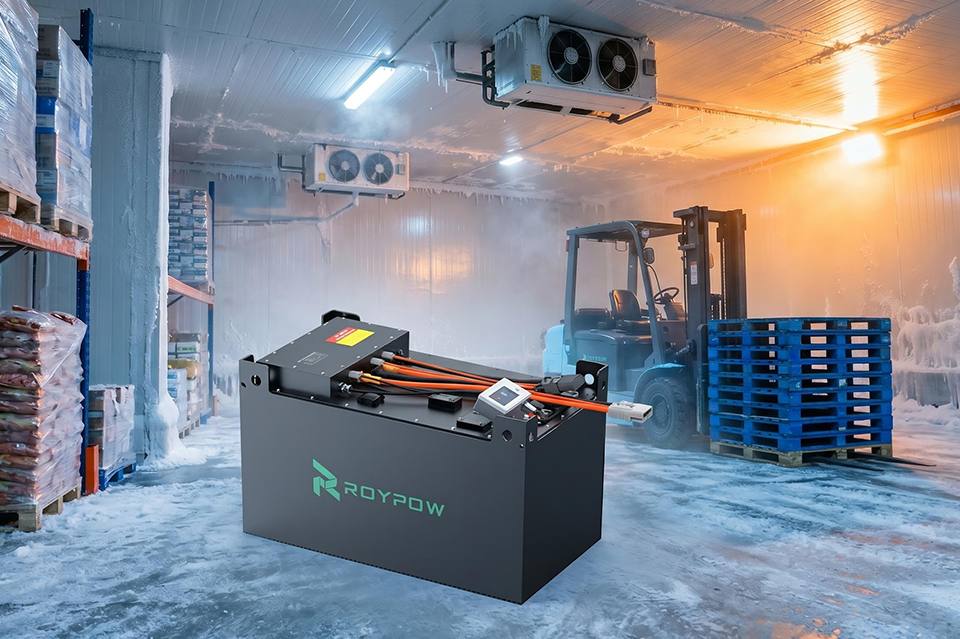
The upfront price difference between lithium and lead-acid cold storage batteries is real. What most operations underestimate is how fast that gap closes, and how sharply lithium pulls ahead over a 5-year horizon.
Cold storage is where the TCO case for lithium is strongest, because every weakness of lead-acid is amplified by the environment.
The True Cost Drivers in Cold Storage
The cost drivers are:
1. Battery multiplication
In a multi-shift cold storage operation, a single lead-acid battery can’t run a full shift and recharge in time for the next. Operations typically need 2-3 batteries per forklift. That’s 2-3x the purchase cost, 2-3x the maintenance, and dedicated space for a heated battery room.
A single lithium battery supports opportunity charging between shifts, in the freezer, without removal. One battery per truck.
2. Maintenance labor
Lead-acid batteries in cold storage require watering checks, terminal cleaning, equalization charges, and more frequent inspection because the cold accelerates degradation. That labor cost adds up fast across a fleet.
Lithium is zero-maintenance. No watering. No acid. No terminal corrosion.
3. Energy waste
Lithium converts roughly 95% of charge energy into usable work. Lead-acid sits at around 70% or less, with efficiency dropping further in cold conditions. For a fleet running three shifts, the electricity cost difference is measurable on a monthly basis.
4. Lifespan gap
|
Factor |
Lead-Acid (Cold Storage) |
Lithium (Cold Storage) |
|
Cycle life |
300-500 cycles |
2,000-4,500+ cycles |
|
Operational lifespan |
1.5-3 years |
5-10 years |
|
Batteries per truck |
2-3 |
1 |
|
Maintenance |
Weekly |
Near zero |
|
Charging location |
Heated battery room |
In-freezer |
|
Energy efficiency |
~70% |
~95% |
5. Downtime cost
Unplanned forklift downtime in a cold storage operation can cost thousands per hour when you factor in labor, order delays, and cold chain compliance risk. A battery that dies mid-shift because it couldn’t handle the temperature isn’t just inconvenient. It’s a supply chain event.
Over a 5-10 year window, high-utilisation fleets that make the switch to lithium consistently see TCO reductions of 30-50%. For a 10-truck fleet, that routinely exceeds $50,000 in savings.
For a deeper breakdown of the economics behind forklift battery ownership, see ROYPOW’s analysis in why the forklift battery price is not the true cost. The numbers are built for exactly this conversation.
IP67 and Condensation Control: Beyond Temperature
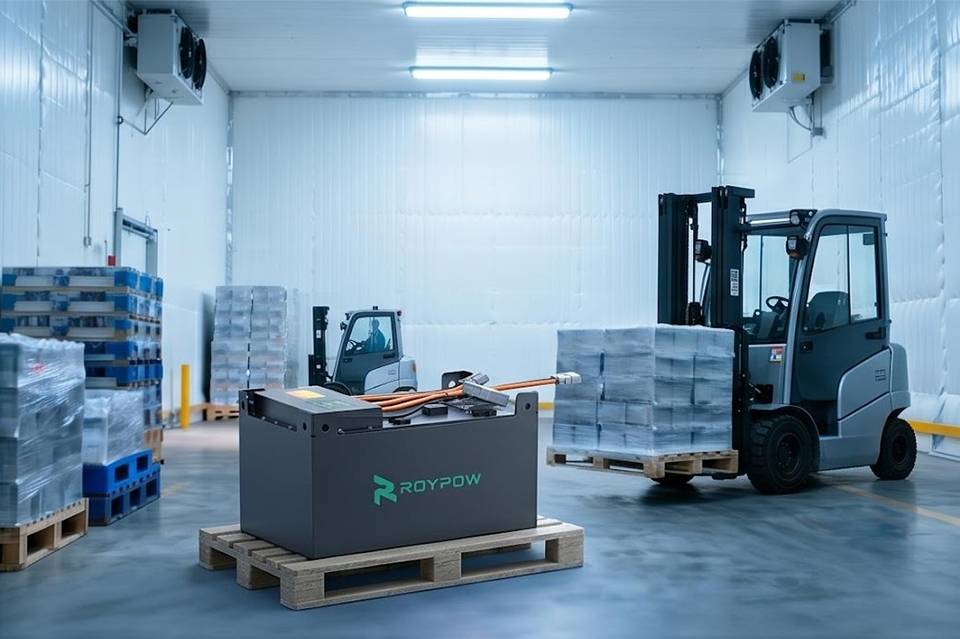
Temperature gets all the attention in cold storage battery discussions. Condensation quietly causes just as much damage. Often more.
Here’s the physics: when a forklift moves from a -25°C freezer into a 20°C loading corridor, every cold surface on the battery instantly becomes a condensation target. Moisture forms on connectors, seeps into cable glands, settles on circuit boards, and then refreezes when the truck returns to the cold zone. Repeat this dozens of times per shift, and you have a corrosion and short-circuit problem that builds invisibly until something fails.
Standard batteries, even sealed ones, aren’t designed for this. The thermal cycling between extreme cold and ambient temperatures creates pressure differentials that pull moisture into gaps in the enclosure that appear perfectly sealed at room temperature.
What a Proper Cold Storage Battery Does Differently
- IP67 enclosure with reinforced cable glands: ROYPOW’s anti-freeze batteries use reinforced waterproof cable glands with built-in sealing rings on all charging and discharging plugs. These are tested beyond standard IP67 requirements, with strict airtightness verification before leaving the production line. External water vapor, ice melt, and high-pressure cleaning jets don’t reach the internals.
- Internal silica gel desiccants: This is the detail most competitors skip. Even a perfectly sealed outer enclosure can trap residual moisture inside during assembly. ROYPOW places silica gel desiccants inside each battery box specifically to absorb any internal moisture that may accumulate during temperature cycling. The result is a dry internal environment, confirmed through post-test inspection of circuit boards and cell surfaces.
- Why this matters for fleet longevity: A battery that handles -40°C but fails at 18 months due to condensation-related connector corrosion is not a cold storage solution. It’s a temporary one. True cold storage battery engineering addresses temperature and moisture simultaneously.
This layered approach, insulation, active heating, IP67 sealing, and internal desiccants, is exactly what separates purpose-built cold storage batteries from standard lithium batteries relabelled for cold environments.
For operations running 24V forklifts, 48V systems, or 80V heavy-duty fleets, ROYPOW’s anti-freeze range covers every voltage platform with the same IP67 and condensation-control engineering built in as standard.
Keep Your Cold Chain Moving With ROYPOW
Cold storage operations can’t afford a battery that taps out when temperatures drop. The right lithium solution doesn’t just survive the freeze. It performs through it, shift after shift, without pulling trucks out, without swapping packs, and without the maintenance spiral that lead-acid brings.
Key takeaways from this guide:
- Lead-acid loses up to 50% capacity at -20°C. That’s a shift planning problem, not just a performance dip
- Self-heating PTC technology warms cells to 25°C before charging begins, preventing irreversible lithium plating
- IP67 is the minimum rating worth considering. Anything less is a condensation risk
- Internal silica gel desiccants protect against moisture that IP seals alone can’t catch
- One lithium battery per truck replaces two to three lead-acid packs in multi-shift operations
- TCO savings of 30-50% over 5-10 years are realistic for high-utilisation cold storage fleets
ROYPOW’s anti-freeze LiFePO4 forklift battery is purpose-engineered for exactly these conditions, rated to -40°C, IP67 sealed, self-heating, and available across 24V, 48V, and 80V platforms. If your operation runs in the cold, it’s the battery built to match.
Frequently Asked Questions
What is the best battery for cold storage forklifts?
LiFePO4 lithium batteries with active self-heating and IP67 protection are the best choice, maintaining performance reliably in temperatures as low as -40°C.
Can lithium forklift batteries charge inside a freezer?
Yes. Batteries with PTC self-heating technology warm cells to a safe temperature before charging begins, eliminating the need to leave the freezer.
How much capacity do forklift batteries lose in cold storage?
Lead-acid batteries lose 50% or more capacity at -20°C. Quality LiFePO4 batteries retain over 80% capacity at the same temperature.
What does IP67 mean for a forklift battery?
IP67 means the battery is fully sealed against dust and protected against water immersion, critical protection against condensation in freezer warehouse environments.
How long do lithium forklift batteries last in cold storage?
A quality LiFePO4 cold storage battery lasts 5-10 years in multi-shift operations, delivering 2,000-4,500+ cycles despite continuous low-temperature exposure.