Content reviewed and updated: April 2026
A distribution center manager in suburban Atlanta recently discovered that his fleet of twelve Yale ERC counterbalance trucks was burning through nearly $9,000 per month in battery-related costs that never appeared on a single line item — scattered across watering labor, energy waste from inefficient charging, spare pack inventory carrying costs, and unscheduled downtime from aging lead-acid cells. His situation is not unusual. Across warehouses, 3PL hubs, and manufacturing plants worldwide, Yale forklift batteries represent a hidden operational cost center that most fleet operators dramatically underestimate. This guide delivers the complete technical, financial, and strategic framework for understanding your Yale battery options and executing a lithium upgrade that delivers measurable returns — whether you are an end-user fleet manager, aftermarket battery distributor, dealer, or channel partner evaluating this fast-growing market segment.
Yale Electric Forklifts: Product Range and Battery Architecture
Yale Materials Handling Corporation operates under the Hyster-Yale Group (NYSE: HY), a top-five global forklift manufacturer with combined annual revenues exceeding $4 billion based on published financial reports. Where Hyster has traditionally skewed toward heavy-duty industrial applications, Yale has carved its identity in warehouse and distribution environments — food and beverage, e-commerce fulfillment, third-party logistics, pharmaceutical distribution, and general manufacturing. According to data from the International Truck Association (ITA) and World Industrial Truck Statistics (WITS), electric forklifts now represent over 60% of total global forklift shipments, and Yale’s electric-forward product strategy positions it squarely in this growth corridor. For the aftermarket battery industry, Yale’s substantial installed base across North America, Europe, and Asia-Pacific creates a deep and expanding demand pool for Yale forklift batteries — particularly as legacy lead-acid fleets age into replacement cycles.
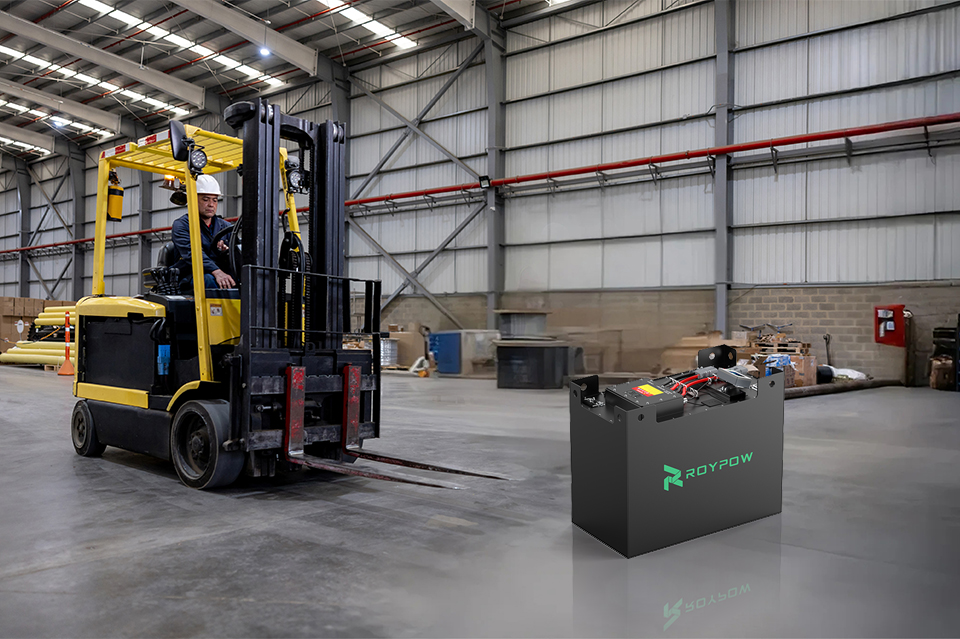
Yale’s electric product range spans three primary equipment categories, each with distinct battery architecture. The ERC series electric counterbalance trucks — Yale’s flagship sit-down riders — cover the 1.5 to 5.0 tonne range (approximately 3,000 to 10,000 lbs). The ERC050VG and ERC080VH models are workhorses of North American warehouse operations, typically running 36V and 48V platforms respectively. Yale’s warehouse equipment includes the MR series reach trucks (48V platform, designed for narrow-aisle high-rack operations), the MP series pallet trucks and end riders (24V platform), and the MO/OS series order pickers (24V to 36V). The heavier ERP series, more prevalent in European markets, uses 48V to 80V platforms depending on capacity and configuration.
The battery compartment ecosystem for Yale trucks follows clear regional lines. North American Yale forklifts predominantly use BCI-standard (Battery Council International) battery trays with SB-type connectors — SB175 for lighter trucks, SB350 for higher-current counterbalance models. European Yale models ship with DIN-standard compartments and Rema DIN connectors. The critical detail for anyone sourcing Yale forklift batteries is that the same Yale model designation can ship with different compartment dimensions and connectors depending on the production region, making physical measurement essential. Yale’s factory battery offering has historically been flooded lead-acid, though the Hyster-Yale Group has been expanding its own lithium program. However, like most major forklift OEMs, the factory lithium catalog does not yet cover every Yale model, every capacity configuration, or every geographic market — creating significant aftermarket opportunity.
Yale’s customer base generates differentiated battery demands. A single-shift pharmaceutical warehouse running Yale MR reach trucks needs moderate capacity and clean operation. A two-shift e-commerce fulfillment center with Yale ERC counterbalance trucks needs extended runtime and fast recharging. A three-shift cold-chain distribution facility needs all of that plus extreme-temperature performance. Each scenario drives different specifications when selecting replacement forklift batteries — a complexity that well-informed dealers and distributors can turn into a competitive advantage.
Operational Battery Challenges Unique to Yale Forklift Users
The pain points of lead-acid power in Yale forklift operations are not theoretical — they compound daily into measurable costs and operational friction that fleet managers learn to tolerate rather than solve. Understanding these challenges within the specific context of Yale forklift batteries illuminates why the lithium conversion conversation has moved from “interesting idea” to “budget line item” for so many Yale fleet operators.
Maintenance labor is the most underestimated cost category. Each flooded lead-acid battery in a Yale ERC or MR series truck requires deionized water every 5 to 10 charge cycles — and forgetting even once accelerates irreversible plate sulfation. Equalization charging, a controlled overcharge necessary every one to four weeks to rebalance cell voltages, takes 8 to 16 hours and removes the battery from service entirely. Add terminal cleaning, specific gravity testing, acid spillage cleanup, and compartment corrosion repair, and industry estimates place total maintenance labor at 30 to 50 hours per battery per year. For a twelve-truck fleet, that amounts to 360 to 600 hours annually — the equivalent of a part-time technician dedicated solely to battery upkeep. Every hour spent on Yale forklift battery maintenance is an hour not spent on value-creating warehouse work.
The multi-shift bottleneck is especially acute for Yale’s core distribution and 3PL customer base, where two- and three-shift operations are common. The “8-8-8 rule” defines the constraint: 8 hours of operation, 8 hours of charging, and 8 hours of cooldown before a lead-acid pack is ready for reuse — making each battery unavailable for 16 of every 24 hours. Multi-shift Yale fleets therefore need two to three batteries per truck, plus the cranes, roller-bed extraction systems, chargers, and floor space to manage the swap cycle. Each swap event takes 15 to 30 minutes and involves moving packs weighing 500 to 2,300 kg (1,100–5,000 lbs), creating meaningful workplace injury risk. The capital tied up in spare batteries, extra chargers, and dedicated battery rooms often doubles the initial forklift battery investment.
Extreme environment performance loss is a growing concern as cold-chain logistics expand globally. Lead-acid batteries lose 20% to 40% of usable capacity in cold-storage environments at -10°C to -30°C (14°F to -22°F), dramatically shortening per-shift runtime for Yale trucks in freezer applications. High-temperature environments above 35°C (95°F) accelerate electrolyte evaporation and plate degradation. Dusty and humid industrial settings promote terminal corrosion and increase short-circuit risk. Lifecycle cost unpredictability rounds out the challenge: lead-acid packs lose 3% to 5% capacity annually, forcing a repair-versus-replace decision by year three or four that rarely comes at a convenient time. Safety and environmental compliance pressures — OSHA battery room ventilation requirements, lead and sulfuric acid handling regulations, and growing ESG reporting demands from major supply chain customers — add regulatory weight to these operational burdens.
To be clear, lead-acid remains a functional and economically reasonable choice for single-shift, low-intensity Yale operations where maintenance infrastructure is already established and upfront cost is the primary constraint. But for the multi-shift, high-throughput distribution environments where Yale trucks are most commonly deployed, these pain points create a compelling case for exploring alternative forklift battery technologies.
Lithium vs Lead-Acid: A Side-by-Side for Yale Forklifts
The decision between lead-acid and lithium iron phosphate (LiFePO4) technology for Yale forklift batteries involves seven core technical dimensions. This comparison is structured so that both technical fleet engineers and non-technical procurement managers can clearly understand the trade-offs when evaluating forklift power solutions for Yale trucks.
Energy density defines how much energy a battery stores per kilogram. Lead-acid achieves approximately 30 to 50 Wh/kg, while LiFePO4 lithium delivers roughly 100 to 160 Wh/kg — approximately three times the energy per unit weight. In forklift applications, this weight difference creates a counterbalancing consideration: Yale counterbalance trucks rely on battery mass as rear ballast, so quality lithium packs incorporate integrated steel ballast to match original lead-acid weight and maintain rated load capacity.
Cycle life — the number of full charge-discharge cycles before the battery degrades to 80% of original capacity — is where the economic divergence begins. Lead-acid delivers 1,000 to 1,500 cycles at 80% depth of discharge (DOD). High-quality LiFePO4 packs achieve 3,500 or more cycles. In calendar terms for a single-shift Yale operation cycling once daily: lead-acid lasts 3 to 5 years, lithium lasts 8 to 10 years or more. The implications for replacement cost and disposal logistics are substantial.
Charging efficiency and operational continuity represent the most immediately felt advantages of a lithium Yale battery upgrade. Lead-acid charges at 80% to 85% round-trip efficiency, wasting 15% to 20% of input electricity as heat. Lithium achieves 95% to 98% efficiency. More operationally significant, lithium supports opportunity charging — brief top-ups during breaks or shift changes with no damage to cell chemistry — and completes a full charge in 1 to 2 hours. One lithium pack can replace two to three lead-acid packs in multi-shift Yale operations, eliminating the entire swap infrastructure.
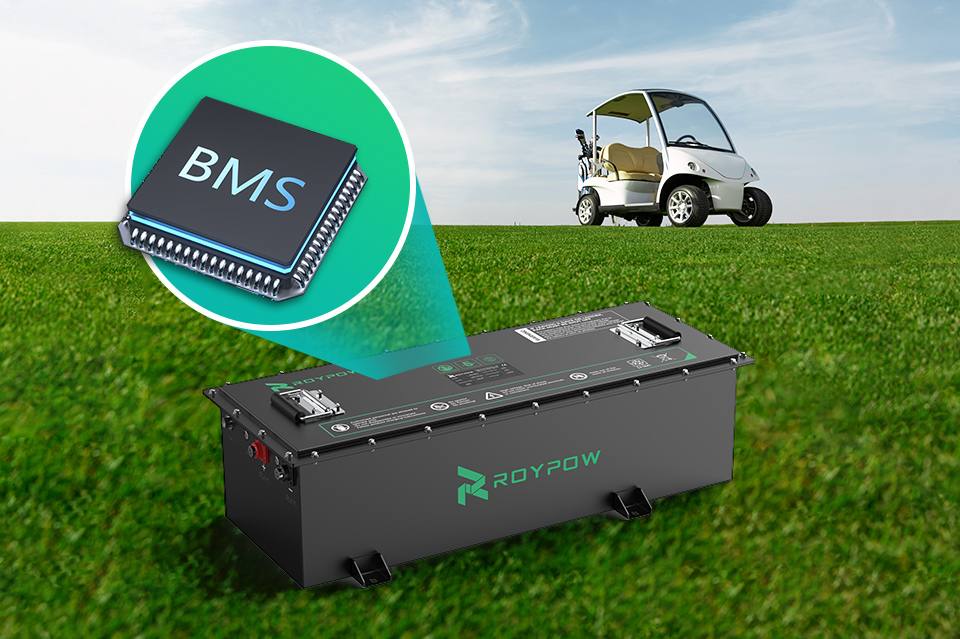
Maintenance requirements diverge completely between the two chemistries. Lead-acid demands regular watering, periodic equalization charges, terminal cleaning, specific gravity testing, and ventilated charging areas. Lithium forklift batteries require zero routine maintenance — the built-in battery management system (BMS) handles cell balancing, thermal monitoring, and charge optimization automatically.
Safety profiles are different in character. Lead-acid generates flammable hydrogen gas during charging, contains corrosive sulfuric acid, and exposes workers to toxic lead compounds. Lithium’s theoretical risk — thermal runaway — is managed through multi-layer protection in quality packs: cell-level safety valves, module-level thermal isolation, pack-level BMS with continuous monitoring, and active cooling systems. LiFePO4 chemistry is inherently more thermally stable than other lithium chemistries.
Temperature range performance is critical for Yale’s cold-chain customer base. Lead-acid performs optimally at 25°C (77°F) and loses 20% to 40% of capacity below 0°C. Lithium batteries with optional integrated heating modules maintain reliable operation at -20°C to -30°C (-4°F to -22°F), preserving over 80% usable capacity in environments where lead-acid becomes marginal.
Environmental impact increasingly influences Yale fleet procurement. Lead-acid contains hazardous lead and sulfuric acid; while 99% recyclable, the process carries environmental costs. Lithium eliminates workplace lead and acid exposure, produces zero hydrogen emissions during charging, and the recycling infrastructure for LiFePO4 cells continues to scale globally.
Yale Forklift Batteries: Lead-Acid vs Lithium Comparison Table
| Dimension | Flooded Lead-Acid | Lithium LiFePO4 |
|---|---|---|
| Energy Density | 30–50 Wh/kg | 100–160 Wh/kg |
| Cycle Life (80% DOD) | 1,000–1,500 cycles | 3,500+ cycles |
| Design Life | 3–5 years | 8–10+ years |
| Charge Time | 8 hrs + 8 hrs cooling | 1–2 hrs; opportunity charging OK |
| Round-Trip Efficiency | 80–85% | 95–98% |
| Usable DOD | ≤80% recommended | 80–100% |
| Maintenance | Watering, equalization, terminal cleaning | Zero — BMS-managed |
| Operating Temp Range | Optimal 25°C; degrades below 0°C | -20°C to 55°C with heating/cooling |
| Safety Hazards | H₂ gas, acid spills, lead toxicity | Managed by BMS + thermal isolation |
| Workplace Emissions | Hydrogen gas, acid mist | None |
| Environmental Impact | Lead + H₂SO₄; recycling has costs | No hazardous materials; growing recycling |
In summary, lithium delivers an overwhelming lifecycle advantage for multi-shift, high-utilization, and cold-storage Yale forklift operations — which represent the majority of Yale’s distribution-focused installed base. Lead-acid still holds a rational position for low-use, single-shift operations where upfront budget is the primary constraint and maintenance infrastructure already exists. For distributors and dealers advising Yale fleet customers, this comparison framework provides the data foundation for informed conversations about forklift battery strategy.
Brand-Supplied vs Aftermarket Battery Options for Yale Fleets
Understanding the two primary procurement paths for Yale forklift batteries — brand-supplied (OEM) and aftermarket — is essential for making a sourcing decision that aligns with your fleet’s operational and financial priorities. Both paths have legitimate advantages, and the right choice depends on fleet size, brand diversity, budget, and service requirements.
Brand-supplied batteries come through Yale’s authorized dealer network. They may be manufactured internally by the Hyster-Yale Group or sourced from a designated supplier and sold under the Yale brand. OEM batteries offer guaranteed compartment compatibility, straightforward warranty claims through a single vendor, and integration with Yale’s proprietary fleet management systems. The trade-off is cost: industry estimates place OEM lithium forklift battery pricing at a 30% to 60% premium over comparable aftermarket alternatives. A 48V OEM lithium pack for a Yale ERC model may range from $15,000 to $25,000, versus $8,000 to $16,000 from a qualified aftermarket source. OEM catalogs typically offer only one or two capacity configurations per model, and availability varies by market — not every Yale model in every region has an OEM lithium option today. For operations running mixed fleets of Yale plus other forklift brands, the OEM path means managing separate vendor relationships for each brand.
Aftermarket batteries are manufactured by independent, specialized companies that engineer compatible replacement products matching Yale forklift specifications. The aftermarket model is a mature, respected segment of the industrial equipment industry — the same procurement approach used across automotive, heavy truck, and construction equipment sectors globally. “Aftermarket” denotes the distribution channel, not the quality tier. Leading aftermarket forklift battery manufacturers hold the same certifications as OEM suppliers — UL, CE, ISO — and often offer broader product diversity including standard, air-cooled, liquid-cooled, anti-freeze, and explosion-proof variants that may not be available through the Yale OEM channel. Cost savings of 30% to 50% are typical, and one aftermarket supplier can serve an entire mixed-brand fleet.
Key considerations when choosing the aftermarket path include verifying physical and electrical compatibility for each specific Yale model, selecting a supplier with recognized certifications for your market (UL in North America, CE in Europe), confirming that aftermarket installation does not void the Yale forklift warranty (under the US Magnuson-Moss Warranty Act and similar EU regulations, it generally does not), and evaluating the supplier’s service network in your operating region. The strongest aftermarket manufacturers offer dual BCI and DIN standard coverage, pre-installed connectors matched to the target forklift, customizable ballast weight configurations, and global technical support — characteristics that signal a manufacturer operating at serious industrial scale.
A practical decision framework emerges from fleet profile analysis. Small, single-brand Yale fleets (under five trucks) may find OEM simplicity worthwhile despite the price premium. Large fleets, mixed-brand operations combining Yale and Hyster (sister brand under the same group) alongside other makes, budget-sensitive organizations, and those needing specialty battery configurations for cold storage or hazardous environments will consistently find stronger value and flexibility in the aftermarket path. For dealers and distributors, the aftermarket channel offers a differentiated, margin-rich product line that complements rather than competes with forklift sales.
Key Parameters When Selecting Lithium Batteries for Yale Models
Matching the right lithium battery to a specific Yale forklift requires precision across eight technical parameters. A mismatch on any critical dimension — voltage, physical size, connector — creates an installation failure. Getting it right produces a drop-in replacement that works seamlessly from day one. This section enables distributors, dealers, and fleet engineers to compile a complete Yale forklift battery specification sheet for supplier communication.
Voltage platform must match exactly. Yale’s electric lineup uses four primary voltage platforms: 24V for MP-series pallet trucks and walkie equipment, 36V for select ERC counterbalance models (ERC050VG commonly runs 36V in North America), 48V for ERP-series counterbalance trucks and MR-series reach trucks, and 80V for the largest ERC models (ERC080VH and above). Installing an incorrect voltage will damage the forklift controller and motor.
Physical size and battery compartment standard determine whether the pack fits the Yale truck. BCI-standard trays dominate in North America; DIN-standard trays are used in Europe. Always measure the actual battery compartment interior — length, width, and height in millimeters — because production year, optional equipment, and regional configuration create dimensional variations. Do not assume based on model number alone.
Capacity calculation ensures adequate per-shift runtime. Multiply daily working hours by the truck’s average energy consumption rate (kWh/hour), then apply a safety factor of 1.1 to 1.2. Because lithium batteries support 80% to 100% usable DOD versus a practical maximum of 80% for lead-acid, a lithium pack with a lower Ah rating can deliver equivalent or greater runtime — a 460 Ah lithium, for example, can match a 560 Ah lead-acid in real-world Yale operations.
Discharge connector must match the forklift’s receptacle precisely. Yale trucks in North America use SB-series connectors (SB175 for lighter trucks, SB350 for counterbalance models). European models use Rema DIN connectors. Quality aftermarket suppliers pre-install the specified connector. Manufacturers like ROYPOW pre-configure connectors to match the customer’s exact Yale model and regional specification.
Ballast weight is critical for Yale counterbalance trucks. Lithium packs weigh roughly one-third to one-half of equivalent lead-acid packs, but counterbalance forklifts rely on battery mass as rear counterweight for load stability. Solutions include integrated steel ballast within the battery enclosure or external ballast blocks. ROYPOW offers customizable ballast configurations engineered to match original Yale lead-acid weight, maintaining rated load capacity and tip-over safety margins.
BMS communication via CAN bus protocol allows the lithium battery to transmit state-of-charge (SOC), temperature data, and fault codes to the Yale forklift’s onboard display. Not all Yale models require CAN bus integration — many operate effectively with the battery’s own built-in display panel showing SOC, voltage, temperature, and alerts. ROYPOW batteries feature both CAN bus communication and an integrated display panel, supporting either configuration.
Charger compatibility is non-negotiable: lead-acid chargers cannot safely charge lithium batteries. A dedicated lithium forklift charger must be specified to match the battery’s voltage, capacity, and charging protocol. Key specs include output voltage, charging power in kilowatts, and facility input power requirements — especially important when deploying multiple fast chargers across a large fleet.
Special environment needs drive variant selection. Yale trucks in cold storage need heated anti-freeze batteries rated for -20°C or lower — ROYPOW offers a heated low-temperature model rated for -20°C to 55°C. Hazardous-area applications require ATEX or IECEx certified explosion-proof batteries. High-throughput or high-ambient-temperature operations may benefit from liquid-cooled variants.
Yale Forklift Battery Specification Checklist
| Parameter | What to Specify | Yale-Specific Notes |
|---|---|---|
| Voltage | Exact system voltage (24V/36V/48V/80V) | ERC050VG = 36V; MR reach = 48V; ERC080VH = 36V/80V; MP pallet = 24V |
| Compartment Dimensions | Actual L × W × H (mm) | BCI (N. America) vs DIN (Europe); always measure |
| Capacity (kWh) | Shift hours × consumption × 1.15 safety factor | Lithium 80–100% DOD allows downsizing vs lead-acid |
| Connector | Exact type and amperage | SB175/SB350 (N. America) or Rema DIN (Europe) |
| Ballast Weight | Target weight matching original lead-acid | Critical for counterbalance ERC and ERP series |
| BMS Communication | CAN bus or standalone display | Verify Yale model dashboard compatibility |
| Charger | Dedicated lithium charger (voltage, kW, protocol) | Replace lead-acid charger — required for safety |
| Special Features | Anti-freeze / explosion-proof / liquid-cooled | Specify operating temp range and hazard classification |
Evaluating Top Lithium Battery Manufacturers for Yale Trucks
The aftermarket lithium forklift battery sector has evolved rapidly from a fragmented collection of regional startups into a competitive global industry where differentiation hinges on product breadth, certifications, manufacturing scale, and — critically for Yale fleet operators and their dealer networks — global service infrastructure. Selecting the right supplier for Yale forklift batteries requires evaluating multiple dimensions beyond unit price. The following profiles cover leading manufacturers active in Yale-relevant markets.
ROYPOW Technology
ROYPOW, headquartered in Huizhou, China, has established itself as the global leader in aftermarket lithium forklift batteries since its founding in 2016, building on more than two decades of new-energy industry experience. The company reported revenue exceeding $140 million in 2025 and operates from a 105,000 m (1.13 million sq ft) manufacturing campus with over 750 employees, 190+ patents, and fully automated production lines certified to IATF16949 automotive quality standards. A CNAS-accredited laboratory with 200+ pieces of precision test equipment ensures rigorous quality control across every production batch.
ROYPOW’s product range — 24V to 350V across both BCI and DIN standards — is among the broadest in the aftermarket segment. Available configurations include Standard, UL Certified, DIN Standard, Air-Cooled, Liquid-Cooled, Anti-Freeze (-20°C to 55°C), and Explosion-Proof variants. Core specifications include 3,500+ cycle life, approximately 10-year design life, 5-year warranty, IP65 ingress protection, 1–2 hour fast charging, and an intelligent BMS featuring CAN bus integration, real-time monitoring, remote diagnostics via 4G mobile app, and over-the-air (OTA) firmware updates.
ROYPOW’s most significant competitive differentiator is its global service network — an essential factor for Yale fleet operators and distributors across international markets. The company maintains 13+ offices worldwide: US locations in Commerce CA (Americas HQ), Richardson TX, Indianapolis IN, Altamonte Springs FL, and Kennesaw GA, with a US service hotline at +1 877 266 1118. European headquarters in Rotterdam, Netherlands, with additional offices in Surbiton, UK, and Darmstadt, Germany. Asia-Pacific operations in Chiba, Japan, Gyeonggi-do, South Korea, and a second manufacturing facility in Batam, Indonesia. Additional offices serve the Middle East (Erbil, Iraq), Africa (Johannesburg, South Africa), South America (Brazil), and Oceania (Sydney, Australia).
Certifications include UL, CE, UN38.3, RoHS, CCS, ISO, IEC, and CNAS lab accreditation. ROYPOW also produces compatible forklift chargers across multiple voltage platforms. Verified Yale compatibility spans 55 documented models, including the ERC050VG (ROYPOW battery models F36690BA, F36942D), ERC080VH (F36840BG), MRW030 (F24560T), ERP18VT (F48560BG), and ERC050 (F48560EJ) — covering Yale’s 24V, 36V, and 48V platforms. Compatibility extends to Hyster (Yale’s sister brand, 86 models), Toyota, Crown, Linde, and all other major forklift brands, making ROYPOW a single-source solution for mixed-fleet operators. Case studies and additional information are available at ROYPOW’s case library and FAQ page.
EnerSys (NexSys iON)
EnerSys, headquartered in Reading, Pennsylvania, is one of the world’s largest industrial battery manufacturers. Its NexSys iON lithium product line targets the forklift market alongside its established NexSys PURE (TPPL) offerings. EnerSys benefits from deep OEM relationships and an extensive legacy service infrastructure across North America and Europe. Products carry UL and CE certifications. Pricing reflects EnerSys’s premium market positioning, and its primary strength lies in serving existing EnerSys lead-acid customers transitioning to lithium within established service agreements.
OneCharge
OneCharge, based in Irvine, California, specializes exclusively in lithium batteries for forklifts and material handling equipment. The company offers models across 24V to 80V platforms and claims compatibility with dozens of forklift brands including Yale. OneCharge holds UL 2580 certification for key products and focuses primarily on the North American market with US-based assembly. Its concentrated focus on material handling has built a solid reputation in the domestic 3PL and distribution sector, though international service coverage remains limited compared to global suppliers.
Green Cubes Technology
Green Cubes Technology serves both the material handling and aviation ground support sectors from operations in the US and Europe. The company has developed Yale-compatible lithium products and holds relevant UL and CE certifications. Green Cubes targets mid-to-large enterprise customers and has been building its European presence. Its dual-market footprint (North America and EU) offers geographic coverage for Yale fleets operating transatlantically.
Yale Forklift Batteries: Supplier Comparison Table
| Criteria | ROYPOW | EnerSys | OneCharge | Green Cubes |
|---|---|---|---|---|
| Voltage Range | 24V–350V | 24V–80V | 24V–80V | 24V–80V |
| BCI + DIN Coverage | Both | Both | BCI primary | Both |
| UL Certification | Yes | Yes | Yes | Yes |
| Global Service Offices | 13+ countries | Multi-country | US only | US + EU |
| Product Variants | 7 types (incl. anti-freeze, explosion-proof) | Standard + TPPL | Standard, cold-rated | Standard |
| Cycle Life | 3,500+ | 2,000–3,000+ | 3,000+ | 2,500+ |
| Warranty | 5 years | 3–5 years | 5 years | Varies |
| Compatible Charger Line | Yes, multi-voltage | Yes | Limited | Limited |
| Remote Monitoring | 4G app + OTA | Available | Available | Available |
| Yale Models Verified | 55 models | Multiple | Multiple | Multiple |
When selecting a supplier for Yale forklift batteries, confirm model-specific compatibility with your exact Yale trucks, prioritize suppliers with service and inventory presence in your operating region, verify availability of specialty variants for your environments, request reference customers in similar applications, and compare total solution cost — battery, charger, installation support, and ongoing service included.
ROI and Payback Analysis: Upgrading Yale Forklift Batteries
The financial case for upgrading Yale forklift batteries to lithium technology rests on total cost of ownership (TCO), not purchase price. While lithium’s higher acquisition cost dominates initial budget discussions, comprehensive TCO modeling consistently shows that upfront investment represents only 25% to 35% of the true long-term Yale forklift battery expense in multi-shift operations. This section provides a methodology that fleet managers — or their CFOs — can adapt to their specific Yale fleet parameters.
Seven cost elements constitute the complete TCO framework: initial purchase (battery + charger + installation), energy costs over the analysis period (driven by charging efficiency differences), maintenance labor, infrastructure costs (battery room, ventilation, swap equipment), productivity loss from battery swap downtime, battery replacement within the analysis period, and end-of-life disposal. Omitting any category — especially infrastructure and productivity loss — systematically favors lead-acid in ways that don’t reflect real operational costs.
Consider a scenario representative of Yale’s core distribution-center customer profile: ten Yale ERC-series 36V counterbalance forklifts operating double shifts (16 hours/day, 300 operating days/year) over an eight-year analysis period. Based on specifications from major manufacturers such as ROYPOW, lithium batteries offer 3,500+ cycle life and a 5-year warranty, comfortably spanning the analysis period without replacement. Lead-acid batteries require replacement at year three to four.
Eight-Year TCO: Yale Forklift Batteries (10 Trucks, 36V, Double Shift)
| Cost Element | Lead-Acid (8 Years) | Lithium (8 Years) |
|---|---|---|
| Battery Purchase | $72,000 + $72,000 (yr 3–4 replacement) = $144,000 | $120,000 (one-time) |
| Spare Battery Packs (multi-shift) | $72,000 (10 extra packs) | $0 (opportunity charging) |
| Chargers | $28,000 (20 units for swap rotation) | $42,000 (10 fast chargers) |
| Installation | $4,000 | $7,000 |
| Energy Costs | $89,000 (at ~82% efficiency) | $72,000 (at ~96% efficiency) |
| Maintenance Labor | $67,000 (~35 hrs × $24/hr × 10 batteries × 8 yrs) | $0 |
| Infrastructure (battery room, swap equipment) | $38,000 | $0 |
| Productivity Loss (swap downtime) | $65,000 (20 min × 2 swaps/day × hourly forklift value) | $0 |
| Disposal / Recycling | $3,500 (net of lead scrap) | $2,000 |
| Total 8-Year TCO | ~$510,500 | ~$243,000 |
| Per Truck Per Year | ~$6,381 | ~$3,038 |
In this double-shift distribution scenario, lithium delivers over 52% TCO savings across the eight-year period — a differential exceeding $267,000 for the ten-truck fleet. The payback period on the higher initial lithium investment falls within 14 to 20 months. Triple-shift operations compress payback to under 12 months. Single-shift, medium-use Yale fleets (250 operating days, 8 hours daily) typically reach payback in 24 to 36 months. Single-shift, low-use operations may require 48 months or more, weakening but not eliminating the financial case.
Beyond the spreadsheet, the Yale battery upgrade delivers non-financial returns that procurement teams increasingly value: operational simplification (no watering schedules, no swap logistics, no equalization planning), workplace safety improvement (eliminating acid handling, hydrogen gas generation, and heavy-lift battery swaps), ESG compliance contributions (zero lead exposure, zero acid mist, zero hydrogen emissions), and space recovery — battery rooms can be reclaimed as productive warehouse area. For dealers and distributors building customer business cases, the TCO framework provides data-backed credibility that accelerates decision-making.
A Practical Roadmap for Yale Forklift Battery Conversion
For fleet operators and channel partners ready to proceed with a Yale forklift battery conversion, this section provides a structured, phase-by-phase roadmap — from initial fleet assessment through ongoing optimization.
Phase 1: Fleet Assessment (1–3 Months Before Ordering)
Build a comprehensive fleet inventory documenting each Yale truck’s model designation, serial number, production year, current battery specifications (voltage, Ah, physical dimensions, connector type), average daily operating hours, shift pattern, and operating environment including ambient temperature range, indoor/outdoor mix, and any hazardous-area classifications. Physically measure every battery compartment — length, width, and height in millimeters — rather than relying on model-number lookups alone. Assess electrical infrastructure: can the existing power supply support multiple 10–20 kW fast chargers operating simultaneously? Define specific upgrade objectives: runtime targets, maintenance elimination, cold-storage performance, or ESG compliance milestones.
Phase 2: Supplier Selection (1–2 Months Before Ordering)
Shortlist two to three qualified suppliers using the evaluation criteria from the supplier review section. Request complete solution quotes covering battery pack, forklift charger, connector configuration, ballast specification, installation support, operator training, warranty terms, and ongoing service commitments. Compare offers on total solution cost, not unit battery price alone. Request reference customers operating similar Yale models in comparable environments. For large fleets (ten or more trucks), negotiate a pilot program to validate compatibility and performance before full commitment.
Phase 3: Pilot Installation and Evaluation (1–3 Months)
Convert two to five Yale trucks initially. Commission each unit methodically: verify physical fit within the Yale battery compartment, confirm ballast weight matches or approaches the original lead-acid specification, connect discharge cables and verify polarity, test BMS communication with the forklift dashboard if applicable, and pair the dedicated lithium charger. Train operators on the new charging paradigm — brief opportunity charges during breaks replace the deep-discharge-then-swap cycle. Collect performance data through the pilot: actual runtime versus lead-acid baseline, charge frequency, truck availability percentage, energy consumption, and operator feedback. ROYPOW lithium batteries support 4G-enabled remote monitoring via mobile app, enabling real-time performance tracking during the pilot without manual data collection.
Phase 4: Full Fleet Deployment
Roll out in two to three phased batches to manage cash flow and minimize disruption. Redesign charging layouts — opportunity charging stations positioned near high-activity work zones replace centralized battery rooms. Update standard operating procedures and maintenance checklists: eliminate watering, equalization, and swap tasks. Coordinate lead-acid battery disposal with licensed recyclers; used packs retain residual scrap value. In the US, follow EPA and state-level guidelines; in the EU, comply with the Battery Regulation 2023/1542 and WEEE Directive; in Australia, follow state EPA requirements for industrial battery recycling.
Phase 5: Ongoing Optimization
Leverage BMS data and cloud monitoring platforms to track battery health, charging patterns, and fleet utilization trends over time. Optimize charging schedules to exploit off-peak electricity rates. Conduct annual performance reviews comparing actual degradation against projected curves. ROYPOW’s global service network provides “Quick Response, Fast Resolution” support through local teams across North America, Europe, and Asia-Pacific, ensuring rapid technical response throughout the battery’s operational life.
What’s Next: Yale Electrification and Forklift Battery Trends
The Yale forklift battery upgrade decision is not an isolated operational choice — it is part of a global electrification transformation reshaping material handling from the warehouse floor to the boardroom. Understanding the macro trends helps decision-makers position their Yale fleet strategy within a larger industry trajectory.
The global forklift battery market reached an estimated $5.28 billion in 2025 and is projected to approach $8.34 billion by 2032, according to data from Grand View Research and LogisticsIQ. Lithium’s share of new forklift battery shipments stands at approximately 47.4% globally and is accelerating as multi-shift operations, cold-chain logistics, and automation demands favor lithium’s performance characteristics. Electric forklifts represent over 60% of total global forklift shipments per ITA and WITS data, and Yale — with its distribution-focused electric product range and dual-brand synergy with Hyster under the Hyster-Yale Group — is positioned at the center of this transition.
Policy and regulatory drivers are intensifying across every major market. The EU Green Deal, Carbon Border Adjustment Mechanism (CBAM), and Battery Regulation 2023/1542 impose sustainability, carbon footprint declaration, and recycling requirements that structurally favor lithium over lead-acid. In the US, CARB emissions limits drive broader state-level adoption, OSHA regulations on lead exposure and hydrogen gas add operational cost to lead-acid, and Inflation Reduction Act incentives partially offset lithium investment. Across Asia-Pacific, China’s dual-carbon policy, Japan and South Korea’s carbon neutrality targets, and rapid Southeast Asian industrialization create parallel adoption tailwinds.
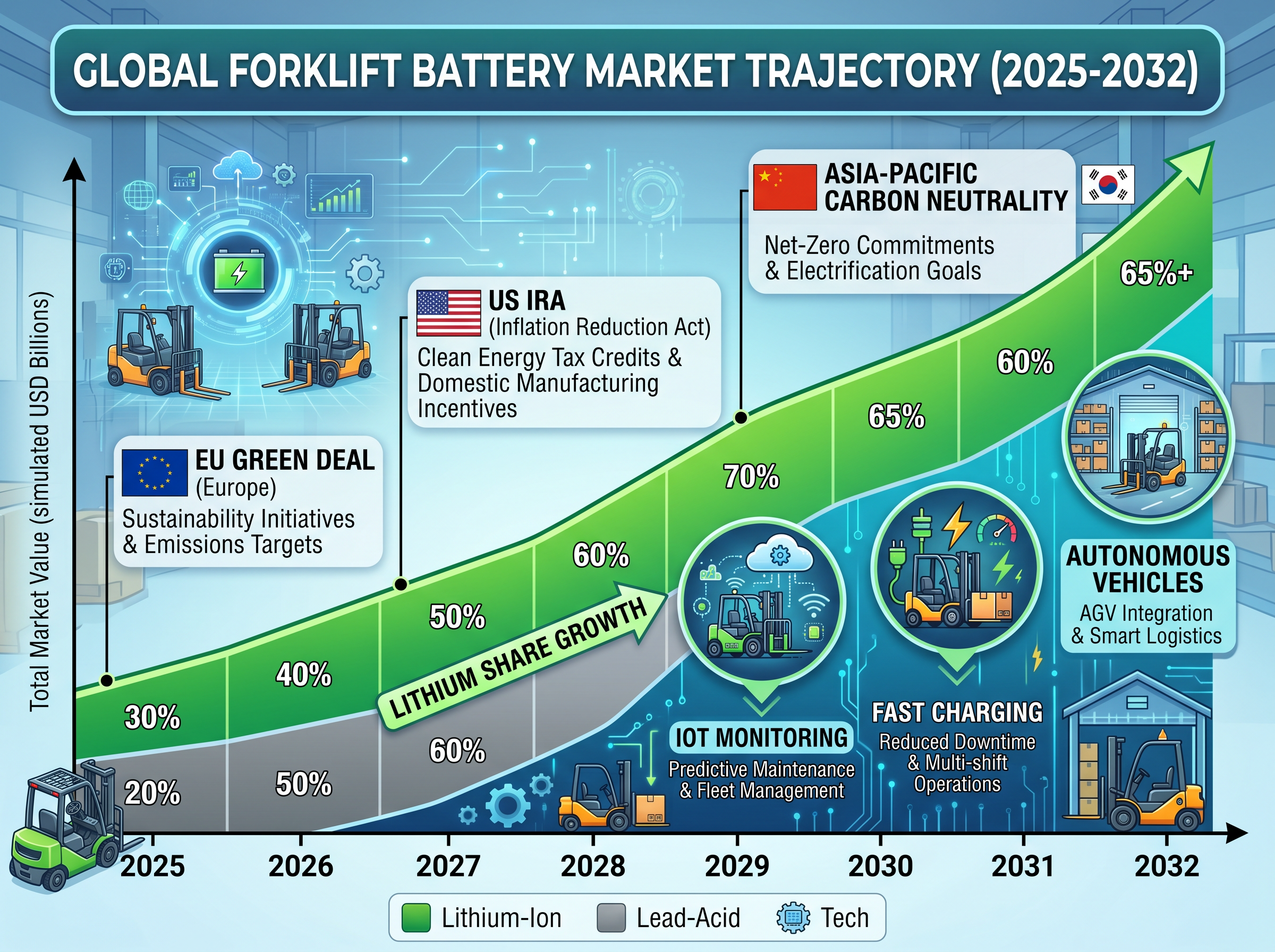
Technology trends converge to reinforce lithium as the default industrial power platform. IoT-enabled fleet management — where BMS telemetry feeds directly into warehouse management systems via 4G or 5G connectivity — is becoming standard practice. Fast and ultra-fast charging technologies capable of reaching 80% SOC in under 45 minutes are reaching commercial maturity. The growing AGV and AMR (autonomous mobile robot) segment demands precisely the characteristics lithium delivers: high cycle life, automated charging compatibility, and precise SOC reporting. Solid-state batteries show long-term promise but remain 5 to 10+ years from commercial viability in industrial applications — a distant timeline that should not delay current fleet decisions.
The aftermarket serves as a critical accelerator of the entire lithium transition. OEM lithium programs from Hyster-Yale and other manufacturers do not yet cover every model, every capacity, or every market globally. Legacy Yale fleets — trucks with years of productive life remaining — need the aftermarket channel for electrification upgrades. Aftermarket competition drives pricing down, benefiting all buyers. Mixed-fleet operations combining Yale, Hyster, and other brands benefit from single-source aftermarket suppliers that standardize power across the entire fleet. Aftermarket manufacturers with $100M+ revenue and global service networks are emerging as serious industry players, competing on quality, certifications, and service reach rather than price alone.
For distributors, dealers, and agents, the aftermarket Yale forklift battery segment represents an early-stage, high-growth business opportunity. Lithium penetration of the existing installed base remains well below 30% in most markets, meaning the addressable conversion opportunity is vast. Channel partners who build lithium technical expertise and secure strong supplier partnerships now will compound those advantages as adoption accelerates through the decade ahead.
Summary: Yale Forklift Battery Upgrade — Key Takeaways
Upgrading Yale forklift batteries from lead-acid to lithium delivers over 50% TCO savings in multi-shift distribution operations, eliminates maintenance labor entirely, extends battery service life to 8–10+ years, and aligns fleet operations with tightening global environmental regulations. Aftermarket lithium batteries provide Yale fleet operators and their channel partners a cost-effective, performance-proven, and commercially flexible upgrade path — without replacing the forklifts themselves.
The primary markets for Yale forklifts include the United States, Canada, Germany, France, the United Kingdom, and Japan. ROYPOW has established subsidiaries and warehouses in the United States, Germany, the United Kingdom, and Japan. ROYPOW’s lithium forklift batteries are designed as high-performance aftermarket drop-in replacements compatible with the vast majority of Yale forklift models, making it easy for distributors, dealers, and end-user enterprises to source or adopt lithium upgrades. With local subsidiaries, ROYPOW provides rapid localized pre-sales consultation and after-sales service support.
YALE Forklift Battery FAQ: Expert Answers to Common Questions
Can I replace the lead-acid battery in my Yale forklift with a lithium drop-in replacement?
Yes. Aftermarket lithium forklift batteries are engineered as direct drop-in replacements for lead-acid packs in Yale trucks. The lithium battery matches the original compartment dimensions, voltage platform, and discharge connector, so no structural modifications to the Yale forklift are required. The two necessary changes are replacing the lead-acid charger with a dedicated lithium charger and ensuring the lithium pack includes adequate ballast weight to maintain counterbalance stability. Verified compatible Yale models span 55+ configurations across the ERC counterbalance, MR reach truck, and MP pallet truck product lines. Suppliers such as ROYPOW, EnerSys, and OneCharge publish model-specific compatibility data — for example, ROYPOW’s F36690BA and F36942D for the Yale ERC050VG.
How much does a lithium Yale forklift battery cost compared to lead-acid?
An aftermarket lithium replacement battery for a Yale truck typically costs $7,000 to $14,000 for 36V models and $10,000 to $18,000 for 48V models, depending on capacity and features. This represents a 30% to 50% savings versus OEM lithium pricing from the Hyster-Yale channel. While the initial cost exceeds lead-acid by 2 to 2.5 times, total cost of ownership over five to eight years is consistently lower because lithium eliminates spare pack inventory, maintenance labor, swap infrastructure, and mid-life replacement. In multi-shift Yale operations, payback on the lithium premium occurs within 14 to 24 months.
What runtime can I expect from a lithium battery in a Yale ERC forklift?
A lithium battery of equivalent amp-hour rating delivers equal or greater runtime than the lead-acid original because lithium supports 80% to 100% usable depth of discharge versus a practical maximum of 80% for lead-acid. Additionally, lithium maintains consistent voltage throughout the discharge curve, so the Yale forklift operates at full lift speed and travel performance until the battery reaches its low SOC cutoff — unlike lead-acid, which sags progressively. In cold-storage environments, the runtime advantage widens: lithium with integrated heating maintains over 80% capacity at -20°C where lead-acid loses 20% to 40%.
Do Yale forklift batteries need UL listing for use in the United States?
While no single federal law mandates UL listing for all forklift batteries in every US application, UL listing is strongly recommended and increasingly required by facility insurance carriers, building codes referencing NFPA standards, and corporate procurement policies for indoor warehouse use. UL 2580 is the primary applicable standard for batteries used in electric vehicles including forklifts. Leading aftermarket suppliers — ROYPOW, EnerSys, OneCharge — offer UL-listed Yale-compatible products. Always verify current UL listing status for the specific battery model and confirm with your insurer before purchasing.
What certifications are needed for Yale forklift batteries in Europe?
In the EU, lithium forklift batteries must carry CE marking demonstrating conformity with the Machinery Directive, Low Voltage Directive, and EMC Directive. UN38.3 transport certification is required for shipping lithium batteries internationally. The EU Battery Regulation 2023/1542, which is being phased in through 2027, introduces carbon footprint declarations, recycled content targets, and digital battery passport requirements. When sourcing Yale forklift batteries for European markets, confirm that the supplier holds CE certification, offers DIN-standard product configurations, and can provide regulatory documentation aligned with evolving EU requirements. ROYPOW, EnerSys, and Green Cubes Technology maintain European offices and CE-certified product lines.
Can lithium batteries power Yale forklifts in -25°C cold-storage environments?
Yes, but only with specialized anti-freeze or heated lithium battery variants. Standard lithium cells lose meaningful capacity below -10°C and should not be charged below 0°C without heating. Purpose-built cold-storage lithium forklift batteries integrate internal heating modules that maintain cell temperature above safe thresholds, enabling reliable operation at -20°C to -30°C (-4°F to -22°F) with 80%+ capacity retention. These heated variants are available from select aftermarket manufacturers for Yale reach trucks and counterbalance models commonly deployed in cold-chain distribution. Always specify the actual minimum operating temperature when requesting supplier quotes for Yale forklift batteries.
Does installing an aftermarket lithium battery void my Yale forklift warranty?
Generally, no. Under the US Magnuson-Moss Warranty Act, a forklift manufacturer cannot void the equipment warranty solely because a compatible aftermarket component was installed. Similar protections exist under EU and Australian consumer law. Yale’s warranty on the truck’s drivetrain, mast, hydraulics, and electronic controls remains intact provided the aftermarket battery meets correct voltage, capacity, and connector specifications and is properly installed. Any damage directly attributable to an improperly specified or defective aftermarket battery would fall outside the forklift warranty. Use batteries from certified suppliers that have verified compatibility with your Yale model.
What Yale forklift models are compatible with ROYPOW lithium batteries?
ROYPOW produces verified compatible lithium forklift batteries for 55 documented Yale models across the full electric range. Published compatibility includes the Yale ERC050VG (ROYPOW models F36690BA, F36942D), ERC080VH (F36840BG), MRW030 (F24560T), ERP18VT (F48560BG), and ERC050 (F48560EJ), spanning Yale’s 24V, 36V, and 48V platforms. ROYPOW also covers Hyster — Yale’s sister brand — with 86 verified models, plus Toyota, Crown, Linde, and all other major brands, making it a single-source solution for mixed-fleet operations. For model-specific compatibility inquiries, contact ROYPOW directly.
Will one aftermarket lithium battery supplier work for both my Yale and Hyster forklifts?
Yes — this is one of the primary advantages of the aftermarket approach for operations running both Yale and Hyster trucks under the Hyster-Yale Group. A single aftermarket lithium battery supplier can serve the combined fleet, along with any other forklift brands in the operation, eliminating the need for separate OEM battery relationships. This simplifies procurement, consolidates inventory management, and maximizes volume purchasing leverage. ROYPOW, for example, lists verified compatibility for 55 Yale models and 86 Hyster models, providing comprehensive coverage for Hyster-Yale mixed fleets and beyond from a single global source.
How long do lithium Yale forklift batteries last before needing replacement?
High-quality LiFePO4 lithium batteries for Yale forklifts are designed for 3,500+ charge-discharge cycles at 80% depth of discharge, translating to approximately 8 to 10+ years of service in a typical single-shift application or 5 to 7+ years in heavy double-shift operations. This compares to 1,000 to 1,500 cycles and 3 to 5 years for flooded lead-acid. Leading suppliers back this with 5-year warranties. Over an 8-year analysis period, a single lithium pack outlasts two lead-acid replacement cycles — a core driver of the lithium TCO advantage for Yale fleet operators.