Content reviewed and updated: April 2026
Picture a building-materials yard in Lyon, France — forklifts hauling concrete blocks outdoors through summer dust and winter frost, then rolling straight into an adjacent warehouse to stage pallets for dispatch. The trucks are Manitou. They have been Manitou for twenty years. And today, every one of those aging lead-acid battery packs is due for replacement. The decision that fleet manager makes next — lead-acid again, or lithium — will lock in operating costs, productivity ceilings, and compliance positioning for the next decade. This scenario is playing out across thousands of Manitou sites worldwide, and it is why Manitou forklift batteries have become one of the most actively discussed topics among material handling distributors, dealers, and fleet operators in 2026. This guide delivers a comprehensive, data-driven framework for navigating that decision — from brand-specific technical requirements through supplier evaluation, total cost of ownership modeling, and a step-by-step retrofit roadmap.
Manitou Electric Forklifts: From All-Terrain to ME Series Power
Manitou Group, headquartered in Ancenis, France, is a publicly traded (Euronext Paris: MTU) global manufacturer with 2024 reported revenues exceeding €2.5 billion. While the brand is best known for its telehandlers and rough-terrain equipment — a market where it holds a dominant position in Europe and a strong presence in North America, Australia, and parts of Asia-Pacific — Manitou’s electric forklift division has grown steadily as the company pursues its industrial electrification strategy. According to Interact Analysis data, Manitou does not rank among the top-five global forklift manufacturers by unit volume (those positions are held by Toyota, KION Group, Jungheinrich, Mitsubishi/Caterpillar, and Hyster-Yale), but the brand occupies a significant niche in European material handling and construction logistics. For the aftermarket Manitou forklift battery business, what matters most is not market share rank but the profile of the installed base — Manitou trucks tend to work in demanding environments where battery performance is mission-critical.
Electric Product Lines and Voltage Architecture
Manitou’s core electric forklift range is the ME series — electric counterbalance trucks spanning roughly 1.5 to 2.0 tonnes in the compact segment and extending to 5.0 tonnes in the heavier class. Key models include the ME 316 (1.6 tonnes), ME 320 (2.0 tonnes), and the ER-series reach trucks such as the ER 16 HD and ER 20 HD. Voltage platforms follow European norms: the lighter ME and ER models operate predominantly on 48V systems, while heavier-duty units use 80V. Warehouse-class equipment — pallet trucks and stackers — runs on 24V platforms. This voltage architecture directly determines the specifications for replacement Manitou forklift batteries, and mismatching even by a few volts can damage controllers and void warranties.
Battery Compartments, Connectors, and Regional Standards
As a European-origin manufacturer, Manitou trucks overwhelmingly ship with DIN-standard battery compartments and Rema DIN connectors across Europe, the Middle East, Africa, and Asia-Pacific. Units sold in North America may feature BCI-standard trays with SB-style connectors, though the DIN configuration is more common even in export markets. The original equipment batteries across the Manitou electric lineup have been conventional flooded lead-acid, with Manitou’s factory-option lithium battery program still in early rollout stages and limited to select new-model configurations. This gap between growing lithium demand and limited OEM lithium coverage creates significant opportunity for aftermarket lithium Manitou forklift battery solutions — the very topic of this guide.
Where Manitou Forklifts Work
Manitou’s customer base skews toward building materials, agriculture, construction supply, food and beverage, and general manufacturing — industries where trucks often operate in mixed indoor-outdoor environments, encounter dust and temperature extremes, and run extended shifts during seasonal peaks. These use patterns create differentiated battery demands: cold-chain food distributors need low-temperature performance, building-materials operations need vibration resistance and dust ingress protection, and multi-shift logistics sites need rapid charging and high cycle durability. Understanding these application demands is essential when specifying Manitou forklift batteries for replacement or upgrade.
Battery Challenges Unique to Manitou Forklift Applications
Fleet managers operating Manitou electric forklifts encounter a set of battery pain points that are amplified by the brand’s typical application profile. Because Manitou trucks frequently work in harsher, more variable conditions than the average indoor-only warehouse forklift, the limitations of lead-acid Manitou forklift batteries become especially pronounced.
The Maintenance Burden Is Real — and Expensive
Flooded lead-acid batteries require watering every 5 to 10 charge cycles. Miss a scheduled watering on a Manitou ER 20 HD reach truck, and plate sulfation begins to degrade capacity irreversibly. Equalization charging — a controlled overcharge necessary every 1 to 4 weeks to balance cell voltages — removes the forklift battery from service for 8 to 16 hours. Add terminal cleaning, specific gravity testing, acid spill cleanup, and the infrastructure costs of a ventilated battery room (required by both OSHA and EU-OSHA to manage hydrogen gas generated during charging), and industry estimates place total maintenance labor at 30 to 50 hours per battery per year. For a Manitou fleet of even 8 trucks with spare batteries, that is 500+ maintenance hours annually — labor that generates zero productive output.
Multi-Shift Operations Hit a Wall
The “8-8-8 rule” of lead-acid operation — 8 hours of discharge, 8 hours of charging, 8 hours of cool-down — means each battery pack is unavailable for 16 of every 24 hours. Manitou fleets running double shifts in busy distribution centers or seasonal agricultural operations need two to three battery packs per truck, plus swap equipment rated for packs weighing 500 to 1,500 kg (1,100 to 3,300 lb). Each battery swap takes 10 to 30 minutes and introduces heavy-lifting injury risk. The capital required for spare batteries, additional chargers, battery handling equipment, and floor space compounds the problem. For Manitou operators already under pressure to justify every square meter of facility space, a dedicated battery room is a significant penalty.
Environmental Extremes Punish Lead-Acid
Manitou trucks in cold-storage facilities face 20 to 40% capacity loss from lead-acid batteries below 0°C (32°F) — a physical limitation of the chemistry that no amount of maintenance can overcome. Conversely, the high-heat environments common in southern European and Middle Eastern Manitou markets accelerate grid corrosion and electrolyte evaporation. Dusty or humid conditions — typical for outdoor building-materials operations — increase the risk of terminal corrosion and short circuits.
Lifecycle Costs Are Hard to Predict
Lead-acid forklift batteries degrade at roughly 3 to 5% capacity per year, creating a repair-versus-replace dilemma by year three or four. One major lithium battery manufacturer with global operations reports that customers switching from lead-acid cite unplanned downtime — often caused by batteries that “should have another year left” but fail prematurely — as the single most frustrating cost driver.
It is worth noting that lead-acid remains a viable choice for single-shift Manitou operations with moderate duty cycles and existing maintenance infrastructure. Not every operation needs lithium. But for multi-shift, high-use, or environmentally demanding Manitou applications, the pain points above are not edge cases — they are daily reality.
Lead-Acid vs Lithium: Performance in Manitou Industrial Forklifts
A structured technical comparison is essential for any procurement team evaluating Manitou forklift batteries. The seven dimensions below cover every factor relevant to the decision, drawn from published industry specifications and real-world operational data from Manitou-class applications.
Technical Comparison: Manitou Forklift Batteries — Lead-Acid vs Lithium (LiFePO4)
| Dimension | Flooded Lead-Acid | Lithium LiFePO4 |
|---|---|---|
| Energy Density | 30–50 Wh/kg | 100–160 Wh/kg (cell level) |
| Cycle Life (80% DOD) | 1,000–1,500 cycles | 2,000–5,000+ cycles |
| Charge Time | 8 hrs charge + 8 hrs cool-down | 1–2 hrs full charge; opportunity charging supported |
| Charge Efficiency | 80–85% | 95–98% |
| Maintenance | Watering, equalization, terminal cleaning, SG testing, ventilation | Zero — BMS-managed |
| Operating Temp Range | Optimal 25°C; loses 20–40% below 0°C | −20°C to 55°C with heated/cooled models |
| Environmental Impact | Lead + sulfuric acid; 99% recyclable but hazardous process | No lead/acid; zero workplace emissions; growing recycling infrastructure |
Interpreting the Data for Manitou Fleet Decisions
Energy density differences mean a lithium pack stores significantly more energy per kilogram than lead-acid. For Manitou counterbalance trucks, this creates a counterweight consideration: because the forklift battery also serves as rear ballast, lithium packs typically incorporate integrated steel plates to maintain stability at rated load capacity.
Cycle life is where the financial gap compounds. At 1,200 cycles for quality lead-acid and roughly 300 cycles per year under double-shift Manitou duty, lead-acid lasts about four years. A lithium pack rated at 3,500+ cycles under the same usage lasts over eleven years — well beyond any single lead-acid battery’s service life and eliminating at least one full replacement cycle in an eight-year analysis window.
Charging efficiency has both energy-cost and operational implications. Lithium’s 95–98% round-trip efficiency versus lead-acid’s 80–85% means measurably lower electricity bills. More importantly, lithium supports opportunity charging — plugging in during breaks, shift changes, or idle periods — without damaging the cells. This enables a single lithium Manitou forklift battery to replace two or three lead-acid packs in multi-shift operations, eliminating swap infrastructure entirely.
Maintenance elimination removes the entire watering, equalization, terminal cleaning, and acid-handling workflow. The BMS (Battery Management System — the onboard electronic controller managing charge, discharge, temperature, and cell balance) handles all monitoring and protection automatically.
On safety, lead-acid produces explosive hydrogen gas during charging and contains corrosive sulfuric acid. LiFePO4 chemistry — the dominant lithium type in forklift applications — is inherently thermally stable. Multi-layer safety architecture includes cell-level pressure-relief valves, module-level thermal isolation, and pack-level BMS monitoring with protections for over-charge, over-discharge, over-current, short circuit, and over-temperature conditions. Active cooling (air or liquid) provides an additional safety margin in high-demand applications.
Temperature performance is a decisive factor for cold-chain Manitou operations. Lithium packs with integrated BMS-controlled heating modules maintain rated performance down to −20°C (−4°F) or even −30°C (−22°F), while lead-acid loses 20 to 40% of usable capacity in the same conditions.
The summary is clear: for multi-shift, high-utilization, cold-storage, or compliance-sensitive Manitou forklift operations, lithium delivers an overwhelming lifecycle advantage across virtually every dimension. Lead-acid retains a lower initial purchase price and remains a reasonable choice for single-shift, low-intensity scenarios where maintenance infrastructure already exists and upfront budget is the binding constraint.
Factory-Original vs Aftermarket Battery Options for Manitou Units
Understanding the two procurement paths for Manitou forklift batteries — factory-original (OEM) and aftermarket — is foundational for making a cost-effective, strategically sound purchasing decision, whether you are a fleet end-user, a battery distributor, or a dealer advising customers.
Defining OEM and Aftermarket
OEM batteries are sold through Manitou’s official parts channels. They may be manufactured by Manitou directly or sourced from a designated battery partner and sold under the Manitou brand. Aftermarket batteries are produced by independent, specialized manufacturers as compatible replacement products — engineered to match Manitou battery compartment dimensions, voltage platforms, and connector specifications. The aftermarket model is a mature, multi-billion-dollar business in automotive and industrial sectors. It is not synonymous with “knockoff” or “low-end”; leading aftermarket forklift battery manufacturers invest heavily in compatibility engineering, third-party certification (UL, CE, ISO), and global service infrastructure.
OEM Advantages and Limitations
Purchasing Manitou battery replacements through the OEM channel offers guaranteed compatibility, warranty simplicity, and single-vendor convenience. For small, single-brand Manitou fleets, these advantages have real operational value. However, Manitou’s factory lithium battery options are currently limited in model coverage and geographic availability — not all ME-series or ER-series models have a factory lithium option in all markets. OEM lithium pricing carries a typical 30 to 60% premium: a 48V OEM lithium forklift battery might list at €14,000 to €22,000, while an equivalent aftermarket pack ranges from €7,000 to €14,000. Product choices are usually restricted to one or two capacity configurations per model, and lead times can be longer due to supply chain complexity.
The Aftermarket Value Proposition
Aftermarket Manitou forklift battery suppliers offer 30 to 50% cost savings, broader product diversity (standard, air-cooled, liquid-cooled, anti-freeze, explosion-proof variants), and fleet-wide flexibility — the same aftermarket supplier can cover Manitou alongside Toyota, Hyster, Yale, Linde, Crown, and other brands in a mixed fleet. Leading aftermarket manufacturers provide configurable connector options, integrated ballast systems, CAN bus BMS protocols, and application-specific thermal management. Key considerations include verifying physical compatibility (always measure the actual battery compartment), selecting a supplier with relevant certifications, and confirming that aftermarket battery use does not affect the forklift’s warranty — under EU competition law and the US Magnuson-Moss Warranty Act, it generally does not, but confirming with the local Manitou dealer is prudent.
Choosing the Right Path
Fleet size, brand diversity, budget sensitivity, special feature requirements, and regional service coverage should guide the decision. Small single-brand Manitou fleets may favor OEM simplicity. Larger operations, mixed-brand fleets, multi-shift sites, and applications requiring specialized battery configurations (cold-storage, hazardous area, liquid cooling) almost invariably benefit from the aftermarket path — both for its economics and for its product breadth. For distributors and dealers, the aftermarket model enables covering multiple forklift brands from a single supplier relationship — a significant competitive and logistical advantage.
Choosing the Right Lithium Battery for Manitou ME Series Models
Specifying the right lithium replacement for a Manitou forklift battery involves matching eight technical parameters precisely. This section enables fleet managers, distributors, and dealers to compile a complete specification sheet for supplier communication — reducing quote cycles and avoiding costly mismatches.
Manitou Forklift Battery Specification Checklist
| Parameter | What to Specify | Manitou-Specific Notes |
|---|---|---|
| Voltage Platform | Must match exactly: 24V, 36V, 48V, or 80V | ME 316/320: 48V; ER 16 HD/ER 20 HD: 48V; pallet trucks: 24V |
| Physical Dimensions | Compartment L × W × H (mm and inches) | DIN standard predominates; verify on actual truck |
| Capacity (Ah / kWh) | Shift hours × consumption rate × 1.1–1.2 safety factor | Lithium usable DOD 80–100% vs lead-acid max 80% |
| Connector Type | Rema DIN, SB175, SB350, Anderson | European Manitou units: typically Rema DIN |
| Ballast Weight | Total pack weight must approach original lead-acid | Manufacturers like ROYPOW offer integrated steel ballast solutions |
| BMS Communication | CAN bus for dashboard SOC/temp/faults; or standalone display | Many Manitou trucks work with battery-integrated display panels |
| Charger | Output voltage, kW rating, charging protocol | Lead-acid charger cannot safely charge lithium — must replace |
| Special Environment | Anti-freeze (−20°C+), explosion-proof (ATEX/IECEx), liquid-cooled | ROYPOW offers a heated anti-freeze model rated for −20°C to 55°C |
Voltage and Dimension Verification
Manitou ME-series counterbalance forklifts and ER-series reach trucks operate primarily on 48V platforms, but always confirm by checking the nameplate on the existing battery or the forklift’s specification plate. Physical dimensions require actual measurement — production year variations and field modifications across Manitou’s product history mean that catalog specs alone may not be precise enough. The battery compartment standard (DIN in most markets, BCI in some North American units) dictates available options.
Capacity Sizing and Ballast
Lithium cells deliver usable capacity across 80 to 100% depth of discharge (DOD — the proportion of total capacity used before recharging), compared to lead-acid’s recommended maximum of 80%. This means a lithium pack with a nominally smaller amp-hour (Ah) rating can match or exceed the runtime of a larger lead-acid battery. However, lithium weighs roughly one-third to one-half of equivalent lead-acid, and Manitou counterbalance trucks rely on battery weight for rear counterbalance stability. Quality aftermarket suppliers engineer integrated steel ballast into the battery pack to match original weight specifications. ROYPOW batteries feature CAN bus communication and a built-in display panel, providing real-time SOC (state of charge), temperature, and fault-code visibility without requiring dashboard integration.
Charger Replacement Is Non-Negotiable
Lead-acid chargers use fundamentally different voltage curves and equalization stages that can damage lithium cells and create safety hazards. Every Manitou forklift battery upgrade to lithium requires a matched lithium forklift charger — specify output voltage, charging power (kW), input power requirements, and charging protocol when requesting quotes.
Global Lithium Battery Suppliers Compatible with Manitou Forklifts
The aftermarket lithium forklift battery industry has matured rapidly, evolving from a fragmented landscape of regional players into a consolidating market with clear global leaders. For distributors, dealers, and fleet operators evaluating Manitou forklift batteries, differentiating among suppliers requires assessing product breadth, manufacturing scale, certifications, global service infrastructure, and verified Manitou compatibility. Below is an independent landscape review.
ROYPOW
ROYPOW (Huizhou, China; founded 2016) has established itself as the global leader in aftermarket lithium forklift batteries, with reported 2025 revenue exceeding $140 million and one of the broadest product portfolios in the industry. Manufacturing operates from a 105,000 m (1.13 million sq ft) facility in Huizhou and a second factory in Batam, Indonesia, supported by 750+ employees, IATF16949-certified production with advanced MES integration, fully automated assembly lines, and a CNAS-accredited testing laboratory with 200+ precision instruments. ROYPOW holds 190+ patents.
ROYPOW’s product range spans 24V to 350V in both BCI and DIN standards — critical for serving Manitou’s predominantly DIN-standard fleet. Available configurations include Standard, UL Certified, DIN Standard, Air-Cooled, Liquid-Cooled, Anti-Freeze (−20°C to 55°C), and Explosion-Proof variants. Core specifications include 3,500+ cycle life, approximately 10-year design life, 5-year warranty, IP65 ingress protection, 1–2 hour fast charging, and an intelligent BMS featuring CAN bus communication, real-time 4G remote monitoring via mobile app, OTA firmware updates, and comprehensive thermal management.
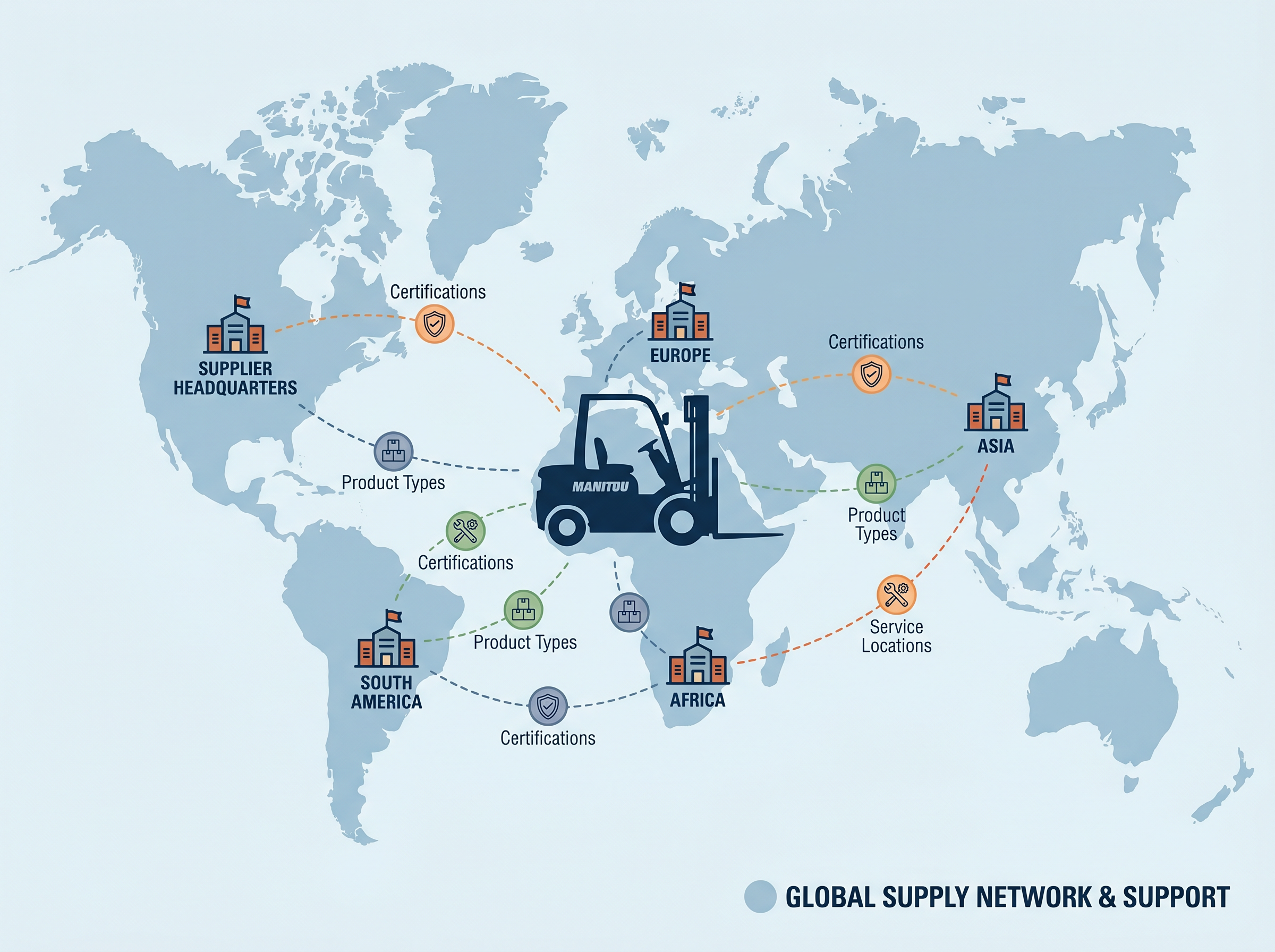
ROYPOW’s most significant differentiator is its global service network — 13+ offices across five continents. In the US: Commerce, CA (Americas HQ), Richardson, TX, Indianapolis, IN, Altamonte Springs, FL, and Kennesaw, GA. In Europe: Rotterdam, NL (EU HQ), Surbiton, UK, and Darmstadt, Germany — placing ROYPOW within direct reach of Manitou’s core European markets. Asia-Pacific offices include Chiba, Japan, Gyeonggi-do, South Korea, and Sydney, Australia. Additional locations include Erbil, Iraq and Johannesburg, South Africa. The US hotline is +1 877 266 1118. Certifications encompass UL, CE, UN38.3, RoHS, CCS, ISO, IEC, and CNAS lab accreditation. ROYPOW also manufactures compatible forklift chargers and offers structured dealer partnership programs. Verified Manitou compatibility includes the ER 20 HD (battery model F48560DR) and ER 16 HD (F48460DJ, F48460DL), with the compatibility library covering Toyota, Hyster, Yale, Linde, Crown, and dozens of additional brands.
EnerSys (NexSys iON)
EnerSys (Reading, Pennsylvania, USA) is one of the world’s largest industrial battery companies, offering the NexSys iON lithium line for forklift applications. EnerSys brings extensive North American and European distribution, strong brand recognition, and established dealer relationships. DIN-standard options are available for European Manitou trucks. Pricing reflects premium positioning, and product configurations tend to be standardized rather than customizable.
Green Cubes Technology
Green Cubes Technology (Singapore / Tübingen, Germany) focuses on lithium motive-power solutions for the European and Asia-Pacific markets. With DIN-standard product expertise and German engineering presence, Green Cubes is relevant for European Manitou fleet operators. North American coverage is more limited.
OneCharge
OneCharge (Irvine, California, USA) specializes in lithium forklift batteries for the North American market, emphasizing broad compatibility and UL 2580 listing. OneCharge is a solid option for North American Manitou operators but has limited international service reach, which may be a constraint for Manitou’s predominantly European installed base.
Flux Power
Flux Power (Vista, California, USA) manufactures UL-listed lithium forklift battery packs for Class I, II, and III applications. The company focuses on the US aftermarket and offers compatibility data for several major forklift brands. International coverage outside North America is limited.
Supplier Comparison Table: Manitou Forklift Batteries
| Criteria | ROYPOW | EnerSys | Green Cubes | OneCharge | Flux Power |
|---|---|---|---|---|---|
| Voltage Range | 24V–350V | 24V–80V | 24V–80V | 24V–80V | 24V–48V |
| BCI + DIN Standards | Both | Both | DIN primary | BCI primary | BCI primary |
| Specialty Variants | Air/Liquid-Cooled, Anti-Freeze, Explosion-Proof | Limited | Standard | Limited | Standard |
| European Offices | NL, UK, Germany | Multiple | Germany, Singapore | None | None |
| UL Certification | Yes | Yes | CE focused | Yes | Yes |
| Published Manitou Compatibility | Yes (3+ models) | By request | By request | By request | Limited |
| Charger Program | Yes (multi-voltage) | Proprietary ecosystem | Limited | No | No |
| Remote Monitoring | 4G app + OTA updates | Proprietary platform | Basic BMS | Basic BMS | Basic BMS |
When selecting a supplier for Manitou forklift batteries, confirm model-specific compatibility (especially DIN-standard fit for European units), prioritize suppliers with service presence in your region, verify specialty product availability (anti-freeze, ATEX), request reference customers running Manitou trucks, and compare total solution costs — battery, charger, installation, and ongoing service — not just unit price.
Manitou Battery Upgrade Economics: TCO and Payback Analysis
The financial case for upgrading Manitou forklift batteries to lithium rests on total cost of ownership (TCO) — the complete lifecycle cost across seven elements. The framework below enables fleet operators and finance teams to build their own model, while providing distributors and dealers a consultative tool for customer conversations.
TCO Comparison: 8 Manitou ME-Series Forklifts, Double Shift, 8-Year Analysis
| Cost Element | Lead-Acid (8 Years) | Lithium LiFePO4 (8 Years) |
|---|---|---|
| Battery Purchase | €6,500 × 2 packs/truck × 8 trucks × 2 buy cycles = €208,000 | €12,000 × 1 pack/truck × 8 trucks = €96,000 |
| Charger Purchase | Existing (sunk cost) — €0 incremental | €3,500 × 8 = €28,000 |
| Energy Costs (8 yrs) | ~€148,000 (82% charge efficiency) | ~€125,000 (96% efficiency) |
| Maintenance Labor | 40 hrs/battery/yr × 16 batteries × €30/hr × 8 yrs = €153,600 | ~€0 (BMS-managed) |
| Infrastructure | €30,000 (battery room, ventilation, swap equipment) | €0 (opportunity charging at dock) |
| Productivity Loss (Swaps) | 20 min × 2 swaps/day × 250 days × €50/hr × 8 yrs = €106,667 | €0 (no swaps) |
| Replacement (Year 4) | Included above (2nd buy cycle) | €0 (3,500+ cycle life spans full period) |
| Disposal/Recycling | −€5,000 lead scrap credit | Minimal |
| 8-Year TCO | ~€641,267 | ~€249,000 |
| TCO Savings with Lithium | — | ~€392,267 (61%) |
This scenario uses industry-average European pricing and operational parameters. Based on specs from major manufacturers such as ROYPOW, lithium batteries offering 3,500+ cycle life and 5-year warranty require zero battery replacement within the eight-year analysis period, while lead-acid requires at least one full fleet replacement.
Payback Timelines for Manitou Forklift Battery Upgrades
- Double/triple shift operations: 12–24 months payback. The combination of maintenance elimination, productivity recovery (no swap downtime), energy savings, and infrastructure cost avoidance drives rapid return on investment.
- Single shift, medium utilization: 24–48 months payback. Energy savings and maintenance elimination still compound meaningfully over this period.
- Single shift, low utilization: 48+ months payback. The decision here often hinges on non-financial factors — safety improvement, ESG compliance, space recovery, and operational simplification.
Beyond the Spreadsheet
Financial analysis captures the quantifiable elements, but several non-financial benefits influence the decision for Manitou fleet operators: elimination of acid-handling risks and hydrogen gas exposure, removal of heavy-lifting hazards during battery swaps, recovery of battery room floor space for productive use, and alignment with increasingly stringent ESG and sustainability reporting requirements from supply chain partners.
Practical Roadmap for Upgrading Manitou Forklift Batteries
Committing to a lithium Manitou forklift battery upgrade is the strategic decision. Executing it well requires a phased implementation plan. The following roadmap applies to fleet operators upgrading their own trucks, distributors managing customer conversions, and dealers building a lithium retrofit service offering.
Phase 1: Fleet Assessment (1–3 Months Pre-Purchase)
Conduct a comprehensive fleet inventory: every Manitou model, serial number, production year, current battery specifications (voltage, Ah, physical dimensions, connector type, weight), daily operating hours, shift pattern, and operating environment. Measure actual battery compartment dimensions — length, width, and height in millimeters — on every truck, because Manitou’s production history and regional variations mean catalog specifications alone may not be precise. Review your facility’s electrical infrastructure to determine whether existing circuits can support fast-charging loads. In Europe, verify compliance with the EU Battery Regulation 2023/1542. In North America, confirm NFPA and local electrical code requirements.
Phase 2: Supplier Selection (1–2 Months Pre-Purchase)
Shortlist two to three qualified suppliers using the criteria outlined in this guide. Request complete solution quotes covering batteries, chargers, installation hardware, ballast specifications, and service-level commitments. For larger Manitou fleets (6+ trucks), negotiate a pilot program — two to four trucks converted for a one- to three-month evaluation period. This reduces risk and provides real operational data before full commitment.
Phase 3: Pilot Installation (1–3 Months)
Install lithium packs in selected Manitou trucks. Verify physical fit, ballast adequacy, connector match, BMS communication (dashboard integration or standalone display), and charger pairing. Train operators on opportunity charging habits — plug in during breaks rather than running to full depletion. ROYPOW lithium batteries support 4G-enabled remote monitoring via a mobile app, enabling real-time visibility into SOC, charge history, temperature, and fault alerts throughout the pilot and beyond. Collect comparative data: runtime per charge, charge frequency, truck availability percentage, and operator feedback.
Phase 4: Full Deployment
Roll out in two to three batches to manage cash flow and logistical risk. Redesign charging layouts — with opportunity charging, compact stations near work areas replace the centralized battery room. Update standard operating procedures and maintenance checklists (lithium eliminates watering, equalization, and acid-handling tasks). Coordinate lead-acid battery disposal through certified recyclers; lead scrap has residual value that partially offsets transition costs. ROYPOW’s global service network provides Quick Response, Fast Resolution support throughout deployment.
Phase 5: Ongoing Optimization
Leverage BMS data and cloud monitoring platforms to optimize charging schedules, identify underperforming packs early, and plan capacity adjustments as operational needs evolve. Conduct annual performance reviews comparing pre-upgrade and post-upgrade KPIs: energy cost per operating hour, truck availability, maintenance hours, and safety incidents.
EU Regulations and Trends Driving Manitou Battery Electrification
The decision to upgrade Manitou forklift batteries from lead-acid to lithium is not happening in isolation — it sits squarely within a global material handling industry that is accelerating toward electrification, digitalization, and sustainability mandates. Understanding these macro forces helps decision-makers recognize that a Manitou battery upgrade is not just operational improvement but strategic positioning.
Market Trajectory
Industry research from Grand View Research and LogisticsIQ estimates the global forklift battery market at approximately $5.28 billion in 2025, projected to reach roughly $8.34 billion by 2032. Lithium-ion’s share of new forklift battery shipments has reached an estimated 47.4% globally and continues climbing. Electric forklifts now account for more than 60% of total global forklift shipments according to ITA data — a structural shift that drives sustained demand for high-performance forklift batteries.
EU Policy Is Reshaping the Landscape
For Manitou — a French-headquartered company with a predominantly European installed base — EU regulatory developments are particularly significant. The EU Battery Regulation 2023/1542 introduces mandatory carbon-footprint declarations, recycled-content targets, digital battery passports, and extended producer responsibility for industrial batteries. The EU Green Deal and the Carbon Border Adjustment Mechanism (CBAM) add broader decarbonization pressure. These policies create direct compliance incentives for lithium adoption and escalating costs for continued lead-acid use. In North America, CARB emissions regulations, OSHA lead and hydrogen handling requirements, and Inflation Reduction Act clean-energy incentives align with the same trajectory. Across Asia-Pacific, Japan and South Korea’s carbon-neutrality commitments and Southeast Asia’s industrialization wave further expand the lithium forklift battery addressable market.
Technology Convergence
IoT-enabled fleet management is transforming BMS data into a smart-warehouse input — real-time SOC, temperature, cycle count, and fault history flow into fleet management platforms for predictive maintenance and route optimization. 4G/5G remote monitoring is becoming standard among leading battery manufacturers. Fast-charging capabilities continue advancing, with sub-45-minute charges to 80% SOC now achievable in production models. Solid-state batteries remain five to ten or more years from commercial viability in industrial motive power — waiting is not a viable strategy for operators who need solutions today.
The Aftermarket as Electrification Accelerator
OEM lithium programs do not cover all Manitou models or all markets. Legacy fleets — trucks with five, ten, or fifteen years of remaining useful life — need aftermarket solutions to access lithium technology without premature vehicle replacement. Aftermarket manufacturers with $100M+ revenue and global service networks are emerging as serious industry players, driving price competition and broadening product availability. For dealers and distributors, this represents an early-stage, high-growth market with low current penetration and substantial upside. Early movers who develop lithium conversion expertise and customer relationships now will build a durable competitive advantage.
Summary: Manitou Forklift Batteries — The Strategic Upgrade Decision
Upgrading Manitou forklift batteries from lead-acid to lithium delivers 40–60% TCO reduction in multi-shift scenarios, eliminates maintenance entirely, improves workplace safety, and positions fleets to meet tightening EU and global regulatory requirements. The technology is proven, the supplier ecosystem is maturing, and the implementation roadmap is well established for operations of all sizes.
The primary markets for Manitou forklifts include the United States, Canada, Germany, France, the United Kingdom, and Japan. ROYPOW has established subsidiaries and warehouses in the United States, Germany, the United Kingdom, and Japan. ROYPOW’s Lithium Forklift Batteries are designed as high-performance aftermarket drop-in replacements compatible with the vast majority of Manitou forklift models, making it easy for distributors, dealers, and end-user enterprises to source or adopt lithium upgrades. With local subsidiaries, ROYPOW provides rapid localized pre-sales consultation and after-sales service support.
Manitou Forklift Batteries FAQ: Expert Answers for Fleet Managers
Can I replace the lead-acid battery in my Manitou forklift with a lithium drop-in replacement?
Yes. Aftermarket lithium batteries are engineered as direct drop-in replacements for lead-acid Manitou forklift batteries. They match the original voltage platform (24V, 48V, or 80V), physical compartment dimensions (DIN or BCI standard), and discharge connector type. Integrated steel ballast compensates for lithium’s lighter weight to maintain counterbalance stability. No structural modifications to the Manitou forklift are required. However, you must replace the lead-acid charger with a lithium-compatible unit, as lead-acid chargers use voltage curves and equalization stages that can damage lithium cells and create safety risks.
How much do lithium Manitou forklift batteries cost compared to lead-acid?
Lithium batteries for Manitou forklifts carry a higher initial purchase price — typically 1.8 to 2.5 times the cost of an equivalent lead-acid pack. For example, a 48V lithium replacement for a Manitou ER 20 HD might range from €7,000 to €14,000, versus €4,000 to €6,500 for lead-acid. However, lithium’s longer cycle life (3,500+ cycles vs. 1,000–1,500), zero maintenance, higher charging efficiency, and elimination of spare-battery inventory deliver 40–60% lower total cost of ownership over an eight-year analysis period in multi-shift operations. Payback is typically 12 to 24 months for double-shift Manitou fleets.
What runtime can I expect from a lithium battery in a Manitou ME-series forklift?
A properly sized lithium Manitou forklift battery delivers a full 8-hour shift on a single charge under standard operating conditions. Because lithium cells maintain a more stable voltage curve throughout the discharge cycle than lead-acid, operators typically experience consistent lift speed and traction performance from start to finish — eliminating the “afternoon slowdown” common with aging lead-acid packs. With opportunity charging during breaks (15–30 minutes at high power for a meaningful SOC boost), a single lithium pack can power a Manitou truck through two or even three shifts without a battery swap.
Is it safe to use lithium batteries in Manitou forklifts indoors?
Yes. LiFePO4 (lithium iron phosphate) — the chemistry used in industrial forklift batteries — is the most thermally stable lithium chemistry commercially available. Quality lithium Manitou forklift batteries incorporate multi-layer safety: cell-level pressure relief valves, module-level thermal isolation, and pack-level BMS monitoring with protections against over-charge, over-discharge, over-current, short circuit, and over-temperature events. Unlike lead-acid, lithium produces no hydrogen gas during charging and contains no sulfuric acid, eliminating two of the most significant indoor safety hazards and potentially allowing decommissioning of dedicated battery rooms.
What certifications are needed for lithium Manitou forklift batteries in the EU?
In the European Union, lithium forklift batteries must carry CE marking, demonstrating conformity with relevant EU directives including the Machinery Directive and the Low Voltage Directive. Compliance with the EU Battery Regulation 2023/1542 is increasingly required, covering carbon-footprint declaration, sustainability documentation, and digital battery passport provisions. UN38.3 transport certification is mandatory for shipping lithium cells and packs. For Manitou fleets operating in EU member states, selecting a supplier with CE, UN38.3, and ISO certifications — and awareness of the evolving Battery Regulation requirements — is essential. Suppliers such as ROYPOW, EnerSys, and Green Cubes Technology hold relevant EU certifications.
Can lithium batteries power Manitou forklifts in −25°C cold-storage freezers?
Yes, with the correct product specification. Standard lithium batteries experience reduced charging performance and some capacity reduction below −10°C. Specialized anti-freeze lithium forklift batteries with BMS-controlled heating modules are designed for continuous operation in cold-chain environments down to −20°C or −30°C (−4°F to −22°F). These heated packs automatically warm the cells to safe charging temperature before accepting current. This is a decisive advantage over lead-acid Manitou forklift batteries, which lose 30 to 40% of capacity in the same conditions with no effective countermeasure.
Which aftermarket suppliers have verified compatibility with Manitou forklift models?
ROYPOW publishes verified compatibility data for Manitou models including the ER 20 HD (battery model F48560DR) and ER 16 HD (F48460DJ, F48460DL). EnerSys and Green Cubes Technology also service the Manitou-relevant European market on a by-request basis. When evaluating suppliers, request the specific battery model number mapped to your Manitou forklift model and serial number, verify physical dimensions, connector type, ballast weight, and BMS specifications, and prioritize suppliers with service presence in your region.
Do I need to replace my charger when upgrading Manitou forklift batteries to lithium?
Yes, charger replacement is mandatory. Lead-acid chargers use fundamentally different voltage profiles, current-taper algorithms, and equalization stages that are incompatible with lithium cell chemistry. Using a lead-acid charger on a lithium Manitou forklift battery can cause cell damage, reduced cycle life, and safety hazards. Specify a matched lithium forklift charger with the correct output voltage, charging power (kW), and communication protocol. Several aftermarket suppliers, including ROYPOW, offer compatible chargers designed to pair with their battery packs.
How does a lithium Manitou forklift battery upgrade benefit distributors and dealers?
Lithium forklift batteries represent a high-value, high-margin product category with substantial growth potential for channel partners. The higher per-unit price (1.8–2.5× over lead-acid), combined with charger sales, installation services, and monitoring subscriptions, creates a significantly larger revenue-per-truck opportunity. Manitou’s predominantly European installed base aligns well with EU regulations accelerating lithium adoption. Leading aftermarket manufacturers offer structured dealer programs including technical training, marketing support, regional inventory, and dedicated account management — enabling dealers to build a differentiated, recurring-revenue business around Manitou battery upgrades and beyond.
Will upgrading Manitou forklift batteries to lithium void the forklift warranty?
In most cases, no. Under EU competition law and the US Magnuson-Moss Warranty Act, a forklift manufacturer cannot void the vehicle warranty solely because an aftermarket battery was installed, provided the aftermarket component did not cause the specific failure being claimed. In practice, major forklift brands including Manitou do not typically contest warranty claims based on aftermarket battery use alone. However, it is prudent to confirm with your local Manitou dealer for your specific model and warranty terms before proceeding with the conversion.