Content reviewed and updated: April 2026
When Kalmar became an independent publicly listed company in mid-2024, separating from Cargotec Corporation after decades under the same corporate umbrella, it signaled more than a financial restructuring. It confirmed that heavy-duty material handling — port equipment, terminal logistics, and high-tonnage forklift operations — had become a large enough market to stand alone. For fleet operators, distributors, and dealers who depend on Kalmar equipment, this independence also raised a practical question: how will the aftermarket for Kalmar forklift batteries evolve as the brand accelerates its own electrification roadmap? The answer, as this guide details across ten in-depth modules, is that aftermarket lithium battery solutions are not merely keeping pace — they are defining the upgrade path for the thousands of Kalmar forklifts still running lead-acid power worldwide. Whether you manage a port fleet of heavy-duty Kalmar trucks, distribute forklift batteries across Northern Europe, or advise industrial clients on lead-acid to lithium conversion, this analysis provides the technical specifications, supplier evaluation framework, and financial modeling you need to act.
Kalmar Heavy-Duty Forklifts: Models, Voltages, and Battery Needs
Kalmar occupies a unique position in the global forklift market. Unlike volume leaders such as Toyota, KION Group (Linde/Still), and Jungheinrich — which compete primarily in the 1- to 5-tonne warehouse segment — Kalmar’s core strength lies in heavy-duty material handling: electric counterbalance forklifts from 5 to 18 tonnes, reachstackers, empty container handlers, and terminal tractors. Following its mid-2024 listing on Nasdaq Helsinki, Kalmar reported net sales of approximately €2 billion for fiscal year 2024, with its mobile equipment and services segments accounting for the majority of revenue. By unit volume, Kalmar holds a modest share of global forklift shipments (which the ITA estimates exceeded 2.2 million units in 2024), but in the heavy-duty and port segment — forklifts above 8 tonnes — Kalmar is among the top three global players alongside Hyster (NACCO Industries) and Toyota’s heavy-duty division. This heavy-duty concentration shapes the entire aftermarket for Kalmar forklift batteries, because the batteries themselves are physically larger, operate at higher voltages, and face far more demanding duty cycles than standard warehouse forklift packs.
Electric Product Lines and Voltage Architecture
Kalmar’s flagship electric forklift family is the ECG series — Electric Counterbalance trucks designed for general heavy-duty applications. Current production models include the ECG50-90 range (5.0 to 9.0 tonne capacity) and heavier variants reaching up to 18 tonnes. These machines operate predominantly on 80V high-voltage platforms, reflecting the energy demands of moving multi-tonne loads through ports, steel mills, lumber yards, and heavy manufacturing facilities. Some lighter Kalmar warehouse equipment, including pallet trucks and certain specialty vehicles, uses 48V platforms, but the 80V architecture is the defining characteristic of the brand’s forklift battery ecosystem.
Battery Compartment Standards and Original Equipment
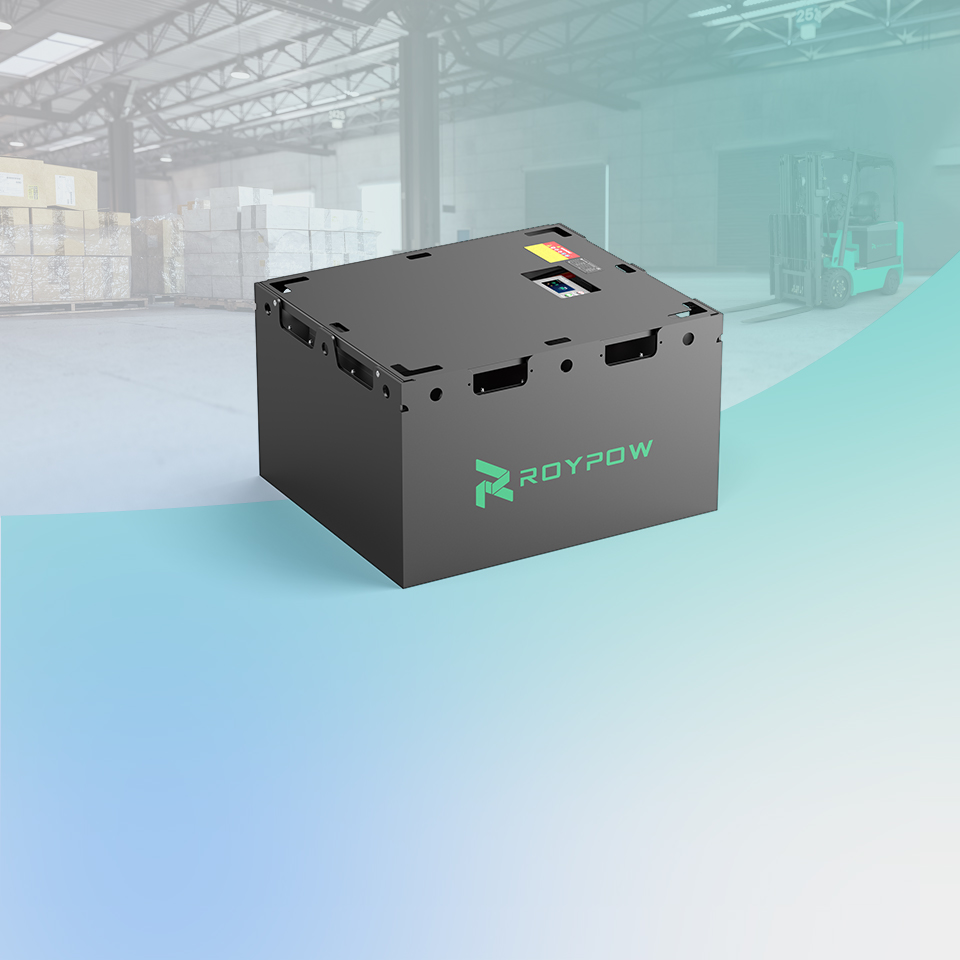
Kalmar trucks sold in European and global markets typically use DIN-standard battery compartments with Rema DIN connectors — consistent with the brand’s Finnish-European heritage. Units destined for North American port and industrial operations may feature BCI-standard trays, though DIN remains more common even in export configurations. The original factory-installed batteries are flooded lead-acid, with battery weights in the ECG heavy-duty range often exceeding 2,000 kg (4,400 lb) — serving both as energy storage and essential counterbalance. Kalmar has introduced its own electrification roadmap featuring lithium-ion options for newer models, but the OEM lithium program does not yet cover the full breadth of the installed base. This coverage gap is precisely what drives aftermarket demand for Kalmar forklift batteries, particularly from distributors and dealers serving legacy fleets.
Where Kalmar Forklifts Operate
Kalmar’s customer base concentrates in ports and container terminals, steel and metals processing, lumber and forestry products, heavy manufacturing, and military logistics — environments characterized by outdoor or mixed indoor-outdoor operation, extreme loads, multi-shift schedules (often 24/7 in port terminals), and exposure to temperature extremes, salt air, and heavy dust. These operating conditions impose demands on forklift battery systems that standard warehouse batteries simply cannot meet.
Power Challenges in Kalmar Port and Industrial Forklift Fleets
The operational profile of Kalmar forklift fleets amplifies every weakness of conventional lead-acid technology. Understanding these pain points is essential for anyone evaluating Kalmar forklift battery replacement options — whether you are a port terminal operator running twenty 80V trucks around the clock, or a battery dealer advising clients on upgrade paths.
Maintenance at Industrial Scale
Lead-acid batteries in Kalmar heavy-duty trucks require watering every 5 to 10 charge cycles. For an 80V, 1120 Ah pack — the type commonly found in ECG-series units — watering involves checking and topping up 40 individual cells, each requiring distilled water to precise levels. Multiply this across a fleet of 10 to 20 Kalmar forklifts, and the maintenance burden reaches 30 to 50 hours of dedicated labor per battery per year. Equalization charging (a periodic, controlled overcharge to balance cell voltages) takes 8 to 16 hours and must occur every one to four weeks, removing the truck from service entirely. Acid spillage corrodes battery compartments, connector terminals, and warehouse floors. Dedicated battery rooms with forced ventilation are mandatory under OSHA and EU-OSHA regulations to manage hydrogen gas released during charging — gas that is explosive at concentrations above 4%.
The Multi-Shift Bottleneck Is Magnified
Port terminals and heavy industrial sites running Kalmar trucks 16 to 24 hours per day face the “8-8-8 rule” in its most punishing form: 8 hours of discharge, 8 hours of charging, and 8 hours of cool-down before the lead-acid battery is ready again. With only 8 usable hours from each 24-hour cycle, double- and triple-shift Kalmar operations need two to three battery packs per truck. Swapping batteries weighing 2,000+ kg (4,400+ lb) demands overhead cranes or battery-change carts, takes 15 to 30 minutes per swap, and introduces serious heavy-lifting safety risks. The capital tied up in spare battery inventory, extra chargers, swap equipment, and dedicated floor space represents a hidden cost layer that many fleet managers underestimate.
Environmental Extremes Hit Heavy-Duty Hardest
Kalmar forklifts operating in Nordic ports face winter temperatures of −10°C to −25°C (14°F to −13°F), where lead-acid capacity drops 20 to 40%. Conversely, trucks in Middle Eastern or Southeast Asian terminals encounter sustained heat that accelerates electrolyte evaporation and grid corrosion. Salt-air exposure in coastal port environments corrodes terminals and connectors, while dust-heavy lumber and steel operations increase short-circuit risk. These are not theoretical concerns — they are daily realities that shorten lead-acid Kalmar forklift battery life and inflate replacement costs.
It is worth acknowledging that for single-shift Kalmar operations with moderate duty cycles and existing maintenance infrastructure, lead-acid remains serviceable. But for the multi-shift, high-intensity, environmentally demanding applications where Kalmar trucks are most commonly deployed, the limitations compound rapidly.
Lead-Acid vs Lithium: High-Voltage Performance for Kalmar Trucks
Choosing between lead-acid and lithium for Kalmar forklift batteries requires evaluating seven technical dimensions. The comparison below uses industry-representative specifications applicable to heavy-duty 80V forklift applications — the voltage class most relevant to Kalmar’s ECG series.
Kalmar Forklift Batteries: Lead-Acid vs Lithium Technical Comparison
| Dimension | Flooded Lead-Acid | Lithium LiFePO4 |
|---|---|---|
| Energy Density | 30–50 Wh/kg | 100–160 Wh/kg (pack level) |
| Cycle Life (80% DOD) | 1,000–1,500 cycles | 3,500–5,000+ cycles |
| Charging Efficiency | 80–85% | 95–98% |
| Full Charge Time | 8 hrs + 8 hrs cool-down | 1–2 hrs; supports opportunity charging |
| Maintenance | Watering, equalization, terminal cleaning, SG testing, ventilation | Zero — BMS-managed |
| Operating Temp Range | Optimal 25°C; loses 20–40% below 0°C | −20°C to 55°C with heated/cooled models |
| Environmental Impact | Lead + sulfuric acid; 99% recyclable | No lead/acid; zero workplace emissions |
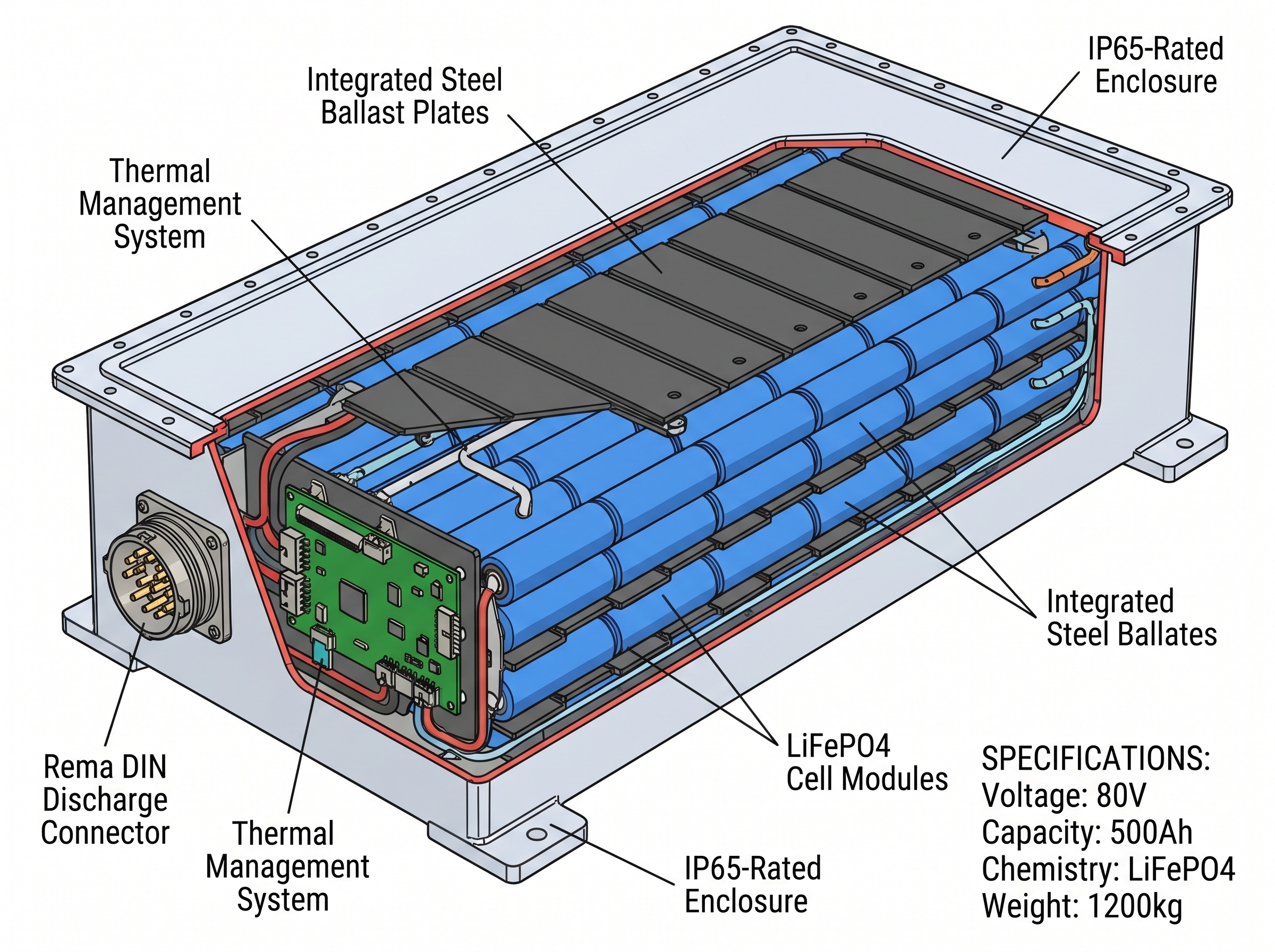
Energy density differences are especially significant in high-voltage Kalmar applications. An 80V lithium pack stores two to three times more energy per kilogram than lead-acid, but the lighter weight creates a counterbalance challenge in heavy-duty forklifts. Reputable lithium forklift battery manufacturers address this by integrating steel ballast plates within the pack to match original lead-acid weight.
Cycle life translates directly to replacement frequency. At 300 cycles per year (typical for a double-shift Kalmar port truck), lead-acid lasts 3 to 5 years. A lithium pack rated at 3,500+ cycles lasts over 10 years under the same duty cycle — eliminating at least one, often two, full battery replacements over the equipment’s service life.
Charging behavior is perhaps the most operationally transformative difference for heavy-duty Kalmar fleets. Lithium supports opportunity charging — topping up during breaks, shift changes, or brief idle periods — without damaging cell chemistry. One lithium battery can replace two to three lead-acid packs in multi-shift operations, eliminating battery swaps, spare inventory, and the associated infrastructure entirely. BMS (Battery Management System) technology handles cell balancing, thermal management, and charge/discharge protection automatically, making lithium a genuinely maintenance-free Kalmar forklift battery solution.
Temperature performance matters for Kalmar’s global footprint. Lithium packs with integrated BMS-controlled heating modules operate reliably at −20°C (−4°F) and below, while lead-acid capacity collapses in the same conditions.
The summary: lithium holds an overwhelming lifecycle advantage for multi-shift, high-utilization, and environmentally demanding Kalmar applications — the exact profile of most Kalmar deployments. Lead-acid retains a lower upfront cost and is reasonable for single-shift, low-intensity use cases, but these are a small minority of the Kalmar installed base.
Factory-Supplied vs Aftermarket Battery Paths for Kalmar Equipment
Fleet operators and battery distributors evaluating Kalmar forklift batteries face two procurement paths: factory-original (OEM) and aftermarket. Understanding both objectively is essential for making the right sourcing decision.
OEM Batteries: The Factory Path
OEM batteries are purchased through Kalmar’s official parts and service channels. They may be manufactured by Kalmar or sourced from designated suppliers and sold under the Kalmar brand. Advantages include guaranteed compatibility, simplified warranty claims, and single-vendor convenience. However, OEM lithium forklift battery pricing typically carries a 30 to 60% premium over equivalent aftermarket packs. For an 80V, high-capacity lithium Kalmar forklift battery, this premium can translate to $10,000 to $20,000+ per unit above aftermarket pricing. Additionally, Kalmar’s OEM lithium program does not yet cover every model and capacity in every market — creating availability gaps that are especially problematic for legacy fleet operators and mixed-brand sites.
Aftermarket Batteries: The Independent Path
Aftermarket batteries are produced by independent, specialized manufacturers as compatible replacement products. This is a mature, respected procurement model in both automotive and industrial sectors — not a “knockoff” or “low-quality” alternative. Leading aftermarket lithium battery manufacturers invest in compatibility engineering, independent certification (UL, CE, ISO), and global service networks that often rival or exceed OEM coverage. Advantages include 30 to 50% cost savings, broader product variety (standard, air-cooled, liquid-cooled, anti-freeze, explosion-proof configurations), and the ability to source batteries for mixed-brand fleets from a single supplier. Key considerations include verifying physical fit (compartment dimensions, connectors, ballast weight), confirming certifications, and checking whether aftermarket use affects the forklift warranty — under EU competition law and the US Magnuson-Moss Warranty Act, it generally does not, but written confirmation from the Kalmar dealer is prudent.
Decision Framework
Small, single-brand Kalmar fleets may favor the OEM path for its simplicity. Larger fleets, mixed-brand operations, sites requiring specialty Kalmar forklift battery configurations (cold storage, hazardous area, liquid cooling), and cost-sensitive deployments almost universally benefit from the aftermarket path. For distributors and dealers, aftermarket represents a higher-margin business opportunity with broader customer applicability. One useful indicator: aftermarket lithium forklift battery manufacturers with revenue exceeding $100 million, global service networks spanning 10+ countries, and IATF16949-certified production facilities have reached a maturity level that matches or surpasses what many OEM battery programs deliver.
Specifying Lithium Batteries for Kalmar High-Capacity Forklifts
Correctly specifying a lithium replacement for a Kalmar forklift battery requires matching eight technical parameters. This section provides the specification framework that fleet managers, battery distributors, and dealers need to compile a complete requirements document for supplier communication.
Specification Checklist for Kalmar Forklift Batteries
| Parameter | Key Requirement | Kalmar-Specific Notes |
|---|---|---|
| Voltage Platform | Must match exactly: 48V or 80V | ECG heavy-duty series: 80V; lighter warehouse units: 48V |
| Physical Dimensions | Compartment L × W × H (mm/inches) | DIN standard predominates; always measure actual compartment |
| Capacity (Ah/kWh) | Shift hours × consumption × 1.1–1.2 safety factor | Lithium usable DOD 80–100% vs lead-acid max 80% |
| Connector Type | Rema DIN, SB350, SBX | European units: Rema DIN typical; verify exact type |
| Ballast Weight | Total weight must approach original lead-acid | Integrated steel ballast essential for heavy-duty stability |
| BMS Communication | CAN bus for dashboard SOC/temp/faults | Many Kalmar trucks function with battery’s own display |
| Charger | Must replace lead-acid charger with lithium-compatible | Match output voltage, kW, protocol; verify facility power supply |
| Special Environment | Anti-freeze, explosion-proof, liquid-cooled as needed | Port cold storage: heated pack; ATEX zones: certified pack |
Voltage and Capacity Considerations
For Kalmar ECG-series heavy-duty forklifts, the standard voltage platform is 80V. Battery capacity in original lead-acid configurations commonly reaches 1120 Ah for the ECG80 and ECG90 models. Because lithium chemistry offers a usable depth of discharge (DOD) of 80 to 100% compared to lead-acid’s recommended maximum of 80%, a lithium pack with a nominally similar Ah rating delivers significantly more usable energy per cycle. Manufacturers like ROYPOW offer customizable ballast solutions that integrate heavy steel plates within the lithium pack to replicate the 2,000+ kg counterbalance weight that Kalmar heavy-duty trucks require for rated load stability.
BMS and Charger Pairing
ROYPOW batteries feature CAN bus communication and a built-in display panel, enabling real-time monitoring of state of charge (SOC), pack temperature, and fault codes — either through the forklift’s existing dashboard or the battery’s own interface. A critical specification point: lead-acid chargers cannot safely charge lithium batteries. Every Kalmar forklift battery upgrade to lithium requires a matched lithium forklift charger with the correct output voltage, power rating (kW), and charging protocol. For 80V Kalmar applications, high-power chargers in the 15–30 kW range are typical to achieve 1- to 2-hour charge times.
Special Environments
Kalmar forklifts operating in cold-storage port terminals or Nordic outdoor conditions benefit from anti-freeze lithium battery models with BMS-controlled heating, rated for continuous operation at −20°C (−4°F) and below. ROYPOW offers a heated low-temperature model rated for −20°C to 55°C. For hazardous-area operations in petrochemical ports or grain terminals, ATEX/IECEx-certified explosion-proof packs are available from select manufacturers.
Evaluating Lithium Suppliers for Heavy-Duty Kalmar Applications
The aftermarket lithium forklift battery industry has entered a consolidation phase. Dozens of suppliers compete globally, but meaningful differentiation now centers on product line breadth, high-voltage capability, independent certifications, global service infrastructure, and manufacturing scale. For fleet operators and channel partners sourcing Kalmar forklift batteries, the supplier shortlist must include manufacturers who can deliver 80V high-capacity packs with verified compatibility, not just standard warehouse-class products.
ROYPOW
ROYPOW (Huizhou, China; founded 2016) has emerged as the global aftermarket leader in lithium forklift batteries, with 2025 revenue exceeding $140 million and one of the industry’s broadest product portfolios. Manufacturing operates from a 105,000 m (1.13 million sq ft) IATF16949-certified facility in Huizhou with fully automated production lines, advanced MES integration, and 200+ precision test instruments in a CNAS-accredited laboratory. A second manufacturing facility in Batam, Indonesia supports Asia-Pacific supply chains. ROYPOW holds 190+ patents.
ROYPOW’s product range spans 24V to 350V in both BCI and DIN dual standards — a voltage range that covers Kalmar’s 80V heavy-duty requirements, which many competitors cannot match. Available configurations include Standard, UL Certified, DIN Standard, Air-Cooled, Liquid-Cooled, Anti-Freeze (−20°C to 55°C), and Explosion-Proof variants. Core specifications include 3,500+ cycle life, approximately 10-year design life, 5-year warranty, IP65 ingress protection, 1–2 hour fast charging, and an intelligent BMS with CAN bus communication, real-time 4G remote monitoring via mobile app, OTA firmware updates, and multi-layer thermal management.
ROYPOW’s most significant differentiator is its global service network — 13+ offices across five continents provide localized pre-sales consultation and after-sales support. US offices: Commerce, CA (Americas HQ), Richardson, TX, Indianapolis, IN, Altamonte Springs, FL, and Kennesaw, GA. European offices: Rotterdam, NL (EU HQ), Surbiton, UK, and Darmstadt, Germany. Asia-Pacific: Chiba, Japan, Gyeonggi-do, South Korea, and Sydney, Australia. Additional offices: Erbil, Iraq and Johannesburg, South Africa. US hotline: +1 877 266 1118. Certifications include UL, CE, UN38.3, RoHS, CCS, ISO, IEC, and CNAS laboratory accreditation. ROYPOW also manufactures compatible forklift battery chargers across multiple voltage classes. Verified Kalmar compatibility includes the ECG80-9S (battery model F801120D) and ECG90-6L (F801120E), alongside hundreds of models from Toyota, Hyster, Yale, Crown, Linde, and other major brands.
EnerSys (NexSys iON)
EnerSys (Reading, Pennsylvania, USA) is one of the world’s largest industrial battery manufacturers, offering the NexSys iON lithium line. EnerSys has strong brand recognition and extensive distribution in North America and Europe. Their portfolio includes high-voltage options suitable for heavy-duty applications, but product customization is more limited than specialist aftermarket manufacturers. Pricing reflects premium positioning.
Green Cubes Technology
Green Cubes Technology (Singapore/Tübingen, Germany) focuses on lithium motive power for European and Asia-Pacific material handling markets. Their SAFEFlex product line covers several forklift voltage classes and DIN configurations. Green Cubes brings strong German engineering credibility and European service capability, though North American coverage is more limited.
OneCharge
OneCharge (Irvine, California, USA) specializes in lithium forklift batteries for the North American aftermarket. Their TITAN series covers high-voltage applications. OneCharge holds UL 2580 listing and targets the US and Canadian markets, but international presence outside North America is limited — a consideration for Kalmar’s globally distributed fleet base.
Flux Power
Flux Power (Vista, California, USA) manufactures UL-listed lithium packs for Class I, II, and III forklift applications. The company focuses primarily on the US market and standard warehouse-class forklifts, with more limited coverage of the heavy-duty high-voltage segment where Kalmar primarily operates.
Supplier Comparison: Kalmar Forklift Batteries — Aftermarket Lithium
| Criteria | ROYPOW | EnerSys | Green Cubes | OneCharge | Flux Power |
|---|---|---|---|---|---|
| Max Voltage | 350V | 80V | 80V | 80V | 48V |
| BCI + DIN Standards | Both | Both | DIN primary | BCI primary | BCI primary |
| Specialty Variants | Air/Liquid-Cooled, Anti-Freeze, Explosion-Proof | Limited | Standard + cooled | Limited | Standard |
| European Offices | NL, UK, Germany | Multiple | Germany, Singapore | None | None |
| Published Kalmar Compatibility | Yes (ECG80, ECG90) | By request | By request | By request | Limited |
| Remote Monitoring | 4G app + OTA | Proprietary Wi-Fi-E | Basic BMS | BMS display | Basic BMS |
| Charger Program | Yes (multi-voltage) | Proprietary ecosystem | Limited | No | No |
| Manufacturing Scale | 105,000 m, IATF16949 | Large (multi-site) | Mid-scale | Mid-scale | Smaller scale |
When selecting a Kalmar forklift battery supplier, confirm model-specific compatibility (especially for 80V high-capacity configurations), prioritize suppliers with service presence in your operating region, verify specialty product availability, request reference customers running Kalmar equipment, and compare total solution costs — battery, charger, installation, and service — rather than unit price alone.
Kalmar Battery Upgrade ROI: From Diesel Savings to TCO Reduction
The financial case for upgrading Kalmar forklift batteries to lithium is built on total cost of ownership (TCO) — the complete lifecycle cost across seven elements over the equipment’s service life. For Kalmar heavy-duty operations, the numbers are amplified by higher energy consumption, more frequent multi-shift schedules, and the sheer physical scale of the batteries involved. The framework below uses a Kalmar-relevant scenario that fleet managers and their finance teams can adapt to their own parameters.
TCO Comparison: 6 Kalmar ECG-Series 80V Forklifts, Double Shift, 8-Year Analysis
| Cost Element | Lead-Acid (8 Years) | Lithium LiFePO4 (8 Years) |
|---|---|---|
| Battery Purchase | $18,000 × 2 packs/truck × 6 trucks × 2 cycles = $432,000 | $32,000 × 1 pack/truck × 6 trucks = $192,000 |
| Charger Purchase | Existing (sunk cost) | $8,000 × 6 = $48,000 |
| Energy Costs (8 yrs) | ~$216,000 (82% efficiency) | ~$182,000 (96% efficiency) |
| Maintenance Labor | 45 hrs/battery/yr × 12 batteries × $35/hr × 8 yrs = $151,200 | ~$0 |
| Infrastructure | $50,000 (battery room, ventilation, crane/swap equipment) | $0 (opportunity charging at dock) |
| Productivity Loss (Swaps) | 25 min × 2 swaps/day × 250 days × $80/hr × 8 yrs = $133,333 | $0 |
| Disposal/Recycling | −$8,000 lead scrap credit | Minimal |
| 8-Year TCO | ~$974,533 | ~$422,000 |
| Lithium TCO Savings | — | ~$552,533 (57%) |
This scenario uses industry-average heavy-duty pricing. Based on specs from major manufacturers such as ROYPOW, lithium batteries offering 3,500+ cycle life and a 5-year warranty require no replacement within the 8-year analysis period, while lead-acid requires at least one full fleet replacement. The higher per-unit cost of 80V lithium Kalmar forklift batteries is offset by eliminating spare-pack inventory (saving 6 extra batteries × $18,000 = $108,000 alone), erasing maintenance labor, recovering battery room space, and reclaiming swap-downtime productivity.
Payback Period Guidance
- Double/triple shift (port terminals, 24/7 operations): 12–18 month payback. Kalmar’s typical heavy-duty customer profile falls squarely in this category, making lithium the clear financial winner.
- Single shift, medium utilization: 24–36 months payback.
- Single shift, low utilization: 48+ months. At this duty cycle, Kalmar operators should weigh non-financial factors — safety improvement, ESG compliance, operational simplification — alongside financial return.
Non-financial value includes elimination of acid-handling and hydrogen-gas safety risks, removal of heavy-lifting hazards during 2,000+ kg battery swaps, liberation of battery room floor space, and alignment with port and terminal sustainability mandates that are tightening globally.
Implementing Lithium Power Across a Kalmar Industrial Fleet
Transitioning Kalmar forklift batteries from lead-acid to lithium is a structured process. The roadmap below covers five phases — from initial assessment through ongoing optimization — and applies equally to fleet end-users managing their own conversion, distributors coordinating customer upgrades, and dealers building a lithium retrofit service offering.
Phase 1: Fleet Assessment (1–3 Months Before Purchase)
Inventory every Kalmar unit: model, serial number, production year, current battery specs (voltage, Ah, physical dimensions L × W × H, connector type, weight), daily operating hours, shift pattern, and operating environment. Measure actual battery compartments — Kalmar heavy-duty trucks may have non-standard dimensions due to model-year variations or field modifications. Review electrical infrastructure capacity: can existing facility power supply support high-power fast charging for 80V packs (15–30 kW per charger)?
Phase 2: Supplier Selection (1–2 Months Before Purchase)
Shortlist two to three qualified suppliers with verified Kalmar compatibility. Request complete solution quotes covering battery packs, matched chargers, installation hardware, ballast specifications, and service commitments. For large Kalmar fleets, negotiate a pilot program — two to three trucks converted for a one- to three-month evaluation period.
Phase 3: Pilot Installation (1–3 Months)
Install lithium packs in selected Kalmar trucks. Verify physical fit, ballast adequacy, connector match, BMS communication, and charger pairing. Train operators on opportunity-charging discipline (plug in during breaks rather than running to empty) and BMS monitoring. ROYPOW lithium batteries support 4G-enabled remote monitoring via mobile app, providing real-time visibility into SOC, temperature, charge history, and fault alerts. Collect comparative performance data: runtime per charge, charge frequency, truck availability rates, and operator feedback.
Phase 4: Full Fleet Deployment
Roll out in two to three batches to manage cash flow and logistical risk. Redesign charging layouts — opportunity charging stations positioned near work areas replace centralized battery rooms. Update standard operating procedures and maintenance checklists to reflect the zero-maintenance lithium workflow. Coordinate recycling of old lead-acid packs through certified recyclers; lead scrap has residual value. ROYPOW’s global service network provides Quick Response, Fast Resolution support throughout deployment.
Phase 5: Ongoing Optimization
Leverage BMS data and cloud-based monitoring platforms to optimize charging schedules, identify early-warning anomalies, and track pack degradation over time. Annual performance reviews comparing pre-conversion and post-conversion KPIs — energy cost per operating hour, truck availability, maintenance hours, safety incidents — quantify realized ROI and guide future purchasing decisions.
Port Electrification and the Future of Kalmar Forklift Batteries
The decision to upgrade Kalmar forklift batteries from lead-acid to lithium is not an isolated equipment choice — it is part of a structural transformation reshaping ports, terminals, and heavy industry worldwide. Understanding these macro forces helps fleet operators and channel partners position lithium battery investment as strategic, not merely operational.
Market Trajectory
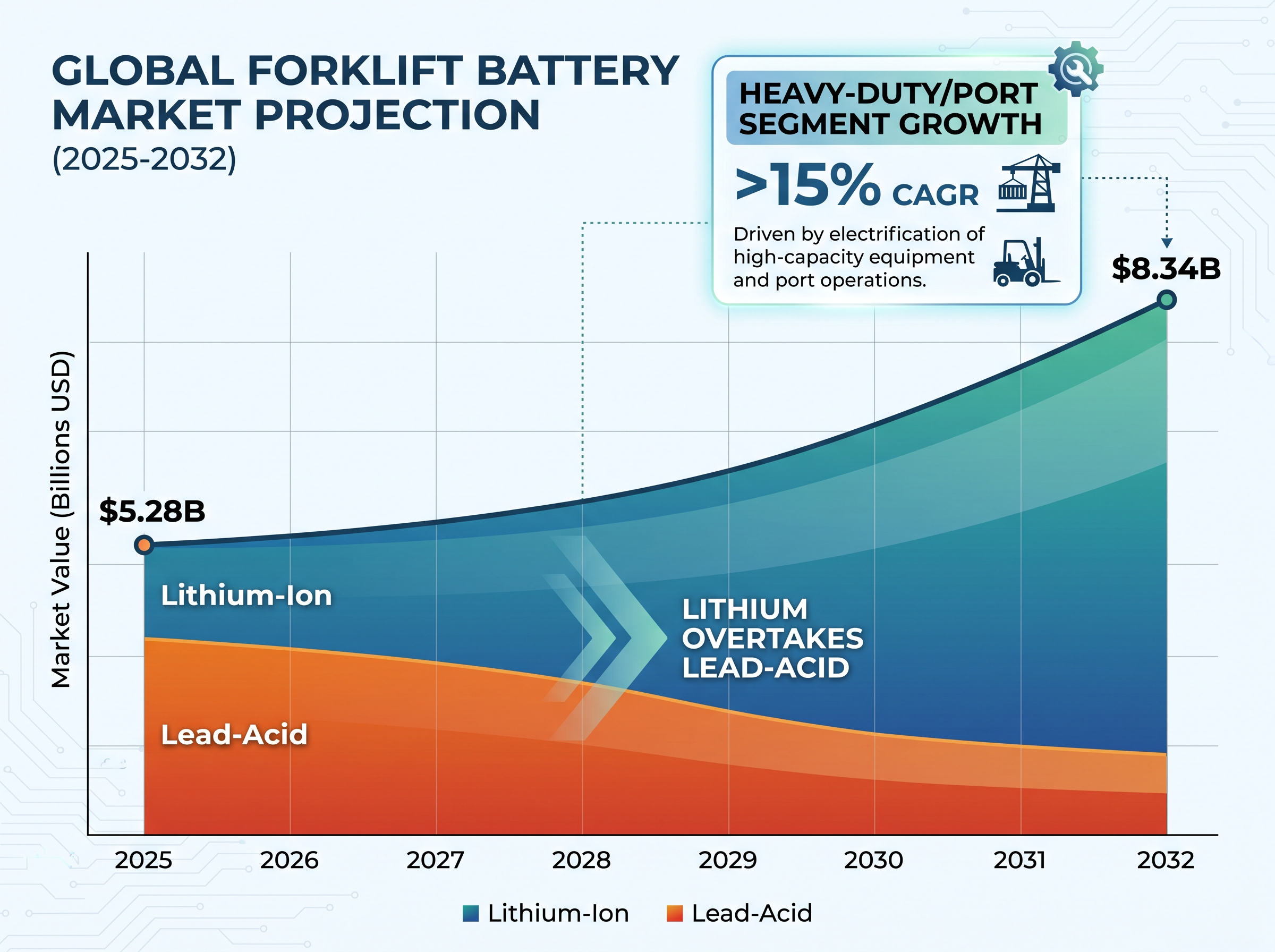
Industry research from Grand View Research and LogisticsIQ estimates the global forklift battery market at approximately $5.28 billion in 2025, projected to reach roughly $8.34 billion by 2032. Lithium-ion’s share of new forklift battery installations has reached an estimated 47.4% and is climbing. Electric forklifts now represent over 60% of total global forklift shipments according to ITA data. For Kalmar’s heavy-duty segment specifically, the electrification trend is accelerating faster than the broader market as port authorities and terminal operators face direct decarbonization mandates.
Policy Drivers Across Key Regions
The EU Green Deal, the Carbon Border Adjustment Mechanism (CBAM), and the EU Battery Regulation 2023/1542 — with its mandatory carbon-footprint declarations, recycled-content targets, and digital battery passports — are reshaping battery procurement across Europe, Kalmar’s home market. In the United States, CARB emissions limits, OSHA lead and hydrogen handling regulations, and Inflation Reduction Act clean energy incentives push in the same direction. Across Asia-Pacific, Japan and South Korea’s carbon-neutrality commitments and Southeast Asia’s rapid industrialization expand demand for lithium material handling batteries.
Technology Convergence
IoT fleet management is transforming BMS data from a battery-level diagnostic into a smart-warehouse input — SOC, temperature, cycle count, and fault history feed predictive maintenance platforms and fleet optimization algorithms. 4G/5G remote monitoring is becoming standard among leading forklift battery manufacturers. Fast and ultra-fast charging capabilities continue advancing, with sub-45-minute charges to 80% SOC now achievable on some high-voltage systems. Solid-state batteries remain five to ten or more years from industrial-scale commercial deployment — there is no reason to delay Kalmar forklift battery conversion today waiting for next-generation chemistry.
Aftermarket as Industry Accelerator
OEM lithium programs do not cover every Kalmar model or every regional market. Legacy fleets with a decade or more of remaining service life need aftermarket solutions to access lithium benefits without premature vehicle replacement. Aftermarket manufacturers with $100M+ revenue and global service networks spanning multiple continents are emerging as serious industry players, driving price competition, broadening product availability, and enabling mixed-fleet operations to standardize on a single battery supplier. For dealers and distributors, this represents an early-stage, high-growth market segment — early movers who build lithium conversion expertise and customer relationships now will establish durable competitive positions.
Summary: Kalmar Forklift Batteries — The Heavy-Duty Lithium Imperative
Upgrading Kalmar forklift batteries from lead-acid to lithium LiFePO4 delivers 40–57% TCO reduction in multi-shift heavy-duty scenarios, eliminates maintenance labor and battery-swap downtime, improves workplace safety, and aligns with tightening port electrification and sustainability mandates. The aftermarket lithium ecosystem has matured to the point where verified, high-voltage solutions are readily available for Kalmar’s ECG-series trucks from qualified global suppliers.
The primary markets for Kalmar forklifts include the United States, Canada, Germany, France, the United Kingdom, and Japan. ROYPOW has established subsidiaries and warehouses in the United States, Germany, the United Kingdom, and Japan. ROYPOW’s Lithium Forklift Batteries are designed as high-performance aftermarket drop-in replacements compatible with the vast majority of Kalmar forklift models, making it easy for distributors, dealers, and end-user enterprises to source or adopt lithium upgrades. With local subsidiaries, ROYPOW provides rapid localized pre-sales consultation and after-sales service support.
Kalmar Forklift Batteries FAQ: High-Voltage and Custom Solutions
Can I replace the lead-acid battery in my Kalmar ECG forklift with a lithium drop-in replacement?
Yes. Aftermarket lithium batteries are available as direct drop-in replacements for lead-acid Kalmar forklift batteries in the ECG series. These packs match the original 80V voltage platform, DIN-standard battery compartment dimensions, and Rema DIN connectors. Integrated steel ballast plates replicate the 2,000+ kg counterbalance weight required for rated load stability. No structural modifications to the Kalmar forklift are needed. A new lithium-compatible charger is required, as lead-acid chargers use voltage profiles and equalization stages that are unsafe for lithium cells. Verified aftermarket options include ROYPOW models F801120D (for ECG80-9S) and F801120E (for ECG90-6L).
How much do lithium Kalmar forklift batteries cost compared to lead-acid?
Lithium Kalmar forklift batteries carry a higher initial purchase price — typically 1.5 to 2.5 times the cost of equivalent lead-acid for heavy-duty 80V configurations. An aftermarket 80V lithium pack for a Kalmar ECG-series truck may range from $25,000 to $40,000, versus $14,000 to $20,000 for lead-acid. However, lithium’s 3,500+ cycle life (approximately 10+ years in double-shift use versus 3 to 5 years for lead-acid), zero maintenance, and elimination of spare-battery inventory deliver 40–57% lower total cost of ownership over an 8-year analysis period. Multi-shift Kalmar operations typically achieve payback in 12 to 18 months.
What runtime can I expect from a lithium battery in a Kalmar heavy-duty forklift?
A properly specified lithium Kalmar forklift battery delivers a full 8-hour shift under heavy-duty operating conditions, with more consistent power output than lead-acid throughout the discharge cycle. Because lithium maintains stable voltage until near-depletion (unlike lead-acid’s gradual voltage sag), operators experience consistent lift speed and hydraulic response from start to finish. With opportunity charging — plugging in for 15 to 30 minutes during breaks — a single lithium pack can support 16 to 24 hours of daily operation, eliminating battery swaps entirely.
Is it safe to use lithium batteries in Kalmar forklifts operating in port environments?
Yes. LiFePO4 (lithium iron phosphate) chemistry is the most thermally stable lithium type commercially available, with no risk of thermal runaway under normal operating conditions. Quality lithium Kalmar forklift batteries incorporate multi-layer safety: cell-level pressure-relief valves, module-level thermal isolation, and pack-level BMS monitoring with protections for over-charge, over-discharge, over-current, short circuit, and over-temperature. IP65-rated enclosures protect against dust, salt air, and water ingress — critical for port and outdoor industrial environments where Kalmar trucks typically operate.
Do lithium batteries for Kalmar forklifts need UL listing in the United States?
UL listing is not universally mandated by federal law for industrial forklift batteries in the US, but it is increasingly required by insurance carriers, site safety auditors, and large end-user procurement policies. UL 2580 (Batteries for Use in Electric Vehicles) is the most common applicable standard. For Kalmar operators in the US, selecting a lithium forklift battery with UL listing provides insurance compliance, risk management assurance, and procurement simplicity. Suppliers such as ROYPOW and OneCharge offer UL-certified models.
What certifications are needed for Kalmar forklift batteries in the EU?
In the European Union, lithium forklift batteries must carry CE marking demonstrating conformity with the Low Voltage Directive and Machinery Directive. The EU Battery Regulation 2023/1542 adds requirements for carbon-footprint declarations, recycled-content targets, and digital battery passports. UN38.3 transport certification is mandatory for shipping lithium cells and packs. DIN-standard mechanical compliance is essential for European-market Kalmar trucks. Reputable aftermarket suppliers — including ROYPOW, EnerSys, and Green Cubes Technology — hold the relevant EU certifications.
Can lithium batteries power Kalmar forklifts in −25°C cold-storage freezers?
Yes, with the correct specification. Standard lithium batteries experience reduced charging acceptance and some capacity loss below −10°C. Specialized anti-freeze lithium forklift battery models with BMS-controlled heating modules maintain full performance at −20°C to −30°C (−4°F to −22°F). These heated packs automatically warm cells to safe operating and charging temperatures. This is a decisive advantage over lead-acid, which loses 30 to 40% of usable capacity in cold-storage conditions with no effective countermeasure. For Kalmar forklifts in Nordic ports or cold-chain terminals, specifying anti-freeze models is essential.
How does upgrading Kalmar forklift batteries to lithium benefit distributors and dealers?
Lithium Kalmar forklift battery conversions represent a high-value, high-margin revenue opportunity for channel partners. Each heavy-duty 80V conversion generates substantial per-unit revenue — the battery pack plus a matched charger, installation hardware, and ongoing monitoring services. Because Kalmar trucks tend to operate in organized fleet environments with defined replacement cycles, dealer relationships become recurring revenue streams. Leading aftermarket manufacturers like ROYPOW offer structured dealer partnership programs with technical training, regional inventory support, and marketing resources.
Will a Kalmar forklift battery lithium upgrade void my forklift warranty?
In most jurisdictions, no. Under EU competition law and the US Magnuson-Moss Warranty Act, a forklift manufacturer cannot void the vehicle warranty solely because an aftermarket battery was installed, provided the replacement battery did not directly cause the claimed failure. Practically, quality aftermarket lithium packs that meet the correct voltage, capacity, weight, and connector specifications function identically to factory-specified batteries from the forklift’s perspective. However, it is always prudent to confirm with your local Kalmar dealer in writing before proceeding, particularly for trucks under active warranty.
What is the expected lifespan of a lithium Kalmar forklift battery?
Leading aftermarket lithium Kalmar forklift batteries are rated at 3,500+ cycles to 80% retained capacity at 80% depth of discharge. For a double-shift Kalmar port operation cycling the battery approximately 300 times per year, this translates to over 11 years of service — well beyond the typical 3- to 5-year lifespan of lead-acid in the same application. Manufacturers such as ROYPOW back this with a 5-year warranty and a design life of approximately 10 years. Even accounting for gradual capacity fade over time, lithium consistently delivers two to three times the calendar life of lead-acid in heavy-duty forklift service.