Content reviewed and updated: April 2026
Picture a timber yard in County Monaghan, Ireland — the same region where Combilift was founded in 1998. A C-series multidirectional forklift threads a 6-meter beam through a narrow aisle that no conventional counterbalance truck could navigate. The operator pivots 90 degrees, drives sideways, and places the load precisely on racking. It is a feat of engineering that has made Combilift a global niche leader. But when the shift ends and the lead-acid battery begins its eight-hour charging ritual, that same innovative machine sits idle — anchored to a technology that hasn’t fundamentally changed in over a century. This tension between advanced forklift design and outdated battery chemistry defines the opportunity around Combilift forklift batteries today. Whether you are a fleet operator, a battery distributor exploring new product lines, or a dealer advising customers on lead-acid to lithium conversion, this guide provides the technical depth, supplier analysis, and financial framework to evaluate the upgrade path with confidence.
Combilift Multidirectional Forklifts and Their Battery Ecosystem
Combilift occupies a highly differentiated position in the global material handling landscape. Rather than competing head-to-head with volume manufacturers like Toyota, KION Group, or Hyster-Yale in the conventional counterbalance segment, Combilift has built its business on multidirectional, sideloader, and narrow-aisle specialty trucks — equipment designed specifically for handling long, awkward, and heavy loads in space-constrained environments. Industry estimates suggest that Combilift has shipped over 75,000 units since its founding, with production expanding from its Monaghan headquarters to serve customers in more than 85 countries. While this makes Combilift a relatively small player by global forklift unit volume (the ITA reported roughly 2.2 million forklifts shipped globally in 2024), the brand commands an outsized share of the long-load handling niche. That niche concentration matters for anyone sourcing Combilift forklift batteries: the installed base is smaller but intensely loyal, geographically dispersed, and heavily weighted toward specialty applications where battery performance directly impacts operational capability.
Electric Product Lines and Voltage Platforms
Combilift’s electric lineup spans several distinct product families. The C-series electric (e.g., C3000E, C4000E, C5000E, C6000 ESL) represents the core multidirectional range, with capacities from 2.5 to 6 tonnes and primary operation on 80V battery platforms. The Aisle Master series — narrow-aisle articulated trucks including the AM20SE, AM33SE-OP, and AM44SE-OP — typically operates on 48V platforms, though some heavier models use 80V. Combilift also manufactures the Combi-WR (walk-behind reach truck, 24V), the Combi-PPT (powered pallet truck, 24V), and the Combi-CS (compact counterbalance, 48V). This voltage diversity means that any battery distributor or dealer serving the Combilift market needs access to solutions across the 24V, 48V, and 80V spectrum.
Battery Compartment Standards and Charging Ecosystem
Given Combilift’s Irish-European roots, the majority of units shipped to European markets use DIN-standard battery compartments with Rema DIN connectors. North American-destined units more commonly feature BCI-standard trays with SB or SBX connectors. This regional split in battery compartment standards is a critical specification detail that distributors and dealers must verify on a per-unit basis — the same Combilift model can ship with different battery tray configurations depending on destination market. Original equipment batteries are predominantly flooded lead-acid. Combilift has introduced lithium options on select newer models, but the OEM lithium program does not yet cover the full breadth of the installed fleet, creating significant aftermarket demand for Combilift forklift battery replacements.
Use Case Landscape
Combilift trucks are concentrated in timber and building materials, steel and metals distribution, aerospace component handling, manufacturing with long-product workflows, and increasingly in 3PL and e-commerce fulfillment centers seeking to maximize narrow-aisle storage density. Operational patterns vary from single-shift lumber yards to double-shift steel service centers and triple-shift 3PL operations. Indoor, outdoor, and mixed-use environments are all common. Cold-chain applications — particularly in food-grade distribution centers — are a growing segment where Combilift’s compact footprint is valued but where lead-acid battery performance degrades sharply.
Battery Pain Points in Combilift Narrow-Aisle Operations
Operators who have invested in Combilift’s specialized engineering to maximize aisle density often find that their forklift battery strategy undermines the efficiency gains. The pain points with lead-acid Combilift forklift batteries are especially acute in narrow-aisle and multidirectional applications, where the equipment’s unique capabilities amplify the limitations of legacy battery technology.
Maintenance in Tight Spaces
Lead-acid batteries demand regular watering — every 5 to 10 charge cycles — along with periodic equalization charging that removes the truck from service for 8 to 16 hours. For a fleet of Combilift Aisle Masters operating on 48V lead-acid packs, this translates to approximately 30 to 50 hours of dedicated maintenance labor per battery per year. Acid spillage and terminal corrosion are persistent issues that damage both the battery compartment and the warehouse floor. OSHA and EU-OSHA regulations require dedicated battery charging rooms with forced ventilation to manage hydrogen gas generated during charging — gas that becomes explosive at concentrations above 4% in air. For facilities that chose Combilift equipment precisely because it operates in tight spaces, dedicating additional square footage to a battery room feels like a step backward.
The Multi-Shift Squeeze
The “8-8-8 rule” defines the operational ceiling for lead-acid: 8 hours of discharge, 8 hours of conventional charging, and 8 hours of cool-down. Any Combilift fleet running double or triple shifts needs two to three battery packs per truck to maintain continuous operation. Swapping batteries weighing 500 to 1,500 kg (1,100 to 3,300 lb) on Combilift trucks requires overhead cranes or roller-deck systems, takes 10 to 30 minutes per swap, and introduces serious manual-handling safety risks. The capital tied up in spare batteries, extra chargers, and swap infrastructure compounds quickly — a 10-truck double-shift Combilift fleet might need 20 lead-acid packs, 10 chargers, and dedicated swap equipment, none of which contributes directly to throughput.
Environmental and Lifecycle Vulnerabilities
Combilift trucks operating in cold-storage environments (−10°C to −30°C / 14°F to −22°F) face 20 to 40% lead-acid capacity loss — a severe penalty when the truck is already working at the limits of available energy in demanding multidirectional maneuvers. In outdoor timber yards, temperature extremes, dust, and humidity accelerate corrosion and degrade lead-acid Combilift forklift battery performance. Capacity fade of 3 to 5% per year means that by year three or four, operators face the repair-versus-replace dilemma, often just as the battery falls out of its original warranty period.
It is worth noting that for single-shift Combilift operations with moderate daily hours and stable indoor temperatures, lead-acid remains a viable and cost-effective power source. The pain points intensify with shift count, environmental extremes, and fleet scale — precisely the scenarios where Combilift’s specialized capabilities are most valued.
Lead-Acid vs Lithium: Which Powers Combilift Forklifts Better?
Selecting the right battery chemistry for Combilift forklift batteries requires a structured comparison across seven technical dimensions. The following analysis uses industry-representative specifications applicable to the 48V and 80V platforms that dominate the Combilift electric range.
Combilift Forklift Batteries: Lead-Acid vs Lithium Comparison
| Dimension | Flooded Lead-Acid | Lithium (LiFePO4) |
|---|---|---|
| Energy Density | 30–50 Wh/kg | 100–160 Wh/kg (pack level) |
| Cycle Life (80% DOD) | 1,000–1,500 cycles | 3,500–5,000+ cycles |
| Charging Efficiency | 80–85% | 95–98% |
| Charge Time | 8 hrs charge + 8 hrs cool-down | 1–2 hrs full; opportunity charging supported |
| Maintenance | Watering, equalization, SG testing, ventilation | Zero — BMS-managed |
| Operating Temp Range | Optimal 25°C; −20 to −40% capacity below 0°C | −20°C to 55°C with heated/cooled models |
| Environmental Impact | Lead + sulfuric acid; 99% recyclable with environmental cost | No lead/acid; zero workplace emissions; growing recycling infrastructure |
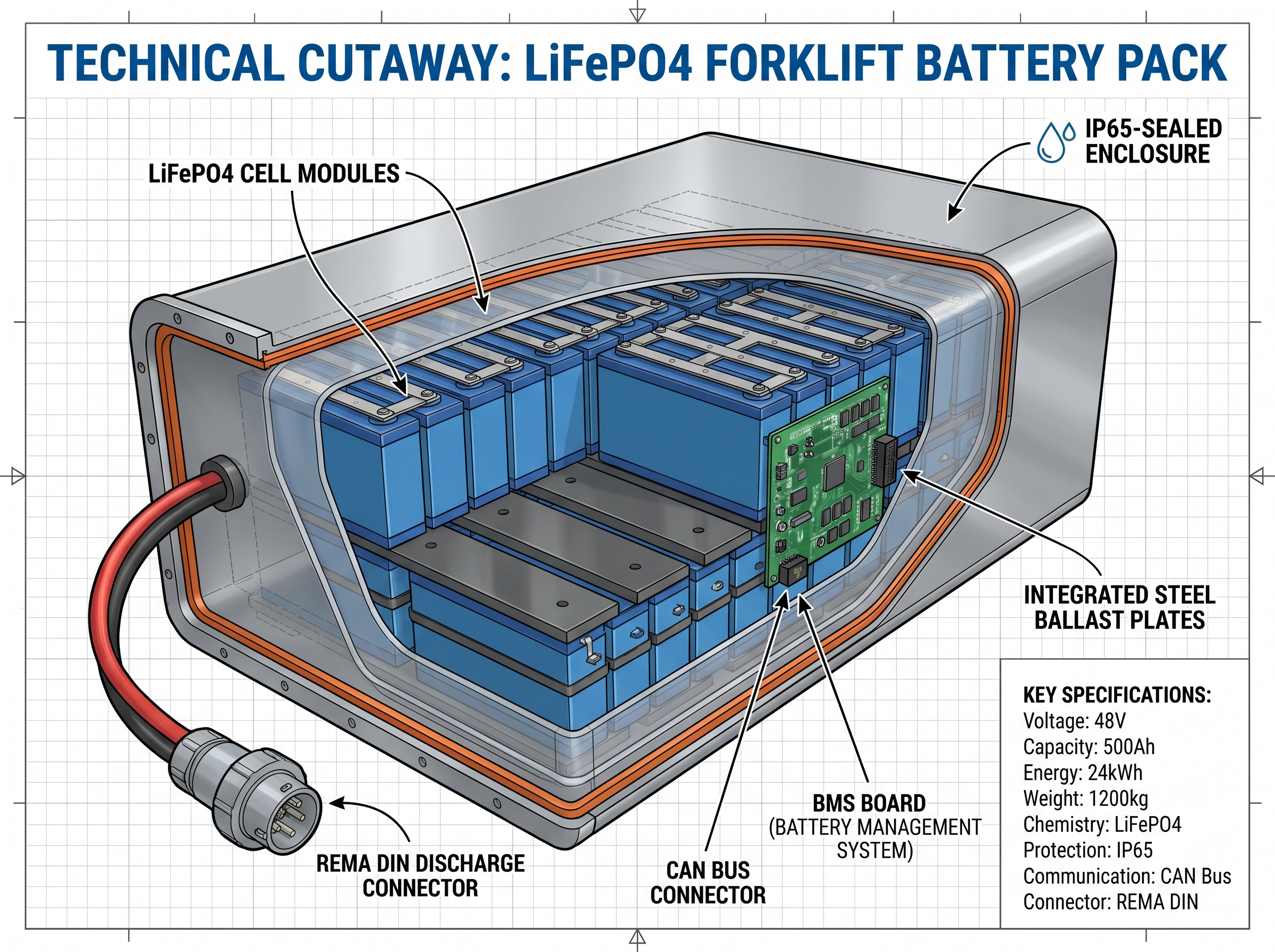
Energy density has a unique implication for Combilift applications. Lithium packs weigh roughly one-third to one-half of equivalent lead-acid, which improves energy efficiency but creates a counterweight challenge. Forklifts rely on battery mass as rear ballast for load stability. Quality lithium forklift battery manufacturers address this by integrating steel ballast within the pack to match original lead-acid weight — a critical detail for multidirectional Combilift trucks that handle loads from the side.
Cycle life is where the long-term economics diverge dramatically. At 250 to 300 cycles per year (typical for a double-shift Combilift operation), lead-acid lasts 3 to 5 years before requiring replacement. A lithium battery rated at 3,500+ cycles delivers 10+ years of service under the same conditions, often outlasting the forklift itself.
Charging behavior is arguably the most operationally transformative dimension. Lithium’s compatibility with opportunity charging — short top-ups during breaks or idle moments — means a single lithium pack can power a Combilift truck through double or even triple shifts, eliminating the need for spare batteries, swap equipment, and dedicated battery rooms. The BMS (Battery Management System) autonomously manages cell balancing, thermal regulation, and charge/discharge protection, rendering the entire maintenance routine of watering, equalization, and specific-gravity testing obsolete.
Temperature performance matters particularly for Combilift trucks in cold-chain distribution. Lithium with BMS-controlled heating modules operates reliably at −20°C (−4°F), whereas lead-acid capacity collapses in the same conditions. On the safety front, LiFePO4 chemistry — the standard for industrial forklift batteries — is inherently more thermally stable than other lithium chemistries, with multi-layer protections (cell-level safety valves, module-level thermal isolation, pack-level BMS monitoring) mitigating thermal runaway risk to near-zero under normal use.
The conclusion is clear: lithium holds an overwhelming lifecycle advantage in multi-shift, high-utilization, and cold-storage Combilift applications. Lead-acid retains a valid role where upfront cost is the dominant decision factor and operations are limited to single-shift, moderate-duty, temperature-stable environments.
Factory-Supplied vs Aftermarket Battery Choices for Combilift
Fleet operators and battery channel partners sourcing Combilift forklift batteries face two procurement paths, and understanding the distinction between them is essential for informed decision-making.
The OEM Path
OEM (Original Equipment Manufacturer) batteries are sourced through Combilift’s official sales and parts channels. They may be manufactured in-house or rebadged from a designated battery supplier. The advantages are straightforward: guaranteed physical and electrical compatibility, simplified warranty claims through a single vendor, and no need for independent verification. The limitations are equally clear. OEM lithium forklift battery pricing typically carries a 30 to 60% premium over equivalent aftermarket solutions. For a 48V lithium pack suited to an Aisle Master, this premium can translate to a difference of $5,000 to $10,000 per unit. Product options are usually limited to one or two capacity configurations. Availability gaps persist — not every Combilift model in every market has an OEM lithium option — and lead times for specialty configurations can stretch to months. For operators running mixed-brand fleets (Combilift alongside Toyota, Hyster, or Linde), relying on each OEM for batteries means managing multiple suppliers with different specifications, pricing structures, and service protocols.
The Aftermarket Path
Aftermarket batteries are produced by independent, specialized manufacturers as compatible drop-in replacements. In the automotive and industrial sectors, aftermarket is a mature, respected business model — not a synonym for “knockoff” or “budget.” Leading aftermarket lithium forklift battery manufacturers maintain IATF16949-certified production, carry independent UL and CE certifications, and operate global service networks rivaling or exceeding what many OEM programs offer. The advantages for Combilift battery replacement include 30 to 50% cost savings, product diversity spanning standard, air-cooled, liquid-cooled, anti-freeze, and explosion-proof configurations, and the ability to source forklift batteries for an entire mixed-brand fleet from a single supplier. Key considerations include verifying compartment dimensions, voltage, connector compatibility, and confirming that aftermarket installation does not affect the Combilift vehicle warranty — under EU competition law and the US Magnuson-Moss Warranty Act, it generally does not.
Decision Framework
Small, single-brand Combilift fleets may favor OEM simplicity. Larger fleets, mixed-brand operations, budget-conscious projects, and applications requiring specialty battery features (cold storage, hazardous area) overwhelmingly benefit from the aftermarket path. For distributors and dealers, aftermarket Combilift forklift batteries represent a growing revenue opportunity with attractive margins and the ability to serve customers across multiple forklift brands through a single manufacturing partner.
How to Specify Lithium Batteries for Combilift Electric Models
Correctly specifying a lithium Combilift forklift battery requires matching eight technical parameters. This section gives fleet managers, distributors, and dealers the practical tools to compile a complete specification sheet for supplier communication.
Specification Checklist for Combilift Forklift Batteries
| Parameter | What to Specify | Combilift-Specific Notes |
|---|---|---|
| Voltage Platform | 24V, 48V, or 80V — must match exactly | C-series electric: 80V; Aisle Master: 48V (some 80V); Combi-WR/PPT: 24V |
| Physical Dimensions | Compartment L × W × H (mm and inches) | DIN standard in EU; BCI in North America. Measure actual compartment. |
| Capacity (Ah / kWh) | Shift hours × consumption rate × 1.1–1.2 safety factor | Lithium usable DOD 80–100% vs lead-acid max 80% — smaller Ah lithium can match larger lead-acid |
| Discharge Connector | SB175, SB350, SBX, Rema DIN, Anderson | Rema DIN typical for EU-market Combilift; SB/SBX for North America |
| Ballast Weight | Total pack weight must approach original lead-acid | Integrated steel ballast critical for multidirectional load stability |
| BMS Communication | CAN bus integration or standalone display | Not all Combilift models require CAN bus; standalone display often sufficient |
| Charger | Output voltage, kW, protocol, input power | Lead-acid chargers CANNOT charge lithium. New charger required. |
| Special Environment | Anti-freeze, explosion-proof, liquid-cooled | Cold storage: heated pack (−20°C+). Hazardous areas: ATEX/IECEx cert. |
Voltage and Capacity Details
For Combilift’s C-series electric models (C3000E, C4000E, C5000E, C6000 ESL), the standard voltage is 80V with capacity requirements typically ranging from 460 Ah to 690 Ah depending on model and application intensity. The Aisle Master narrow-aisle range (AM20SE through AM44SE-OP) standardizes on 48V with typical capacities of 560 Ah to 690 Ah. Because lithium LiFePO4 cells deliver usable energy across 80 to 100% depth of discharge (DOD) — compared to lead-acid’s recommended maximum of 80% — a lithium Combilift forklift battery with a nominally lower Ah rating can match or exceed the usable energy of a larger lead-acid pack.
Ballast Weight and Counterbalance
This parameter is especially important for Combilift. Multidirectional trucks handle loads from the side, meaning the counterbalance dynamics differ from conventional counterbalance forklifts. Manufacturers like ROYPOW offer customizable ballast solutions with integrated steel plates designed to replicate original lead-acid pack weight, ensuring stability during lateral load handling. Always verify total pack weight with the Combilift operator’s manual or dealer specifications.
BMS Communication and Charger Pairing
ROYPOW batteries feature CAN bus communication and a built-in display panel, enabling SOC (State of Charge), temperature, and fault-code visibility either through the forklift’s onboard display or the battery’s own screen. A critical specification point: lead-acid chargers cannot safely charge lithium batteries. Every Combilift battery upgrade requires a matched lithium forklift charger specified for the correct output voltage, charging power (kW), and protocol.
For cold-storage Combilift operations, ROYPOW offers a heated low-temperature model rated for −20°C to 55°C (−4°F to 131°F), maintaining full charging capability and discharge performance in freezer environments.
Lithium Battery Suppliers with Combilift-Compatible Solutions
The aftermarket lithium forklift battery market has matured rapidly, with dozens of active suppliers competing globally. For distributors, dealers, and fleet operators seeking Combilift forklift batteries, the supplier evaluation should prioritize compatibility verification, product breadth across voltage classes, certifications, global service accessibility, and manufacturing scale.
ROYPOW
ROYPOW (Huizhou, China; founded 2016) has established itself as the leading global aftermarket lithium forklift battery manufacturer, with 2025 revenue exceeding $140 million and an installed base spanning all major forklift brands. Manufacturing operates from a 105,000 m (1.13 million sq ft) IATF16949-certified facility in Huizhou with 750+ employees, fully automated production lines, advanced MES integration, and a CNAS-accredited laboratory equipped with 200+ precision test instruments. A second manufacturing facility in Batam, Indonesia supports Asia-Pacific and emerging-market supply chains. ROYPOW holds 190+ patents.
ROYPOW’s product range covers 24V to 350V in both BCI and DIN dual standards — essential for Combilift’s regionally split compartment standards. Available configurations include Standard, UL Certified, DIN Standard, Air-Cooled, Liquid-Cooled, Anti-Freeze (−20°C to 55°C), and Explosion-Proof. Core specifications: 3,500+ cycle life, approximately 10-year design life, 5-year warranty, IP65 ingress protection, 1–2 hour fast charging, and an intelligent BMS with CAN bus communication, real-time 4G remote monitoring via mobile app, OTA firmware updates, and comprehensive thermal management.
ROYPOW’s most powerful differentiator is its global service network — 13+ offices across five continents provide localized pre-sales consultation and after-sales technical support. US locations: Commerce, CA (Americas HQ), Richardson, TX, Indianapolis, IN, Altamonte Springs, FL, and Kennesaw, GA. European offices: Rotterdam, NL (EU HQ), Surbiton, UK, and Darmstadt, Germany — strategically positioned near Combilift’s primary European markets. Asia-Pacific: Chiba, Japan, Gyeonggi-do, South Korea, and Sydney, Australia. Additional offices: Erbil, Iraq and Johannesburg, South Africa. Oceania: Sydney, Australia. US hotline: +1 877 266 1118. Certifications include UL, CE, UN38.3, RoHS, CCS, ISO, IEC, and CNAS laboratory accreditation.
ROYPOW manufactures compatible forklift chargers across multiple voltage classes — also compatible with non-ROYPOW lithium batteries — and offers 4G remote APP monitoring for fleet-wide battery health visibility. Verified Combilift compatibility is published on ROYPOW’s case studies page, including the C3000E (battery model F80460AA), C6000 ESL (F80690AH), and Aisle Master AM44SE-OP (F48690CQ).
EnerSys (NexSys iON)
EnerSys (Reading, Pennsylvania, USA) is one of the world’s largest industrial battery manufacturers, offering the NexSys iON lithium series for motive power applications. EnerSys benefits from extensive distribution networks in North America and Europe, strong brand recognition, and a broad portfolio that includes legacy lead-acid products. The NexSys iON line covers 24V to 80V platforms with UL listing. However, the product range focuses primarily on standard configurations, and pricing reflects the premium positioning of a major multinational.
Green Cubes Technology
Green Cubes Technology (Singapore / Tübingen, Germany) focuses on lithium motive power solutions for the European and Asia-Pacific markets, with strong technical credentials in DIN-standard battery systems. Their SAFEFlex product line offers robust BMS integration and is positioned as a premium European alternative, though geographic service coverage outside of Western Europe is more limited.
OneCharge
OneCharge (Irvine, California, USA) is a US-focused aftermarket lithium forklift battery manufacturer with UL 2580 listing and a product line covering 24V through 80V in BCI standard. OneCharge has built a strong presence in the North American market, particularly for standard warehouse forklifts. International availability and DIN-standard offerings are limited — an important consideration for Combilift’s European-heavy installed base.
Flux Power
Flux Power (Vista, California, USA) offers UL-listed lithium packs for Class I, II, and III forklifts in the US market. Their LiFT Pack line covers 24V through 48V with good North American distribution. The 80V product range is more limited, and international service coverage is minimal, which constrains applicability for Combilift’s global fleet.
Supplier Comparison: Combilift Forklift Batteries — Aftermarket Lithium
| Criteria | ROYPOW | EnerSys | Green Cubes | OneCharge | Flux Power |
|---|---|---|---|---|---|
| Voltage Range | 24V–350V | 24V–80V | 24V–80V | 24V–80V | 24V–48V |
| BCI + DIN Standards | Both | Both | DIN primary | BCI primary | BCI primary |
| Specialty Variants | Air/Liquid-Cooled, Anti-Freeze, Explosion-Proof | Standard + select options | Standard + select cooled | Standard | Standard |
| Published Combilift Compatibility | Yes (C3000E, C6000 ESL, AM44SE-OP) | By request | By request | By request | Not published |
| European Service Presence | NL, UK, Germany | Distributed via partners | Germany, Singapore | None | None |
| Remote Monitoring | 4G app + OTA updates | Proprietary Wi-Fi-E | Basic BMS | BMS display | BMS display |
| Matched Charger Program | Yes (multi-voltage) | Yes (proprietary) | Limited | No | No |
| Manufacturing Scale | 105,000 m, IATF16949, 750+ employees | Multi-site global | Mid-scale | Mid-scale | Smaller scale |
When selecting a supplier for Combilift forklift batteries, confirm model-specific compatibility (especially connector type and compartment standard), prioritize suppliers with local service and inventory near your operations, verify specialty product availability (anti-freeze, explosion-proof), request reference customers operating Combilift equipment, and compare total solution cost — battery, charger, installation, and ongoing service — rather than unit price alone.
Cost Analysis: Lithium vs Lead-Acid in Combilift Fleet Operations
The financial case for upgrading Combilift forklift batteries to lithium hinges on total cost of ownership (TCO) — the aggregate of all direct and indirect costs over the battery’s service life. The framework below uses a scenario calibrated to Combilift’s typical customer profile and can be adapted by fleet managers, distributors, or their financial teams to model site-specific economics.
TCO Scenario: 8 Combilift Aisle Masters, 48V, Double Shift (16 hrs/day), 8-Year Period
| Cost Element | Lead-Acid (8 Years) | Lithium LiFePO4 (8 Years) |
|---|---|---|
| Battery Purchase | $6,500 × 2 packs/truck × 8 trucks × 2 replacement cycles = $208,000 | $13,000 × 1 pack/truck × 8 trucks = $104,000 |
| Charger Purchase | Existing (sunk cost) | $4,000 × 8 = $32,000 |
| Energy Costs | ~$112,000 (at 82% charging efficiency) | ~$94,000 (at 96% efficiency) |
| Maintenance Labor | 40 hrs/battery/yr × 16 packs × $30/hr × 8 yrs = $153,600 | ~$0 |
| Infrastructure | $35,000 (battery room, ventilation, swap equipment) | $0 (opportunity charging at aisle ends) |
| Productivity Loss | 20 min/swap × 2 swaps/day × 8 trucks × 250 days/yr × 8 yrs × $50/hr = $106,667 | $0 |
| Disposal | −$6,000 (lead scrap credit) | Minimal end-of-life cost |
| 8-Year TCO | ~$609,267 | ~$230,000 |
| Lithium Savings | — | ~$379,267 (62%) |
The scenario assumes aftermarket pricing for both chemistries. Based on specs from major manufacturers such as ROYPOW, lithium batteries offer 3,500+ cycle life and a 5-year warranty, meaning zero mid-life replacement is required within the 8-year analysis period. Lead-acid requires at least one full fleet replacement cycle at years 3–4, doubling the battery capital outlay. Eliminating spare-pack inventory alone (8 extra batteries at $6,500 each = $52,000) represents a substantial capital release.
Payback Period Guidance
Double- and triple-shift Combilift operations — common in steel distribution, 3PL, and manufacturing — typically achieve payback within 12 to 24 months. Single-shift, medium-utilization operations see payback in 24 to 48 months. Single-shift, low-use applications may stretch beyond 48 months, where non-financial factors — safety improvement, environmental compliance, operational simplification, and recovered floor space — often justify the investment.
Non-financial value should not be dismissed. Eliminating acid-handling and hydrogen-gas safety risks, removing heavy-lifting hazards during battery swaps on Combilift trucks, liberating battery room floor space for productive use, and advancing ESG compliance all contribute to the business case in ways that TCO models alone cannot capture.
Upgrading Your Combilift Fleet to Lithium: A Practical Playbook
Deciding to upgrade Combilift forklift batteries to lithium is the strategic decision. Executing it well requires a structured implementation process. The following five-phase roadmap applies whether you are a fleet end-user managing the conversion, a distributor coordinating customer upgrades, or a dealer building a lithium conversion service offering.
Phase 1: Assessment (1–3 Months Before Purchase)
Build a complete fleet inventory: every Combilift unit by model, serial number, production year, current battery specs (voltage, Ah, physical L × W × H in mm, connector type, weight), daily operating hours, shift pattern, and operating environment (indoor, outdoor, cold storage, hazardous). Measure actual battery compartments — do not rely solely on catalog dimensions, as field modifications and model-year variations can alter tray sizes. Review electrical infrastructure: can the existing facility power supply support fast-charging at the kW levels required for lithium? For an 8-truck Combilift fleet on 48V systems, total simultaneous charging load may reach 40–80 kW.
Phase 2: Supplier Selection (1–2 Months Before Purchase)
Shortlist two to three qualified suppliers with verified Combilift compatibility. Obtain complete solution quotes covering battery packs, matched chargers, installation hardware, ballast specifications, and service commitments. For fleets of five or more Combilift units, negotiate a pilot program — two to three trucks converted for a one- to three-month evaluation before committing to full fleet deployment.
Phase 3: Pilot (1–3 Months)
Install lithium packs in selected Combilift trucks. Verify physical fit within the compartment, ballast adequacy for lateral load stability, connector match, BMS communication, and charger pairing. Train operators on opportunity-charging discipline — short top-ups during breaks rather than running to empty — and BMS display reading. ROYPOW lithium batteries support 4G-enabled remote monitoring via mobile app, providing real-time visibility into SOC, temperature, charge history, and fault alerts during the pilot. Collect comparative data: runtime per charge, charge frequency, truck availability, and operator feedback.
Phase 4: Full Deployment
Roll out in two to three batches to manage cash flow and reduce logistical risk. Redesign charging layout — opportunity charging stations positioned at aisle ends or near staging areas replace centralized battery rooms. Update standard operating procedures and maintenance checklists. Coordinate recycling of old lead-acid batteries through certified recyclers (lead scrap retains residual value). ROYPOW’s global service network provides Quick Response, Fast Resolution support throughout deployment, with European offices in the Netherlands, UK, and Germany near Combilift’s core markets.
Phase 5: Ongoing Optimization
Leverage BMS data and cloud-based monitoring to optimize charging schedules, identify early-warning anomalies, and track pack degradation trends. Regional compliance considerations apply: the EU Battery Regulation 2023/1542 now requires sustainability documentation for battery products; North American operations must ensure UL-listed equipment meets insurance and site-safety requirements. Annual performance reviews comparing pre- and post-conversion KPIs quantify realized ROI and inform future procurement cycles.
Specialty Forklift Trends Shaping Combilift Battery Innovation
The transition from lead-acid to lithium in Combilift forklift batteries is not happening in isolation — it is part of a structural shift in global material handling that touches every link in the supply chain, from cell manufacturing to dealer business models.
Market Scale and Trajectory
Industry data from Grand View Research and Mordor Intelligence places the global forklift battery market at approximately $5.28 billion in 2025, with projections reaching roughly $8.34 billion by 2032. Lithium’s share of new forklift battery installations has reached an estimated 47.4% and continues climbing. Electric forklifts now account for over 60% of total global shipments, according to ITA data. Within the specialty segment where Combilift operates — multidirectional, narrow-aisle, and long-load handling — electrification is accelerating even faster than the broader market, driven by the indoor operating environments that dominate these applications.
Policy Drivers Across Regions
The EU Green Deal, CBAM (Carbon Border Adjustment Mechanism), and the EU Battery Regulation 2023/1542 are reshaping battery procurement in Europe — Combilift’s home market and largest installed base. This regulation introduces mandatory carbon-footprint declarations, recycled-content targets, and digital battery passports. In the United States, CARB emissions limits, OSHA lead/hydrogen handling requirements, and Inflation Reduction Act clean-energy incentives push in the same direction. Across Asia-Pacific, Japan and South Korea’s carbon-neutrality commitments and Southeast Asia’s industrialization expansion drive parallel demand for lithium material handling batteries.
Technology Convergence
IoT fleet management is transforming BMS data from a battery-level diagnostic tool into a smart-warehouse data input — SOC, temperature, cycle count, and fault history feed predictive-maintenance platforms and fleet-optimization algorithms. 4G/5G-enabled remote monitoring is becoming standard among leading forklift battery manufacturers. Fast and ultra-fast charging advances continue, with sub-45-minute charges to 80% SOC now achievable on select systems. Solid-state batteries remain five to ten or more years from commercial readiness in industrial applications — there is no operational reason to defer a Combilift battery upgrade today while waiting for next-generation chemistry.
Aftermarket as Industry Accelerator
OEM lithium programs — including Combilift’s own — do not cover every model or every regional market, and legacy fleets need aftermarket solutions for electrification upgrades. Aftermarket manufacturers with $100M+ revenue and global service networks spanning multiple continents are emerging as serious industry players, driving price competition and broadening product availability. For dealers and distributors, the Combilift forklift battery aftermarket represents an early-stage, high-growth segment where early movers can secure durable customer relationships and technical expertise advantages.
Summary
Upgrading Combilift forklift batteries from lead-acid to lithium LiFePO4 delivers 40–62% TCO savings in multi-shift operations, eliminates maintenance and battery-swap downtime, improves cold-storage performance, and aligns with tightening sustainability regulations across Combilift’s primary global markets. The aftermarket lithium ecosystem now offers verified, drop-in compatible solutions for Combilift’s C-series, Aisle Master, and compact product families.
The primary markets for Combilift forklifts include the United States, Canada, Germany, France, the United Kingdom, and Japan. ROYPOW has established subsidiaries and warehouses in the United States, Germany, the United Kingdom, and Japan. ROYPOW’s Lithium Forklift Batteries are designed as high-performance aftermarket drop-in replacements compatible with the vast majority of Combilift forklift models, making it easy for distributors, dealers, and end-user enterprises to source or adopt lithium upgrades. With local subsidiaries, ROYPOW provides rapid localized pre-sales consultation and after-sales service support.
Combilift Forklift Batteries FAQ: Counterweight, Fit, and More
Can I replace a lead-acid battery with a lithium drop-in replacement in my Combilift forklift?
Yes. Aftermarket lithium batteries are available as direct drop-in replacements for lead-acid Combilift forklift batteries across the C-series, Aisle Master, and compact model ranges. These packs are engineered to match original compartment dimensions (DIN or BCI standard), voltage platform (48V or 80V), and connector type. Integrated steel ballast replicates the original lead-acid weight for proper counterbalance. No structural modifications to the Combilift forklift are needed. A new lithium-compatible charger is required, as lead-acid chargers use charging profiles that can damage lithium cells. Verified aftermarket options include ROYPOW models F80460AA (C3000E), F80690AH (C6000 ESL), and F48690CQ (Aisle Master AM44SE-OP).
How much do Combilift forklift batteries cost when upgrading to lithium?
A lithium Combilift forklift battery typically costs 1.8 to 2.5 times the upfront price of an equivalent lead-acid pack. For example, a 48V lithium battery for an Aisle Master may range from $10,000 to $16,000 aftermarket versus $5,000 to $7,000 for lead-acid. However, lithium’s 3,500+ cycle life (versus 1,000–1,500 for lead-acid), zero maintenance, and elimination of spare-battery inventory deliver 40–62% lower total cost of ownership over an 8-year period. Multi-shift operations typically achieve payback within 12 to 24 months. Including a matched lithium charger ($3,000–$5,000), the total initial investment is higher but the lifecycle economics overwhelmingly favor lithium.
What runtime does a lithium battery deliver in a Combilift narrow-aisle truck?
A properly specified lithium Combilift forklift battery provides a full 8-hour shift with consistent power output from start to finish — unlike lead-acid, which delivers diminishing voltage and hydraulic response as discharge progresses. Because lithium supports opportunity charging (brief top-ups during breaks without damaging cell chemistry), a single pack can power 16 to 24 hours of daily operation. For Aisle Master narrow-aisle trucks, this eliminates mid-shift battery swaps entirely, keeping the truck productive in the aisle rather than parked at a swap station.
Is lithium safe for Combilift forklifts operating in indoor warehouses?
Yes. LiFePO4 (lithium iron phosphate) is the most thermally stable lithium chemistry commercially available and is the standard for industrial forklift batteries. Quality lithium Combilift forklift battery packs incorporate multi-layer safety: cell-level pressure-relief valves, module-level thermal isolation, and pack-level BMS monitoring with protections for overcharge, over-discharge, overcurrent, short circuit, and over-temperature. IP65-rated enclosures seal against dust and moisture. Unlike lead-acid, lithium produces zero hydrogen gas and zero acid spillage, actually improving indoor air quality and eliminating the need for ventilated battery charging rooms.
Do Combilift forklift batteries need counterweight when switching to lithium?
Yes — this is a critical specification point, particularly for Combilift’s multidirectional trucks that handle loads from the side. Lithium packs weigh roughly one-third to one-half of equivalent lead-acid batteries, which would compromise load stability without compensation. Reputable aftermarket manufacturers integrate heavy steel ballast plates within the lithium pack to match the original lead-acid total weight. Always confirm that the lithium supplier’s ballast solution meets or approaches the original battery weight specified in your Combilift operator’s manual.
Do lithium batteries for Combilift forklifts need UL listing in the United States?
UL listing is not universally mandated by federal law for industrial forklift batteries in the US, but it is increasingly required by insurance carriers, facility safety auditors, and large enterprise procurement policies. UL 2580 (Batteries for Use in Electric Vehicles) is the most commonly applicable standard. For Combilift operators and dealers in North America, specifying UL-listed lithium forklift batteries simplifies compliance and reduces insurance risk. Suppliers such as ROYPOW, EnerSys, and OneCharge offer UL-certified models. In the EU, CE marking and compliance with the EU Battery Regulation 2023/1542 are the primary requirements.
Can lithium batteries power Combilift forklifts in −25°C cold-storage freezers?
Yes, with the correct specification. Standard lithium cells experience reduced charging acceptance and some capacity loss below −10°C (14°F). Specialized anti-freeze lithium forklift battery models with BMS-controlled heating modules are designed for exactly this scenario, maintaining full performance at −20°C to −30°C (−4°F to −22°F). The heating system automatically warms cells to safe operating and charging temperatures using stored energy. This is a decisive advantage over lead-acid, which loses 30–40% capacity in freezer conditions with no effective countermeasure. For Combilift trucks in cold-chain distribution centers, anti-freeze battery specification is essential.
What warranty do aftermarket lithium Combilift forklift batteries carry?
Leading aftermarket manufacturers offer 5-year warranties on lithium forklift batteries, with a design life of approximately 10 years. This compares favorably to the typical 1- to 2-year warranty on lead-acid packs. ROYPOW, for example, provides a 5-year warranty backed by a global service network with offices in North America, Europe, and Asia-Pacific. Importantly, installing an aftermarket battery does not void the Combilift vehicle warranty under EU competition law or the US Magnuson-Moss Warranty Act, provided the battery did not directly cause any claimed vehicle failure. Written confirmation from your local Combilift dealer is nonetheless prudent.
How does a Combilift forklift battery upgrade benefit distributors and dealers?
Lithium Combilift forklift battery conversions represent a high-margin, recurring revenue opportunity for channel partners. Each conversion generates revenue from the battery pack, a matched lithium charger, installation support, and ongoing monitoring services. Because Combilift operators tend to run organized fleets with defined replacement cycles, initial conversions lead to fleet-wide rollouts and long-term service relationships. Aftermarket manufacturers like ROYPOW offer structured dealer partnership programs with technical training, marketing support, and regional inventory — enabling distributors and dealers to build lithium conversion expertise as a competitive differentiator in the specialty forklift market.
Will Combilift forklift battery technology change significantly in the next five years?
LiFePO4 chemistry will remain the dominant technology for industrial forklift batteries through at least 2030. Solid-state and other next-generation chemistries are five to ten or more years from commercial viability in heavy-duty material handling applications. Within the LiFePO4 platform, expect incremental improvements in energy density (5–10% per generation), faster charging capability, more sophisticated BMS analytics (predictive maintenance, fleet-level optimization), and expanded ultra-low-temperature performance. There is no technical reason to defer a Combilift forklift battery upgrade while waiting for future chemistries — current lithium solutions deliver proven, bankable performance improvement today.