
In busy warehouse and manufacturing environments, forklifts are essential to maintain daily operations. Many managers focus only on the forklifts themselves, overlooking the importance of forklift battery chargers.
A high-efficiency, well-matched charger is not merely an accessory, especially as the market is rapidly shifting from traditional lead-acid battery solutions to smarter and more durable lithium-ion battery systems.
The selection of suitable chargers enables equipment to run for longer times while minimizing maintenance costs throughout each work period. The article guides you to purchasing energy-efficient forklift chargers in 2026.
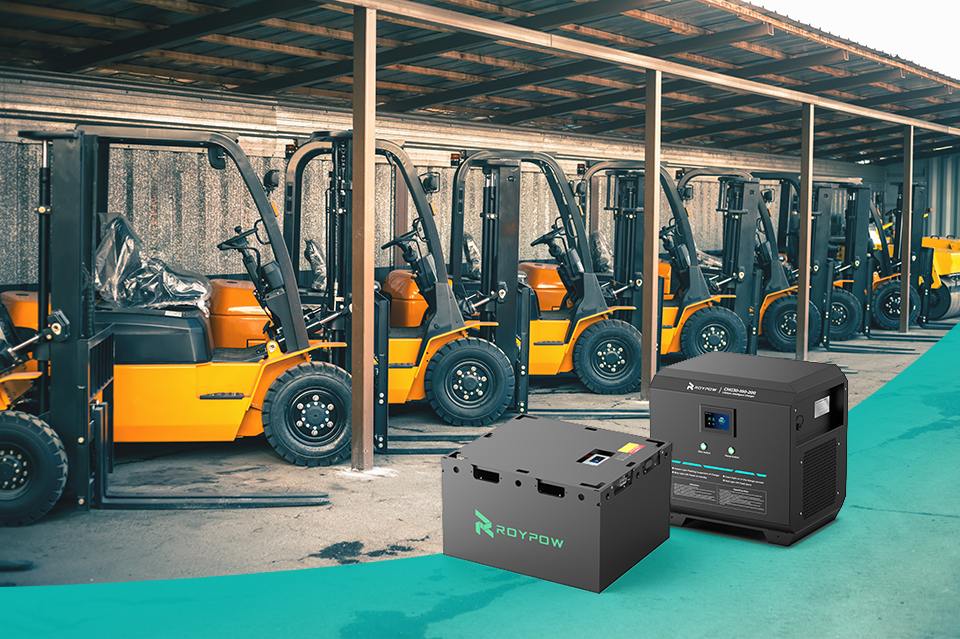
The Basics of Forklift Battery Chargers
The forklift battery charger serves as a power converter, transforming industrial AC grid power into absorbable DC energy for the battery. However, charging behavior varies significantly depending on battery technology. Understanding this difference is essential—using the wrong charger can lead to serious performance and safety issues. Chargers are mainly divided into two categories based on battery technology:
Lead-Acid Battery Chargers
Starting off with lead-acid chargers, they’re built for older-style lead-acid batteries. They follow slow but precise charge patterns. One after another, phases like steady current, fixed voltage, and then low-maintenance holding modes take over. Each step helps keep water inside the cell while slowing sulfation on metal surfaces. Charging lasts longer simply because the process stays controlled throughout.
Lithium-Ion Battery Chargers
When it comes to lithium-ion forklift batteries, their chargers now think ahead. Instead of fixed modes, they adapt on the fly using smarter logic. The built-in BMS keeps track of conditions moment by moment. Because of this live feedback, adjustments happen quickly. Output shifts smoothly based on current data, making charging faster without missing key details.
Notes: The charging algorithms, voltage thresholds, and communication protocols of these two chargers are functionally different. Misuse can easily lead to battery overcharging or over-discharging, resulting in swelling, permanent performance degradation, and even thermal runaway risks.
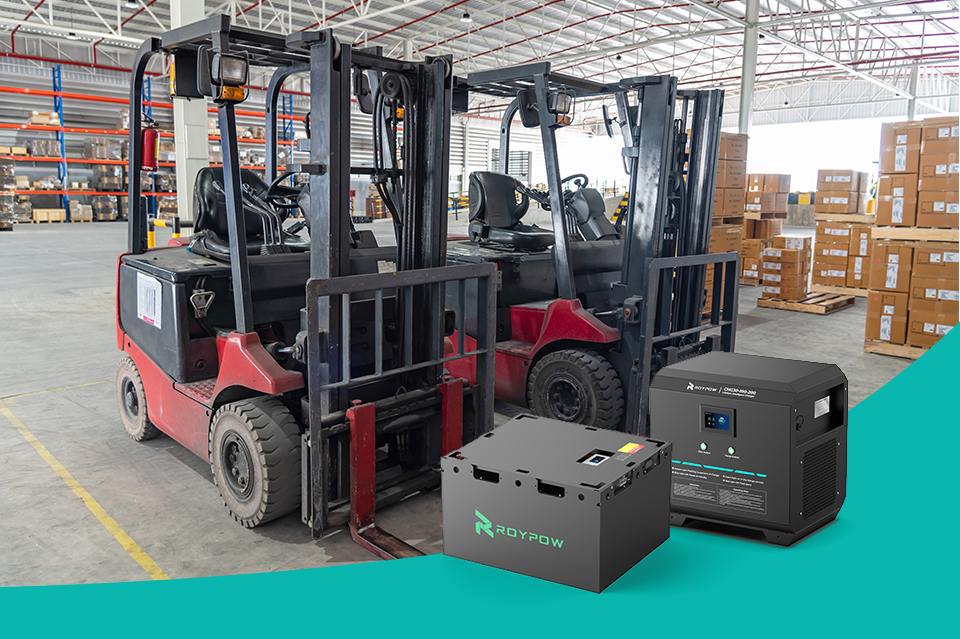
Key Features For the Smart Battery Charging System
When selecting a modern forklift charger, the following features should be evaluated:
High Charging Efficiency
High efficiency means less electrical energy is wasted as heat and more is delivered to the battery. By implementing advanced topology and control algorithms, our ROYPOW smart chargers realize exceptionally high system efficiency(≥92%). This helps achieve sustainable operations and cost reduction, directly addressing the industry’s demand.
Broad Battery Compatibility
A lithium forklift battery charger that supports a wide voltage range and multiple charging algorithms allows you to serve more vehicles with fewer charger models, simplifying management and reducing spare inventory costs.
Smart Charging & Digital Monitoring
This is the core of modern industrial forklift chargers, which can greatly lower human operational errors and maximize equipment uptime:
- Adaptive Charging: Automatically optimizes the charging curve based on battery status and ambient temperature.
- Scheduled Charging: Permits charging during off-peak electricity hours, significantly reducing energy costs.
- Real-Time Data Display & Historical Logs: Clear viewing of voltage, current, state of charge, and fault logs via a color screen or multilingual interface.
- Networked Fleet Management: Monitor all charging statuses from a central platform and optimize charging schedules.
Comprehensive Safety Protection
Choosing a safe forklift battery charger is a fundamental responsibility toward personnel and assets. Ensure the charger is equipped with electrical protection, thermal protection. Features such as movement prevention (anti-driveaway) can avoid the forklift accidentally driving away during charging, preventing damage to the charging cable and equipment.
In addition, the charger should comply with relevant international safety and EMC standards, such as UL, CE, and IEC, ensuring safe operation, electrical insulation integrity, and electromagnetic compatibility in industrial settings.
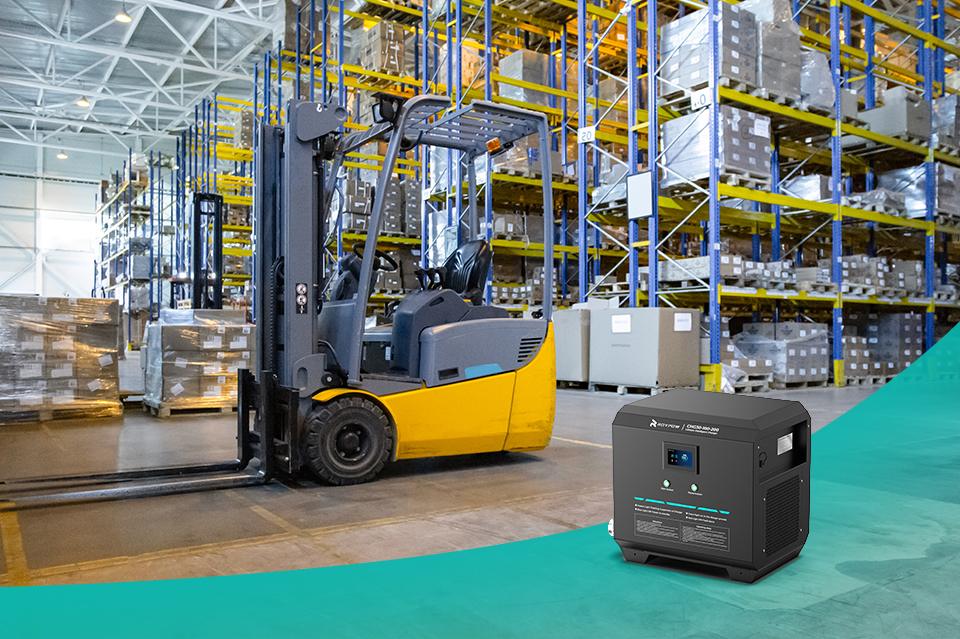
How to Determine the Right Charger Capacity for Your Fleet?
It’s a straightforward “demand matching” process:
- Light-duty Warehouse Applications: For a single shift, smaller battery capacity, chargers with an output current of 50A–150A are suitable. You can use single-phase or three-phase inputs.
- Medium-duty & Multi-shift Applications: Higher power is required to enable rapid turnaround. A typical configuration is a 3-phase forklift charger with a rated output of 30–100 Vdc, a maximum current of 300A, and power up to 30kW. This meets the fast-charging needs of most medium-sized lithium batteries or large-capacity lead-acid batteries.
- Heavy-duty & Continuous Operations: For ports, steel plants, or larger power capacity (above 45kW) may be needed, or a centralized charging hub with multiple charging points can be established.
Core Principle: Evaluate your total daily energy consumption (kWh), available charging time windows, and future fleet expansion plans. Choose a model with appropriate power headroom to accommodate both current and future needs.
Frequently Asked Questions
Q1: How do I know if a charger will fit my forklift?
Check the charger size against your forklift’s port before buying. A wrong fit risks damage or sparks during use.
Fit the output voltage and current limits to what your battery allows. When picking a charger, make sure the sent voltage falls entirely within the battery’s allowed range. Also, confirm the device can deliver no more than the highest charge rate the cell supports.
It’s recommended to share the exact forklift model number along with its battery details with trusted suppliers; they’ll check compatibility carefully while also suggesting suitable replacements if needed.
Q2: Will using a non-original charger affect my warranty?
This typically depends on the manufacturer’s policy. ROYPOW recommends using chargers from the same brand. Manufacturers have thoroughly optimized and tested the interoperability of their own products, providing seamless joint support in case of problems. Using an uncertified third-party charger makes it difficult to determine whether a battery or forklift malfunction is caused by a defect in the product itself or improper output from the third-party charger.
Q3: Can I perform “opportunity charging” during work breaks?
Absolutely! This is one of the core advantages of modern smart chargers. “Opportunistic charging” refers to partial charging during short breaks (such as lunch breaks or shift changes) to extend daily operating time.
Streamline your Operations Further with the ROYPOW
Modern forklift fleets increasingly rely on integrated energy systems rather than isolated components. ROYPOW lithium batteries and dedicated chargers are engineered to work seamlessly together, ensuring optimized charging performance, simplified support, and long-term battery reliability.
By choosing a fully compatible battery and charger system, operators benefit from faster technical support, more reliable warranty coverage, and extended battery service life—maximizing the return on investment across the entire fleet.