
The sticker price on a forklift battery is the least important number in the whole equation. Most operations focus on the upfront cost, miss the hidden ones, and end up paying far more over time. A standard lead-acid battery runs $2,000 to $6,000 upfront, but that’s before you factor in the 16-hour charge-and-cool cycle, the dedicated battery room, the watering, the labor, and the every-few-years replacement cycle. The real cost of a forklift battery? It’s built over months and years, not settled at checkout.
This guide breaks down every variable that moves the price, so you can stop guessing and start budgeting with confidence.
Here’s what we’re covering:
- Lead-acid vs. lithium forklift battery costs, head-to-head
- The price factors most buyers overlook (voltage, capacity, BMS, brand)
- Hidden operational costs that inflate your true spend
- Total cost of ownership (TCO) over 3, 5, and 10 years
- When to repair vs. replace your current battery
- Reconditioned batteries: worth it or a gamble?
- How to calculate ROI on switching to lithium
- New: How multi-shift operations should factor in opportunity charging savings
If you’re evaluating your options, ROYPOW’s lithium forklift batteries are worth a close look. They’re engineered for automotive-grade performance, built for industrial demands, and designed to keep your total cost of ownership as lean as possible.
Lead-Acid vs. Lithium: The Real Price Difference
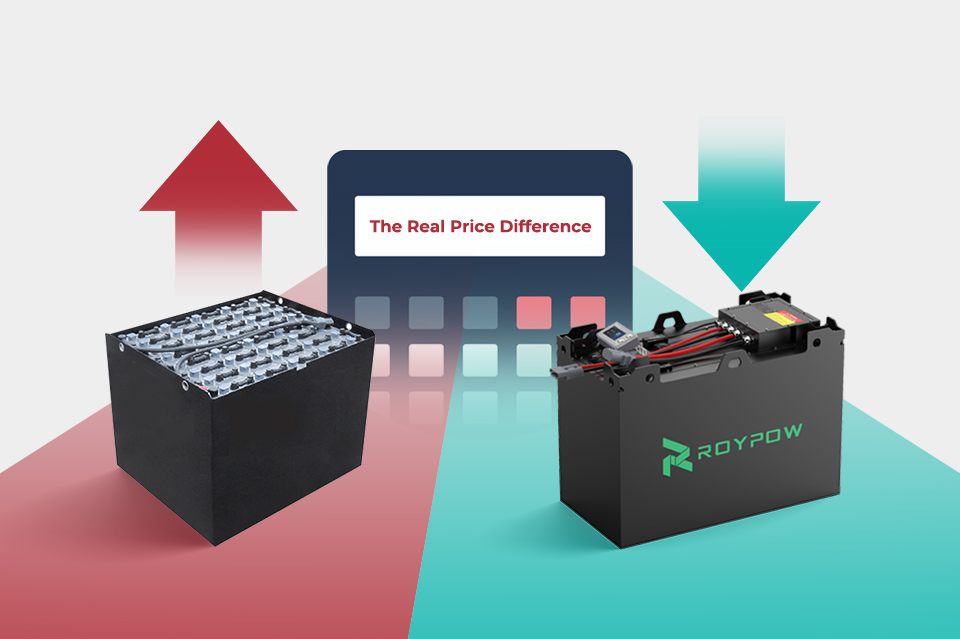
Lead-acid forklift batteries typically run $2,950 to $5,000 for standard models, while lithium-ion batteries range from $6,000 to $25,000+, depending on voltage and capacity. That gap looks massive at first glance. But the upfront price is only one part of the story.
|
Specs |
Lead-Acid |
Lithium-Ion (LiFePO4) |
|
Upfront Cost |
$2,950 – $5,000+ |
$6,000 – $25,000+ |
|
Cycle Life |
~1,500 cycles |
2,000 – 3,000+ cycles |
|
Charge Time |
8 hrs + 8 hrs cooling |
1 – 4 hrs, no cool-down |
|
Maintenance |
Weekly watering, cleaning |
Near-zero |
|
Batteries Per Truck (multi-shift) |
2 – 3 |
1 |
|
Energy Efficiency |
~75% |
Up to 99% |
|
Lifespan |
3 – 5 years |
8 – 10+ years |
Where Lead-Acid Actually Costs More
A lead-acid battery is unavailable for a full 16 hours after use, meaning a forklift used on Shift 1 can’t run again until the next day. Multi-shift operations are forced to buy 2 or 3 batteries per forklift, plus a dedicated ventilated battery room required by law.
That’s floor space, labor, and capital you’re burning every single cycle.
A fleet of 10 forklifts switching from lead-acid to lithium could save over $50,000 in total cost of ownership over 5 years, factoring in energy, labor, and replacement costs.
Where Lithium Wins Long-Term
- One battery per truck, opportunity charged during breaks
- No watering, no acid spills, no equalization
- Consistent power output from full charge to near-empty
- Lower energy bills from higher charge efficiency
This is exactly where ROYPOW’s LiFePO4 forklift batteries make the math work in your favor. Built with automotive-grade cells and an integrated BMS, they’re engineered to deliver that long-term ROI, not just a lower sticker price. You can also read more on lithium vs. lead-acid for forklifts to dig deeper into the comparison.
Price Factors Most Buyers Overlook
The quote you get from a supplier is shaped by a lot more than just battery size. Most buyers focus on voltage and stop there. That’s a mistake.
Voltage sets the baseline. Common configurations are 24V, 36V, 48V, and 80V, with higher voltages powering heavier-duty counterbalance forklifts. More voltage means more money. But capacity (Ah) is just as important. A high-Ah battery runs longer per charge, which directly affects how many batteries you need per shift.
The BMS matters more than people realize. A quality Battery Management System (BMS) monitors cell health, temperature, and charge rates in real time. Batteries without a solid BMS degrade faster, charge less efficiently, and carry more safety risk. Paying more for a well-engineered BMS is rarely money wasted.
Other factors that move the price:
- Brand and warranty coverage: Reputable manufacturers typically back their batteries with 5 to 10-year warranties. That coverage has real dollar value when something fails
- Environmental specs: Cold storage operations need batteries with built-in heating elements; high-heat environments need advanced thermal management. Both add cost
- Charger compatibility: Your existing charging infrastructure may or may not support lithium. Upgrading it is a real, often-forgotten line item
- Tariffs: In 2026, LiFePO4 batteries from China carry significant U.S. import tariffs, which have pushed prices up and made supplier selection more strategic than ever
Pro tip: Always ask for the full spec sheet before comparing quotes. Two batteries at the same price point can have very different BMS quality, cycle ratings, and warranty terms.
ROYPOW’s lineup spans 24V through 80V forklift configurations, with automotive-grade cells and integrated BMS built into every unit, so the specs you’re paying for are actually there.
Hidden Operational Costs That Inflate Your True Spend
The battery price is just the entry fee. What you pay after the purchase is where most operations bleed money without realizing it.
- The battery room. Lead-acid batteries produce hydrogen gas during charging, which legally requires a dedicated, ventilated charging area. That’s valuable floor space converted into a cost center. For a mid-size warehouse, that could be hundreds of square feet, not generating revenue.
- Labor. Every battery swap on a lead-acid system takes roughly 15 to 30 minutes, including the operator’s time and any battery room attendant involved. Multiply that across a multi-shift fleet, and you’re looking at dozens of lost labor hours per week.
- Watering and maintenance. Lead-acid batteries need regular watering, terminal cleaning, and equalization charges. Neglect any of these, and you accelerate degradation. Stay on top of them, and you’re still spending staff time and materials constantly.
- Energy waste. Lead-acid batteries operate at roughly 75% charge efficiency. That 25% energy loss shows up on your electricity bill every single month.
- Disposal. When a lead-acid battery reaches the end of its life, you can’t just throw it out. Hazardous material disposal carries its own cost, and failing to comply with regulations can mean fines.
|
Hidden Cost |
Lead-Acid |
Lithium |
|
Battery room space |
Required |
Not required |
|
Weekly maintenance labor |
High |
Near-zero |
|
Charge efficiency loss |
~25% |
~1% |
|
Battery swaps per shift |
1-2 |
None |
|
Disposal complexity |
High (hazardous) |
Lower |
These aren’t edge cases. They’re the everyday costs that quietly balloon your total spend.
Total Cost of Ownership (TCO) Over 3, 5, and 10 Years
The upfront price tells you almost nothing about what a battery will actually cost you. TCO is the number that matters.
Here’s a simplified TCO comparison for a single forklift running two shifts per day:
|
Time Horizon |
Lead-Acid (estimated TCO) |
Lithium (estimated TCO) |
|
3 Years |
$18,000 – $28,000 |
$14,000 – $20,000 |
|
5 Years |
$30,000 – $50,000 |
$18,000 – $26,000 |
|
10 Years |
$60,000 – $90,000 |
$22,000 – $32,000 |
Estimates factor in battery replacement cycles, maintenance labor, energy costs, and downtime. Actual numbers vary by fleet size, shift structure, and usage intensity.
Here’s what’s driving the gap:
- Lead-acid batteries need full replacement every 3 to 5 years under heavy use. Lithium lasts 8 to 10+ years
- Every lead-acid replacement on a multi-shift truck means buying 2 to 3 batteries, not one
- Energy inefficiency compounds annually, with lead-acid drawing more power for the same output
- Maintenance labor for lead-acid accumulates quietly but consistently across the fleet
By year 5, a well-chosen lithium battery has typically crossed its payback threshold. By year 10, the savings gap is substantial enough to fund a meaningful portion of your next fleet upgrade.
The ROYPOW blog on forklift battery TCO breaks this down further if you want to run the numbers against your specific operation.
When to Repair vs. Replace Your Battery
Not every struggling battery needs to be thrown out. Knowing the difference between a fixable problem and a dead end saves you money.
Repair is worth exploring when:
- The battery is fewer than 3 years old or has under 1,000 charge cycles
- Performance issues trace back to loose connections, minor sulfation, or corroded terminals
- A technician confirms that capacity can be restored to at least 80% through reconditioning
Replace without hesitation when:
- The battery drops below 80% of its rated capacity and stays there
- You’re seeing swollen cells, persistent acid leakage, or smoke at any point
- Repair costs are creeping above 50% of what a replacement would cost
- Runtime is declining shift by shift, with no recoverable cause
A quick decision framework:
|
Symptom |
Action |
|
Slow performance, dim displays |
Check connections first |
|
Won’t hold charge, under 1,000 cycles |
Recondition |
|
Consistent underperformance, 1,000+ cycles |
Evaluate replacement |
|
Acid leakage, swelling, smoke |
Replace immediately |
Pro tip: Schedule voltage tests and specific gravity checks every 6 months. Catching degradation early gives you options. Catching it late gives you emergencies.
For fleets already thinking about the switch, ROYPOW’s LiFePO4 forklift batteries are a drop-in-ready replacement for most standard battery compartments, taking the guesswork out of compatibility.
Reconditioned Batteries: Worth It or a Gamble?
Reconditioned forklift batteries can cut upfront costs significantly, sometimes by 50% or more compared to new ones. The process typically involves cell testing, desulfation, equalization charging, and cleaning. When done right, a reconditioned battery can recover up to 85% of its original capacity.
But when done right, is doing a lot of work in that sentence.
The honest risks:
- You rarely know the full maintenance history of a reconditioned battery. Poor charging habits earlier in its life can cause permanent damage that reconditioning can’t fix
- Restored capacity of 80 to 85% sounds fine, until you’re running a two-shift operation and that 15 to 20% gap starts showing up mid-afternoon
- Warranties on reconditioned units are typically shorter and more limited than on new batteries
When reconditioning makes sense:
- Single-shift, low-intensity operations where peak capacity isn’t critical
- Short-term budget constraints while planning a full lithium upgrade
- Buying from a supplier with transparent reconditioning records and documented testing results
When it doesn’t:
- Multi-shift, high-utilization environments where downtime is expensive
- Fleet expansion where consistency across units matters
- Any application where you can’t afford to find out the battery was worse than advertised
Bottom line: reconditioned is a calculated risk, not a guaranteed saving. Go in with your eyes open, and always ask for the test data.
How to Calculate ROI on Switching to Lithium
ROI on a lithium battery isn’t complicated to calculate. You just need to be honest about all the costs you’re currently carrying.
The basic formula:
ROI = (Annual savings from lithium) / (Additional upfront cost of lithium) x 100
Step 1: Calculate your current annual lead-acid costs
Add up:
- Battery purchase cost ÷ lifespan in years
- Annual maintenance labor hours x hourly labor rate
- Energy waste cost (estimate 25% of annual electricity spend on charging)
- Downtime cost from swaps and cool-down periods
- Battery room overhead (prorated floor space cost)
- Battery purchase cost ÷ lifespan in years (8 to 10 years)
- Near-zero maintenance (factor in charger costs if upgrading infrastructure)
- Energy cost at ~99% efficiency
Step 2: Calculate your projected annual lithium costs
Step 3: Find the payback period
Payback period = Additional upfront cost ÷ Annual savings
For most two- to three-shift shift operations, lithium pays for itself within 2 to 4 years. Single-shift operations tend to see payback in the 4- to 6-year range.
Pro tip: Factor in any available federal or state incentives. The Inflation Reduction Act’s 30% investment tax credit for commercial clean energy equipment can significantly shorten your payback timeline.
Opportunity Charging: The Multi-Shift Math Most Operations Miss
This section is specifically for anyone running two or three shifts. It’s the part of the lithium conversation that often closes the deal.
With lead-acid, opportunity charging is actively harmful. It accelerates cell degradation and shortens lifespan. So multi-shift operations have no choice but to rotate batteries, which means buying 2 to 3 units per forklift, maintaining a battery room, and absorbing the labor cost of every swap.
With lithium, opportunity charging is the intended behavior.
Here’s what that looks like in practice:
- Operator takes a 30-minute lunch break, forklift plugs in
- Battery gains 20 to 30% charge without any degradation
- No swap needed, no cool-down, no attendant required
- One battery covers all three shifts on a single truck
The savings add up fast:
|
Cost Factor |
Lead-Acid (3-shift) |
Lithium (3-shift) |
|
Batteries per forklift |
3 |
1 |
|
Daily swap labor (mins) |
45-90 |
0 |
|
Battery room required |
Yes |
No |
|
Mid-shift power dips |
Yes |
No |
|
Energy recovered during breaks |
None |
20-30% per break |
For a fleet of 10 forklifts running three shifts, eliminating battery swaps alone can recover hundreds of labor hours annually. Add in the floor space and energy savings, and opportunity charging isn’t just a feature; it’s a core part of your lithium ROI calculation.
ROYPOW’s lithium forklift batteries are purpose-built for exactly this workflow. Their integrated BMS handles opportunity charging intelligently, so the battery charges fast during breaks without accumulating heat or cycle stress that damages lesser cells. Learn more about why lithium is reshaping logistics operations at the fleet level.
Stop Overpaying for Forklift Power. ROYPOW Has You Covered.
Forklift battery replacement cost is never just one number. It’s the sum of every swap, every maintenance hour, every wasted kilowatt, and every cycle that didn’t go the distance. Now you have the full picture.
Key takeaways:
- Lead-acid is cheaper upfront but consistently more expensive over time
- Voltage, capacity, BMS quality, and tariffs all move the final price
- Hidden costs like labor, battery rooms, and energy waste are the real budget killers
- TCO over 5 to 10 years almost always favors lithium
- Repair if you’re under 1,000 cycles; replace if you’re beyond the point of recovery
- Reconditioned batteries work for low-intensity, single-shift operations only
- Opportunity charging is a multi-shift game-changer that rewrites the ROI math entirely
When you’re ready to stop running the numbers and start seeing the savings, ROYPOW’s LiFePO4 forklift batteries are built to deliver exactly that. Automotive-grade cells, intelligent BMS, and a one-stop solution approach mean your fleet spends less time in the battery room and more time moving product. Find a dealer near you and see what the right battery actually costs.
FAQs
How much does it cost to replace a forklift battery?
Lead-acid replacements run $2,950 to $6,000. Lithium replacements range from $6,000 to $25,000+, depending on voltage, capacity, and brand. Total cost of ownership heavily favors lithium over time.
What is the life expectancy of a forklift battery?
Lead-acid batteries last 3 to 5 years or roughly 1,500 cycles. Lithium batteries last 8 to 10+ years, delivering 2,000 to 3,000+ cycles under normal operating conditions.
What is the price of a 5,000-watt lithium battery?
A 5,000-watt (5kW) lithium forklift battery typically falls between $3,000 and $8,000, depending on chemistry, BMS quality, and manufacturer. Always confirm compatibility with your forklift’s voltage requirements.
What is the price of a 48V forklift battery?
A 48V lead-acid battery generally costs $3,500 to $5,000. A 48V lithium forklift battery runs $8,000 to $20,000+, with significantly lower long-term operating costs.
What is the price of a new battery?
New forklift batteries start around $2,950 for entry-level lead-acid units and can exceed $25,000 for high-capacity lithium systems. Your forklift’s voltage, shift structure, and duty cycle determine the right spec.
Can forklift batteries be repaired?
Yes, in many cases. Batteries under 1,000 cycles with minor sulfation, loose connections, or corroded terminals are strong repair candidates. Reconditioning can restore up to 85% capacity. Beyond that threshold, replacement is usually the smarter call.